Palestine before Zionism: A Golden Age?
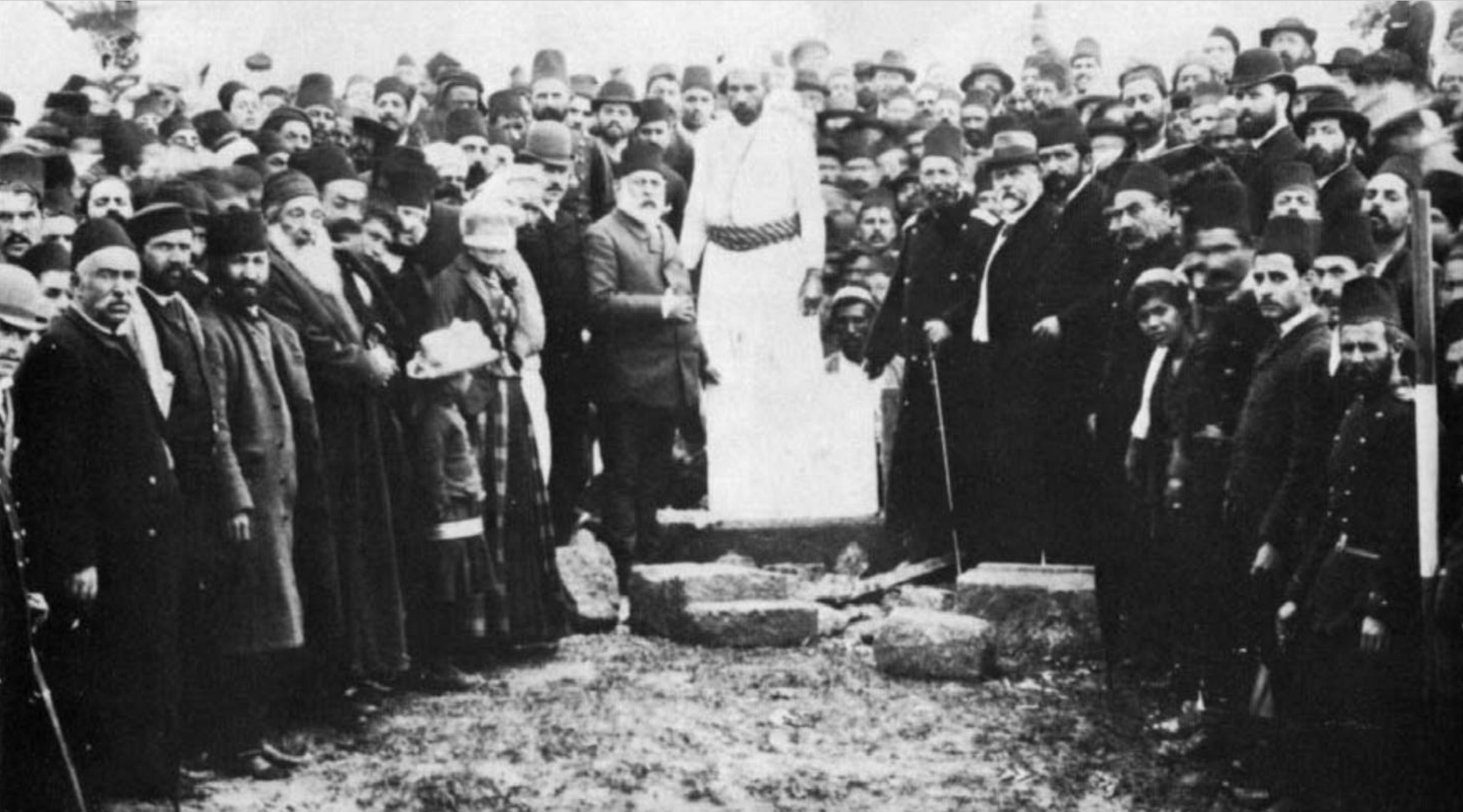
The Ottoman Mutasarrif of Jerusalem Rashid Beyk, with Mayor Salim Husseini, members of the Jerusalem Council and other Jewish notables, including members of the Elyachar family. Source.
Introduction
April 13, 2026 — In the 1870s, on the eve of Zionist immigration to Palestine, the land was 85% Muslim, 10% Christian, and 5% Jewish. Relations among the communities were positive, with Jews, Muslims and Christians sharing social spaces, celebrating each other's holidays and embracing a common Arab consciousness. Many also aligned around a political vision for the region that transcended confessional boundaries. The fault lines in late Ottoman Palestine often lay within religious communities rather than between them. This was a time before Zionism contaminated relations among Palestine’s religious groups. This is a brief history of Palestine’s golden age, a world before the Zionist conquest of Palestine.
Daily life in late Ottoman Palestine
In the 1870s, Palestine’s religious communities lived in close physical proximity. In Jerusalem, Hebron, Safed and Tiberias, they had cohabited for centuries. In Jerusalem, Jews, Muslims and Christians lived on the same streets, shopped at the same stores and shared residential courtyards (1, 2, 3). The al-Wad neighborhood, for instance, was home to three churches, three synagogues and seven mosques, with Christians and Jews living in the heart of the so-called “Muslim” quarter. In Tiberias, travelers had long noted the mutual tolerance among the city’s religious groups. There, as well, Muslims lived in the Jewish quarter and Jews lived in the Muslim quarter, as class divided the city as much as religion. In Hebron, Jews and Christians were well integrated into the commercial life of the town. By the early 20th century, Jews and Muslims also lived side by side in Jaffa, and, at least until the influx of Zionists, Jews were considered “sons of this place,” as one observer put it.
Jews, Muslims and Christians occupied not just a shared physical space but also a shared social space. Jews went to bathhouses run by Muslims. Muslims were invited over for Shabbat dinner. Muslim girls learned Judeo-Spanish from their Sephardi Jewish neighbors. Christian musicians like Wasif Jawhariyyeh played at Jewish weddings and Aleppo Jews living in Jerusalem performed at Muslim and Christian weddings. Jews had Muslim physicians, and vice versa. Jews, Muslims and Christians also started attending school together, in Ottoman schools as well as the Israelite Alliance schools, while at least one Christian parent, Jirjis Jawhariyyeh, made his sons memorize the Quran. Palestine’s Jews and Christians used Muslim religious courts to settle disputes among themselves. Jerusalem’s Jews formed business partnerships with Muslims in the wheat, livestock and dairy industries, such as the Jewish Irmoza and Muslim Abu-Khalil families. The Ottoman Red Crescent Society, founded in Jerusalem in 1915, had two native Jews, two native Christians, and one native Muslim on its board.
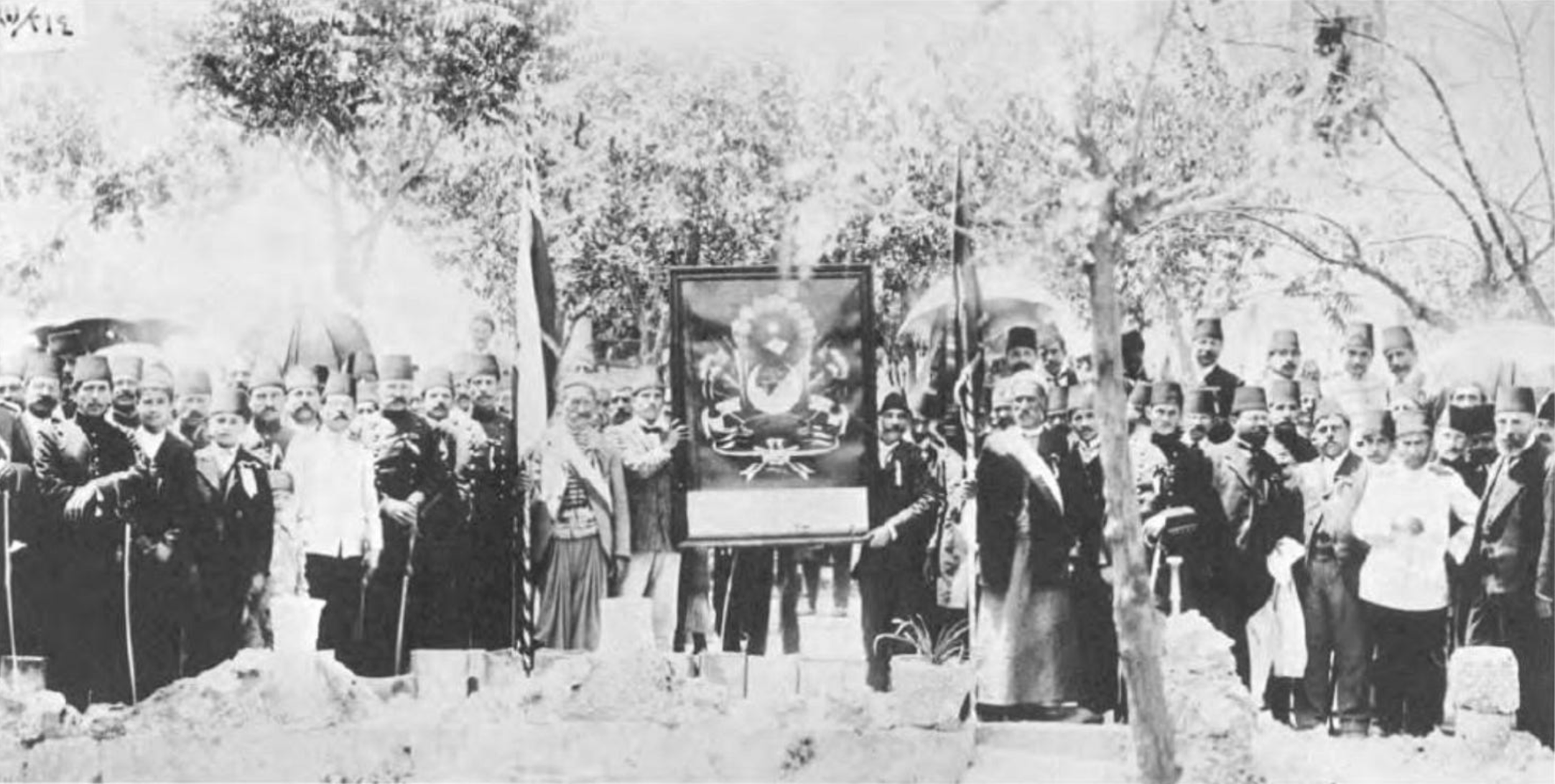
Official ceremony in Jerusalem, August 1908, attended by Muslim, Jewish, and Christian elites of the city. Source (p.44).
Personal relations between and among Jews, Christians and Muslims ran very deep. The Arab Christian family, the Jawhariyyehs, were on intimate terms with many Jewish families, including the Eliashars, Hazzans, Anteibis, Manis (from Hebron), and Navons. Jacob Yehoshua, a Jew born around 1890, described life growing up in the old city of Jerusalem as follows:
There were joint compounds of Jews and Muslims. We were like one family. We spent time together. Our mothers shared their thoughts with the Muslim women, and vice versa […] Our children played with their children in the yard, and if children from the neighborhood hurt us, the Muslim children who lived in our compound protected us. They were our allies.
Put another way, Muslim and Jewish children from one courtyard would defend one another against Muslim and Jewish children from another courtyard. Muslim and Jewish women also breastfed one another’s babies in the event of a death or if the mother was unable to nurse. Needless to say, these scenes would be almost unthinkable today.
Religious celebrations in late Ottoman Palestine
Many religious holidays were occasions for joint celebrations in late Ottoman Palestine. Muslim and Christian children dressed up for Jewish holiday of Purim, which they called the “sugar holiday,” wandering through Jewish neighborhoods in costume. Twice a year, Muslims and Christians joined Jewish celebrations at the shrine of Simon the Just in Sheikh Jarrah, an event known as “The Jewish Outing.”(1, 2). Here is a first-hand account of the scene:
Jewish pilgrims visited this sanctuary [the tomb of Simon the Just in Sheikh Jarrah] twice a year when they would spend the whole day in the olive groves. Most of those were Eastern Jews who kept their Arab traditions. They had a number of instrumental musical bands, of which I remember those led by Haim, the oud and violin player, and Zaki, the drummer from Aleppo. He had a beautiful voice and would sing mostly Andallusian scores. Jerusalem Christians and Muslims would share their Jewish compatriots’ day-long activities of singing and festivities in the picnic known as the Yehudia. The slopes of Sheikh Jarrah would be teeming with participants, as well as with peddlers. My brothers and I never missed this festival.
During the springtime, Christians and Muslims merged Orthodox Easter with the Muslim Nabi Musa Pilgrimage, with Jews joining in the national festivities. Fire Saturday, commemorating the resurrection of Christ, was combined with Muslim folk festivals. There were Muslim processions on Palm Sunday, starting at the Abrahamic Mosque in Hebron heading toward Jerusalem. Meanwhile, Jews and Muslims exchanged gifts on the last day of the Jewish holiday of Passover. Muslims gave their Jewish friends a round copper bowl, laden with fresh bread, goats’ butter and honey, while Jews gave back the same copper bowl with matzot and home-made jam.
Religion and culture fused together. All three communities shared beliefs and traditions about the evil eye, droughts, and visiting the tombs of local saints. They shared common holy sites, like the tombs of Nebi Samuel and Nebi Rubin. When the Christian Jirjis Jawhariyyeh died, the Muslim sheikh Ali Rimawi lamented, “I cannot believe that Jawhariyyeh’s soul will remain in Zion [Cemetery]...for tonight surely it will move to Mamillah [the Muslim cemetery].” Religious boundaries were fluid.
Arab Jews in the late Ottoman Palestine
It is well known that, beginning in the mid-late 19th century, Christians and then Muslims began embracing an Arab identity around the Arabic-speaking world, including Palestine. Many have wondered, what about the Jews?
Jews were not just integrated into the physical, social and religious fabric of late Ottoman Palestine, but, as we shall see, many also embraced an Arab consciousness, as was the case elsewhere in the Arab world.
These were mainly Sephardi Jews who spoke Arabic and lived amidst Muslims and Christians in Jerusalem, Hebron and Tiberias. Most spoke Ladino, a Judeo-Spanish, as a first language, although a minority known as Moghrabi Jews spoke Arabic as a native language and some wrote in Arabic as well, such as Shimon Moyal and Nissim Malul. They even established a short-lived Arabic newspaper. As one native Jew put it in 1902, “we knew Arabic and conversed freely with our Arab neighbors, but Judeo-Spanish (Ladino) was our mother tongue.” Other Jewish families in Palestine had roots in Damascus, Salonica or elsewhere in the Empire.
Although the native Jews of Palestine defined their own community in variety of ways, the Jews of Tiberias seem to have identified as Arab Jews. In a 1914 Ottoman military conscription registry document, about 300 Jews in Tiberias were described as Yahūd evlād-ı ʿArab, or “Jewish sons of the Arabs” or “Jewish children of the Arabs.” The entry was validated with the signet stamp of Yaakov Neḥmad, who identified himself as muḫtār-i evvel, the head of a local community bearing the same designation.
Christian writers at the time such as Khalil Sakakini and Wasif Jawhariyyeh referred to the native Jews of Palestine as “sons of the country” (‘abna’ al-balad’), “compatriots” or “Jews, sons of Arabs,” (“Yahud awlad Arab”) in their diaries and autobiographies. The community was also known as “ha-‛am ha-yisra’eli” (‘the Israelite people’) or “yahadut falestinit,” “Palestinian Jews,” or “Ivrim” (Hebrews).
Of course, on the eve of Zionist immigration, about half of the Jewish population of Palestine spoke Yiddish as a native language and had immigrated to Palestine in the previous centuries from Europe, primarily for spiritual reasons. Many of these Jews also spoke some Arabic and Ladino, and they were considered part of the native Jewish community of Palestine, although they would not have thought of themselves as Arab Jews.
Jewish, Muslim & Christian Ottomans
Palestine’s religious communities also united around Ottomanism, a political vision based on shared civic values. Leading figures in each community were attracted to this ideology championed by the political party known as the Young Turks, or the Committee for Union and Progress (CUP). They advocated for an Ottoman civic identity transcending ethnicity or religion.
The CUP carried out a constitutional revolution in 1908 and ushered in a euphoric moment celebrated by all of Palestine’s religious communities. The slogan of the revolution was Liberty, Equality, Fraternity and Justice, and the CUP called for a constitution, freedom of the press, democratic elections and the centralization of the empire (1,2).
And, indeed, in elections held in the 1910s, Jewish (Zionist) Ottomans like David Yellin, and Muslim Ottomans (anti-Zionists) like Ruhi al-Khalidi, loyaly served the CUP side by side. Similarly, Palestinian Arab newspapers like Filastin and Jewish Sephardi newspapers like ha-Herut both supported the CUP. Of course, the same was true for the opposition, known as the Decentralization Party (Hizb al-Lamarkaziyya) which was much less popular in Palestine, but nevertheless attracted Jewish, Muslim and Christian members. This was a time when Ottoman politics trumped local politics even as the Zionist movement gained traction in the 1910s.
Alas, the Ottoman parliament collapsed after World War I. The British disbanded the Ottoman legislative assembly, whose representatives were democratically elected, as we just discussed, and replaced it with various Christian and Muslim religious, rather than political, bodies. Their leaders would be appointed by unelected British colonial officials to pit Christians and Muslims against one another to fracture the Arab coalition against Zionism. Progress and modernity!
Conclusions
This is of course not to pretend there was never any tension amongst Palestine religious communities. The Ottoman Empire had long privileged Muslims over non-Muslims in its imperial bureaucracy, which created an inherent hierarchy in society, exacerbated by conscription laws that varied by religious community. Schools were by and large segregated. Villages were, on average, religiously homogenous. Religion was obviously an important marker in society.
But, remember, much of the tension in late Ottoman Palestine happened within confessional boundaries. The Orthodox Christian community of Palestine was ripped apart because of the power struggle between the local Arab Orthodox community and their Greek ecclesiastical leadership (1, 2). There were fifteen other Christian denominations in the Holy Land, including Catholics and Protestants, and each of these communities had plenty of their own controversies as well.
There were of course major divisions within the Muslim Arab community, especially between the urban notables, who accumulated huge swaths of land in the late Ottoman period, and Muslim Arab cultivators, who became landless as a result (1, 2). There were major divisions between nomadic and semi-nomadic Muslim Arabs, or Bedouin, and Muslim Arabs cultivators. There were divisions between Qays and Yaman Muslim Arabs and between the historic family rivalries across Palestine.
And there were of course major divisions within the Jewish community as well. The “old yishuv,” meaning Jews living in Palestine before Zionist immigration in the 1880s, consisted of pious Yiddish-speaking Ashkenazim, dependent on charity from abroad, and the Ladino-Arabic speaking Sephardim whose leaders ran Jewish affairs and served as the chief rabbis, judges and council officials. They often lived in separate quarters, prayed at separate synagogues and spoke different languages. The tension was so great that in 1867 Ashkenazi Jews in Jerusalem asked the Muslim notables of the city to recognize them as a separate “madhhab”, or sect, which would grant them autonomy from Sephardi hegemony.
No society with religious diversity is without religious tension. But late Ottoman Palestine was a world before the Zionist movement had tainted relations between Palestine’s religious communities, and it offers us a taste of what a world without Zionism could look like once again.
Subscribe to the Palestine Nexus Newsletter: