My Motherhood Journey During the Gaza Genocide
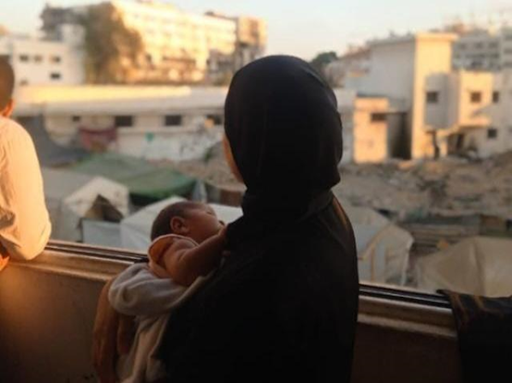
The author with her baby boy, Mahmoud, when he was 40 days old. Photo courtesy of the author.
April 20, 2026 — Can the heart bear two conflicting emotions at once? The joy of life growing within me, and the fear of death lurking around every corner?
Allah willed that I become pregnant, and I was overwhelmed with mixed feelings: immense joy at the arrival of a new life, and a deep fear of an unknown fate.
On August 17, 2024, I found out I was pregnant. My husband, Luqman, was the first person to know about it. He was very happy because he was going to be a father. We lived in the Hamad Towers area at the time.
Negative thoughts constantly crept into my mind, coloring every moment of the wait with shades of anxiety. I had always dreamt of giving birth to a child in normal circumstances: safe, in a functioning hospital surrounded by my husband and family. I had dreamt of preparing for my child’s arrival by buying new clothes, toys and arranging a room with the help of my family and friends who would be eagerly awaiting to celebrate. I had dreamt of watching my child growing up in a healthy, clean environment and a peaceful family atmosphere, just like any other child.
But in September 2024, two months into my pregnancy and almost a year into Israel’s genocidal war on Gaza, our situation deteriorated further, bringing new challenges for both my husband and me as first-time parents.
The Israeli Army had dropped leaflets demanding that displaced people evacuate the Hamad Towers area, where my husband, my parents, my siblings, and I had fled. We had already been displaced before from Jabalia camp to Al-Nasr neighborhood, to Khan Yunis, Rafah, and finally to Hamad Towers on May 10, 2024.
Being forced to leave a place you're used to and being driven away against your will is incredibly difficult, especially in the early stages of pregnancy.
I'll never forget the sound of bullets fired by quadcopter drones overhead as they ordered us to leave Hamad Towers immediately. We threw ourselves to the ground to avoid the bullets, reciting,“أشهد أن لا إله إلا الله، وأن محمدًا رسول الله (I bear witness that there is no God but God, and Muhammed (Peace and Blessings Be Upon Him) is the Messenger of God)”, as panic gripped everyone. We quickly found ourselves hastily packing our belongings into bags and boxes, searching for transportation to a safe area.
I vividly remember the looks of sorrow and grief on my family's faces; I could read silent questions in their eyes: "Will we all get out safe? Or will we lose someone?" After the martyrdom of my older brother, Muhammad, we couldn't bear the separation again.
As we waited for hours, searching for transportation, whispers rippled around us: “Where are we going?” “Will we find a safe place?” “What about our children?” Fear and anxiety filled the air, mingled with the cries of children and the screams of mothers.
After a long wait to get transportation, we finally managed to hire a car to take us to the Al-Mawasi area, where we would finally settle for 5 months before moving to northern Gaza.
Every day, I lived there in constant fear, worried about my unborn child because of the bombs falling around us and the unknown chemicals they carried.
The first three months of my pregnancy passed between the bitterness of displacement, the harshness of life in Al-Mawasi, and the physical exhaustion that overshadowed the joy of awaiting my baby. The days dragged on, each one bringing a new challenge.
Food was scarce; we could barely find enough to eat, and sleep was a luxury we didn't know, as the sound of shelling never ceased; the fear of the unknown haunted us every moment. I suffered from severe back pain and constant headaches, pains that could have been alleviated if proper healthcare and decent living conditions had been available, but amid the bombings, these were just distant dreams.
As my due date in May 2025 approached, the spectre of famine loomed over my city. At the time, one kilogram of flour cost over 100 shekels (USD $32). When we couldn’t afford it, we were forced to grind and knead lentils to make a loaf of bread.
This wasn't enough for me, a pregnant woman in her last trimester. I was suffering from low blood sugar and malnutrition, making the journey to the hospital for a checkup much longer and more arduous, despite its proximity.
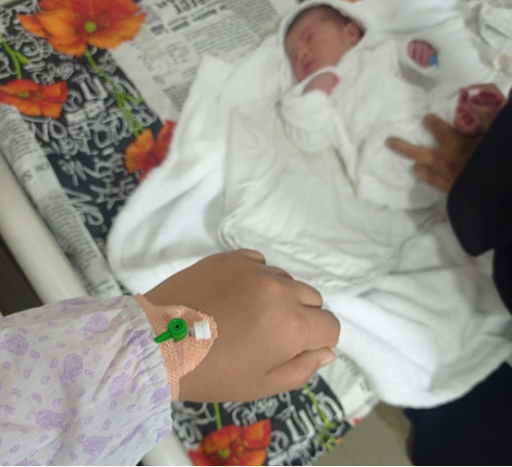
First picture of Mahmoud, 13 hours after he was born. Photo courtesy of the author.
On May 28, 2025, my C-section was due. My mother, my husband, and I went to the government hospital around 8:00 AM. It was overflowing with people injured in the airstrikes.
I waited for hours, filled with fear and anxiety that something might happen to me or my baby during the delivery. I was also excited to see him, to see what he would look like, and who he would resemble. My thoughts were interrupted by the arrival of my aunts, who helped ease the tension I was experiencing.
Around 4:00 PM, the nurses called me to prepare me for the operating room. The procedure took half an hour and went well.
My firstborn, Mahmoud, arrived, bringing peace to my mind and heart. Ululations and congratulations filled the air, and everyone started taking pictures and calling to check on me. My brothers and some of Luqman's friends also came to congratulate me. It's our custom to distribute sweets on happy occasions, but in besieged Gaza, sugar was scarce, and if it was available, it was prohibitively expensive.
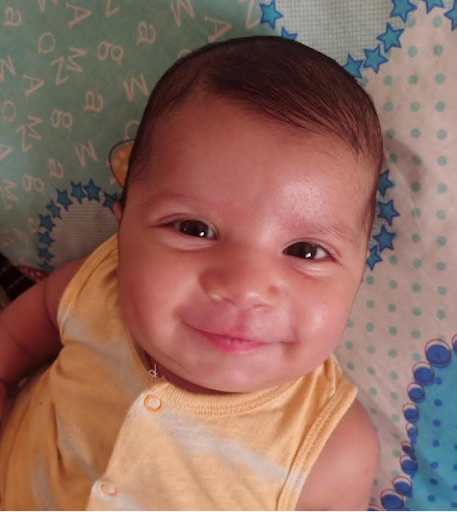
Mahmoud at 4 months old. Photo courtesy of the author.
After the drug's effects wore off, I faced many complications. I was too weak to move. I was supposed to be able to walk a few hours after the operation, so my mother and Luqman helped me get up. But exhaustion got the best of me, and I started bleeding and almost fainted. The medical staff intervened and gave me some painkillers, which relieved some of the pain.
I was eager to hold Mahmoud, that little boy who had kicked inside me for nine months, and whose kicks I cherished despite the exhaustion. When I held him for the first time, a strange warmth enveloped me, as if all the world's pain had vanished. His skin was soft as silk, his scent like musk, and his tiny eyes looked at me with utter innocence. I heard his first breaths; they were like music playing the melody of life in my ears. In that moment, I forgot all the pain and bitterness I had endured. He didn't resemble me as I had imagined but he was a spitting image of his father. I thanked God profusely for His blessings.
Amid the destruction and despair, Mahmoud dazzled us with wonder. He shines like a ray of sunshine, reminding me that life always finds its way, even in the darkest of times. He is not just a child but a symbol of resilience, a testament to the fact that human will is stronger than any war.
He is my solace for everything we witnessed during the war. His murmurs and laughs fill our tent with love and peace. Life is still full of challenges under this fragile calm, but Mahmoud's presence gives me the strength to face them. I try to raise him on hope and resilience, to instill in him a love of life, and to make him understand that no matter how long the darkness lasts, rays of sunshine will inevitably rise. I always pray to God that our situation will improve, and that I will be able to make up for every moment of fear we endured.
Although the occupying powers have declared a “ceasefire”, its planes are still flying overhead, the airstrikes are still hitting our people, and we continue to pray to God to protect us from all harm and to grant us the true peace we deserve.
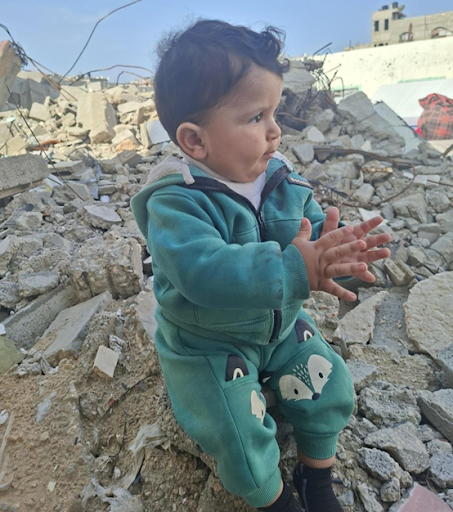
Mahmoud, 10 months old. Photo courtesy of the author.
Mahmoud, like all the children of Gaza, deserves a safe childhood and a future filled with hope, not fear.
Editor's note: You can support Heba, her husband Luqman and little Mahmoud rebuild their lives by donating to their fundraiser.
Subscribe to the Palestine Nexus Newsletter: