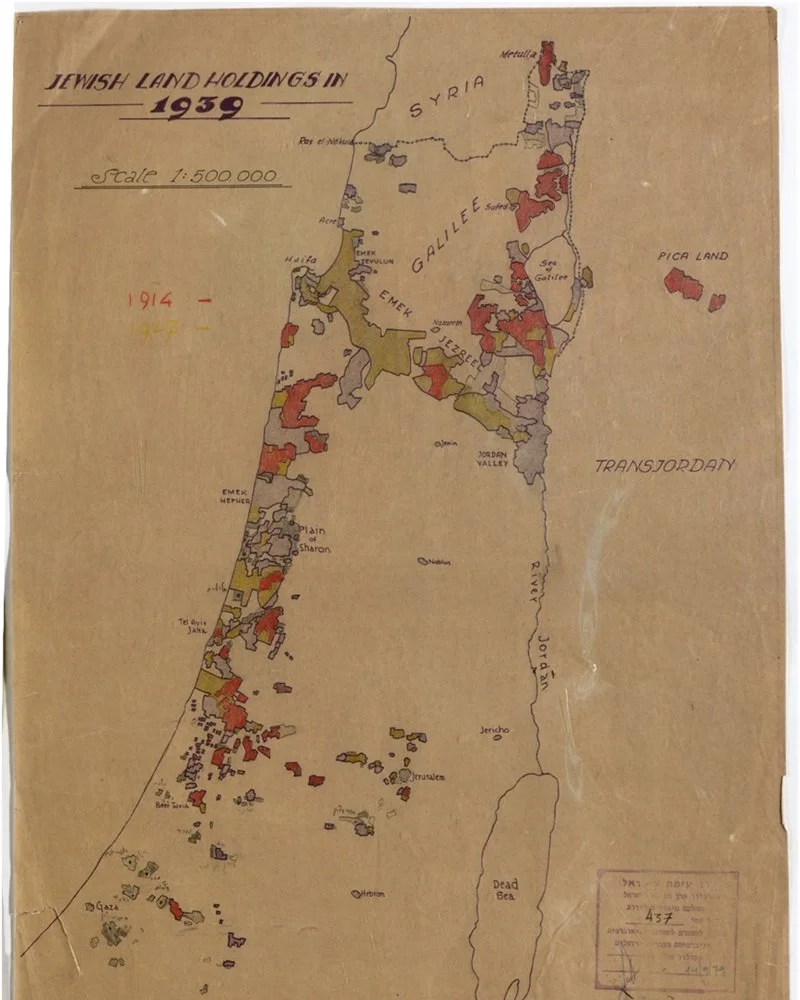
Jewish-owned land in Palestine circa 1941. Colors correspond to the year of the land purchase. Source: Central Zionist Archive
Introduction
February 19, 2026 — The Zionist movement continued to evict and displace Arabs and Palestinians throughout the 1920s-1940s. Backed by British bayonets, Zionist immigrants flooded Palestine in the tens of thousands in the 1920s and hundreds of thousands in the 1930s and 1940s. They transformed Palestine from 10% Jewish in 1918 to 17% Jewish in 1930 to 30% Jewish in 1940 to 33% Jewish in 1947, buying up 6-8% of the land (~2 million out of ~26 million dunams), wiping seventy Arab villages off the map and uprooting more than ten thousand Palestinians and Arabs in the process. This boiled over into deadlier and deadlier violence, from dozens killed in the 1900s and 1910s, as discussed in part I of this II part series, to hundreds killed in the 1920s to thousands killed in the 1930s.
Zionist leaders tried to minimize the scale and visibility of the evictions and usually kept quiet about their vision for the native population of Palestine. That vision, a land without a people, or as Chaim Weizmann put it in 1919, a Palestine “as Jewish as England is English, or America American,” formed the core of the Zionist consensus. It's why the Zionist movement evicted Palestinians from the lands it purchased, it's why so many Zionist leaders developed proposals to expel Palestinians from Palestine and it's why every major Zionist institution supported “transfer” by the 1930s, today known as forcible displacement or ethnic cleansing. This is a brief history of the origins of the ethnic cleansing of Palestinian Arabs from their lands, 1920-1947.
The British Regime in Palestine
The British Empire conquered Palestine in 1918 and established the colonial state called the Government of Palestine, also known as the Mandate. The Mandate embraced the Balfour Declaration, which called for the establishment of a “national home for the Jewish people” in Palestine. An earlier draft seems to have made a provision for the Arabs, 90% of the population, to be removed altogether, although the final version affirmed their religious and civil, but not political rights. Democracy quickly emerged as Britain's mortal enemy in Palestine.
British land policy was codified with the 1920 Land Transfer Ordinance. It stipulated that land had to be registered in the land registry by individuals and thus it rejected the customary practice of collective ownership known as musha‘a. The ordinance was amended to limit government interference in land transfers, a measure supported by certain Arab elites, the owners of much of the land, and the Zionist movement, the hopeful buyer of it. The British also required tax payments on land be made in cash, rather than cash or kind, as had been the case under Ottoman rule, and set fixed tax rates based on the net productivity of the plot, determined by agricultural output minus the cost of production (thus reducing the Jewish tax burden relative to the Palestinian tax burden due to higher wages and higher capital expenditures in the Jewish sector), further aggravating the economic condition of Palestine’s indigenous inhabitants. The ordinance could have been named, “British, Zionist and Arab capitalists of the world unite” (1, 2, 3, 4, 5)!
The policies accelerated both the privatization of land and the consolidation of land ownership. Arab landlords tempted musha‘a farmers with predatory offers and charged their own tenants with high interest rates, leading to farmer debt accumulation. As a result, many were forced to sell their land shares as debt payment, even if they continued to cultivate the land as tenant farmers (1, 2, 3). Arab cultivators despised the British Land Registry office just as they had its Ottoman predecessor, and so even without temptation, pressure or coercion to sell, they continued to register their lands in the names of village elders or sell their land titles to urban elites anyways.
The result was that Arab villages adhering to the collective ownership system fell from 56% in 1923, to 46% in 1930 to 40% in 1940. In one subdistrict of Palestine, for example, some 30% of the land passed from Arab farmers to Arab capitalists in the 1920s. This accelerated the process of land sales to the Zionist movement, as individuals were much more likely to sell land to Zionists than village collectives. The British set out to facilitate Arab land sales to Jews, and that’s exactly what happened.
Displacement in the 1920s
The Zionist movement doubled its land holdings in the 1920s, displacing some six thousand Arabs in the process, according to the best estimates (1, 2). The Jewish National Fund (JNF) adopted a policy that the lands it purchased be emptied of their Arab inhabitants. Dozens of villages were in effect wiped off the map following successive land acquisitions in the Jezreel Valley, the coastal plain, the Hula Valley, and the Baysan area, including Harbaj, Kneifis, Solam, Tel-Tora, Jenjar, al-Safafa, Tall al-Far, Jalud, al-Fula, Tall al-ʿAdas, Jayda, Tall al-Shumam, Qamun, Jabata and Khnayfas. By 1930, some 30% of all Palestinian villagers were landless and as many as 80% held insufficient land to meet their subsistence needs.
In the 1920s, Arab farmers were usually offered compensation and usually left without a fight, displaced to nearby plots of land, villages and towns (1, 2). In Ma‘lul, near Nazareth, and in the Beit She’an district, the Zionist movement hired Arab thugs to clear out tenants farmers or persuade them to sign release documents for their lands. In other cases, Bedouins were employed to raid the homes of tenants to intimidate them into leaving. Violence broke out occasionally, such as in al- ‘Afula, where Zionist settlers backed by British police killed a Palestinian who resisted eviction.
By the late 1920s, a burgeoning crisis had developed in the countryside due to a shortage in cultivable land, as more Palestinian tenant farmers and shareholders living on collectively owned lands became landless.
The case of Mishmar ha-Emek, southeast of Haifa, established on top of the Arab village of Abu Shusha, is illustrative of broader trends. The colony was established in 1926 when a half dozen settlers set out from Afula, proceeding along camel tracks and ridges lined with thorny cactus hedges until reaching a large home on the property. “When we came,” as one settler described it, “several fallahin families were still living there, land tenants of the previous owner. They received reparations from the JNF and left the next morning, without any trouble.” The Zionists settlers arrived, replaced the natives, and built a settlement next to the remaining six hundred Arabs of Abu Shusha.
In the late Ottoman period, many Zionist leaders had flirted with the idea of “transfer” as the solution to the “Arab problem,” as it was known, i.e., the problem that there were Arabs in Palestine. Those calls grew louder in the 1920s as Israel Zangwill frequently wrote and spoke openly of transferring Palestine’s Arabs to Transjordan, which he said was necessary to establish a Jewish, democratic state. The Arabs should be persuaded to “trek,” since the Arabs had the whole Arab world, while the Jews had only Palestine, in what was probably the single most popular Zionist talking point in the 1920s and 1930s. Palestinian Arabs began citing Zangwill as evidence of Zionism’s nefarious aims, teaching the movement an important lesson: eviction and expulsion would erode sympathy for Zionism, and so both the ongoing evictions, as well as plans for large-scale evictions, had to be carried out quietly.
From Displacement to Violence, the 1929 Riots
Although most evictions took place in rural Palestine, Jerusalem was also a target. For decades, the Zionist movement sought to take over the Mughrabi or Moroccan neighborhood and expel its residents because of its close proximity to the Western Wall, the Jewish holy site. Edmond de Rothschild tried to buy the neighborhood in 1887; Rabbi Chaim Hirschensohn and the Palestine Land Development Company in 1895; Chaim Weizmann in 1919 and Nathan Straus in 1926. The Zionist movement wanted to expel its residents and demolish the quarter for Jewish use.
By the mid-1920s, as one British official said, the Zionist objective was to "quietly evacuate the Moroccan occupants of those houses which it would later be necessary to demolish" to create more space for Jewish worshippers at the Western Wall. To that end, Yosef Hecht, the leader of the Haganah militia, planted a bomb in the home of a Palestinian family in the Mughrabi neighborhood in 1927, destroying it, causing panic and leading to the flight of some families from the area. By summer 1929, Zionist leaders began advocating for the forcible displacement of Palestinians living in the neighborhood and even for rebuilding the Third Temple on top of the third holiest site in Islam, the al-Aqsa Mosque.
These threats boiled over into violence, culminating in a countrywide rebellion known as “the 1929 Palestine riots.” It was the deadliest violence to date with some 133 Jews and 116 Arabs killed in what one historian called “Year Zero” of the Palestine question. Arabs massacred Jews in Hebron and Safed and the British and Zionists massacred Arabs throughout the country. Over half of the Jewish colonies in the country were attacked in late August as Arabs destroyed six or seven colonies and forced others to evacuate, including Mishmar ha-Emek, discussed above (1, 2). As a result of the bloodshed, the Zionist movement consolidated its land acquisition strategy, abandoning efforts to colonize Acre, Nablus, Beersheba, Ramle, Tulkarm and Gaza. The 1929 Riots marked the struggle over Palestine with front lines and lots of bloodshed.
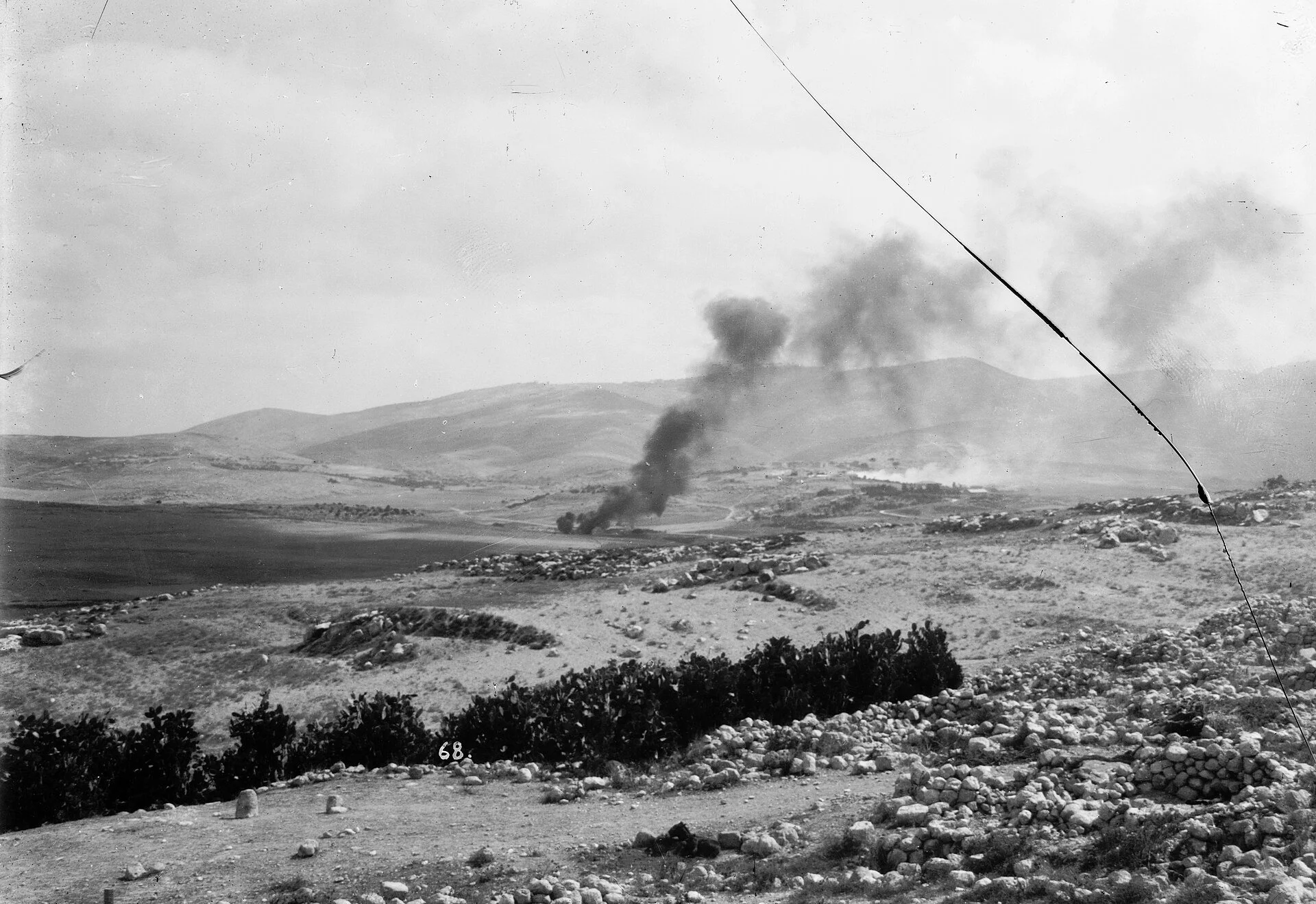
Hartuv, a Jewish colony built in the Hebron Hills, set on fire by Arabs. August 23 to 31, 1929. source
The 1929 Riots were also a wake up call. British High Commissioner John Chancellor proclaimed there was no remaining uncultivated arable land in the country, which was, incidentally, the consensus among Zionist leaders as well, especially those in charge of land acquisition. Chancellor believed Zionist land purchases necessarily meant more Palestinian landlessness, which meant more violence. The British carried out multiple commissions of inquiry, concluding that Jewish immigration and Jewish land purchases were the root causes of the violence. The Arab Executive, the closest thing to a Palestinian political leadership at the time, went further. The Zionist project was, in their words, pursuing the "extinction of the Arab nation in its natural home,” and its replacement with a Jewish one.
No need to trust the Palestinians, though, just listen to the public statements of Zionist leaders, who continued to say the quiet part out loud. In April 1930, Menahem Ussishkin, JNF Chairman, publicly called for transfer in a speech to journalists in Jerusalem. “We must continually raise the demand that our land be returned to our possession,” he said. “lf there are other inhabitants there, they must be transferred to some other place. We must take over the land. We have a greater and nobler ideal than preserving several hundred thousands of Arab fellahin.”
For Chaim Weizmann, president of the Zionist Organization and the Jewish Agency (JA) Executive, the solution to the 1929 violence was not an end to Jewish immigration, it was Arab emigration. In May 1930, Colonel F. H. Kisch, head of the JA Political Department, told Weizmann the JA should pressure the British to promote the emigration of Palestinian Arabs to Iraq. Wiezmann began promoting the idea of a transfer of Arabs from Palestine to Transjordan or Iraq in private discussions with top British officials and ministers in 1929 and 1930, and asked his subordinates for a detailed account of land available in Transjordan. The result was the 1930 Weizmann - Rutenberg scheme, presented to the British Colonial Office, calling for the “resettlement” of Palestinian farming communities to Transjordan on land to be purchased by Jewish financiers.
The plan was quickly rejected by the British, but it kicked off a wave of proposals to depopulate Palestine. In 1930, the US American Zionist Felix Warburg wrote a letter to High Commissioner Chancellor, proposing the transfer of Arabs to Transjordan, apparently home to more, better and cheaper land than Palestine! A year later, Jacob Thon said similarly that moving Palestine’s Arabs to Transjordan was desirable, but any steps to transfer Arabs would have to be taken privately. In 1932, Victor Jacobson, then representative of the Zionist Organization at the League of Nations, agreed in a secret proposal to partition Palestine on condition that 120,000 Arabs be removed from the Jewish area. In 1933, Moshe Shertok suggested to the British they buy the village of Rumman in Transjordan to settle Arabs uprooted as a result of Zionist colonization. In 1934, the US American Zionist aficionado Edward Norman wrote a 19-page plan to transfer Palestine’s Arabs to Iraq, and spent the next decade and a half trying to implement it.
It wasn’t just Warburg, Ussishkin, Weizmann, Rutenberg, Kisch, Thon, Jacobson, Shertok, Norman and many others calling for transfer by the early-mid 1930s, it was the most important Zionist institutions as well. In July 1930 and April 1931, the JNF leadership supported a proposal to transfer Arabs from Palestine to Transjordan. The JA also submitted a proposal to the British in 1931, calling for dispossessed Arab farmers in Palestine to be removed to Transjordan. By the early 1930s, many Zionist leaders coalesced around transfer as the most desirable solution to the problem that there were Arabs in Palestine.
The British rejected Zionist calls for expulsion, instead issuing a call in 1931 for Arab landless claims, seeking a cosmetic remedy to the crisis. This terrified the Zionist leadership, which at first refused to appoint an advisor to the claims committee, hoping to stall or torpedo its work. When that failed, the Zionist movement lobbied the British to install a favorable figure to run it and ensure a highly restrictive definition of landlessness was adopted. As a last resort, they tried to force Arab resettlement in the interior rather than coastal plains or Galilee, the Zionist stronghold. In the end, the British accepted only a quarter of the 3,737 claims, or about 900, with only 74 families ever resettled.
Displacement in the 1930s
By the 1930s, the largest tracts of land for sale had already been purchased, forcing the Zionist movement to buy smaller tracts from a larger number of land owners, including many tracts operating under the communal land structure. From 1934-6, for instance, the Zionist movement made 2,339 separate land deals, more than 90% of which were plots of land of less than 100 dunams. This further exacerbated the landlessness problem.
Large purchases continued, of course, such as in Wadi al-Harawith, in the Tulkarem District, home to some 1,000-1,500 Arab Bedouin. The JNF purchased land there in April 1929 and first tried to evict its residents in November, but they refused to vacate in what had become an increasingly familiar scene. Meanwhile, a Jewish settlement was established on Wadi al-Harawith’s lands, and the Arabs were provided a smaller plot to rent nearby (1, 2).
This tense state of affairs persisted for years in Wadi al-Harawith. “The tenants lived face to face with some 22 Jewish settlers,” as one historian put it. Eventually, in September 1930, this boiled over into violence when Arab men and women, armed with sticks and stones, attacked both the British police officers and the Jewish settlers. Clashes continued to erupt over equipment, ploughing, digging wells accessing grazing pastures. In February 1933, the Zionist settlers tried to evict the Arabs, resulting in the death of a Zionist guard. The matter proceeded in court, and after countless appeals were rejected, the evictions were carried out with British bayonets and Zionist boots. In June 1933, about half of the Arab population of Wadi Hawarith was evicted, while the remaining half were evicted from an adjacent plot five months later.
A similar case unfolded in al-Sakhina, in the Baysan, home to over a hundred families. Their land was sold to the Zionist movement in 1925 on condition its tenants could not be uprooted for 15 years. In 1928, however, the British annulled the ordinance protecting the tenants, and the JNF pursued eviction, as they always did. The Sakhinites appealed to British officials and fought in court for years, eventually losing in early 1935. But the villagers refused to vacate, defying court orders by taking possession of the disputed plots. The JNF sent a group of settlers to plow the land and assert possession. Soon enough, the Sakhinites, armed with sticks, attacked the settlers later that summer, blocking access to their tractors. The police arrived, arrested 19 Sakhinites and evicted the villagers by threat of force, enabling the settlers to take over the land.
In another case, in 1935, Zionists built the settlement of Yokneʿam, southeast of Haifa, in close proximity to two Arab villages—Qira and Abu Zureiq. It was “irresponsible,” as one British official put it, but the settlers refused to budge. They dug ditches, erected a watchtower on a nearby hill, fortified with double wooden walls filled with gravel. They also built markers around their camp and fenced off their fields of cultivation. By the mid-1930s, this was the only way to take and hold land and it would become the hallmark of Zionist land acquisition for the next decade and a half.
From Displacement to Revolt, 1936-9
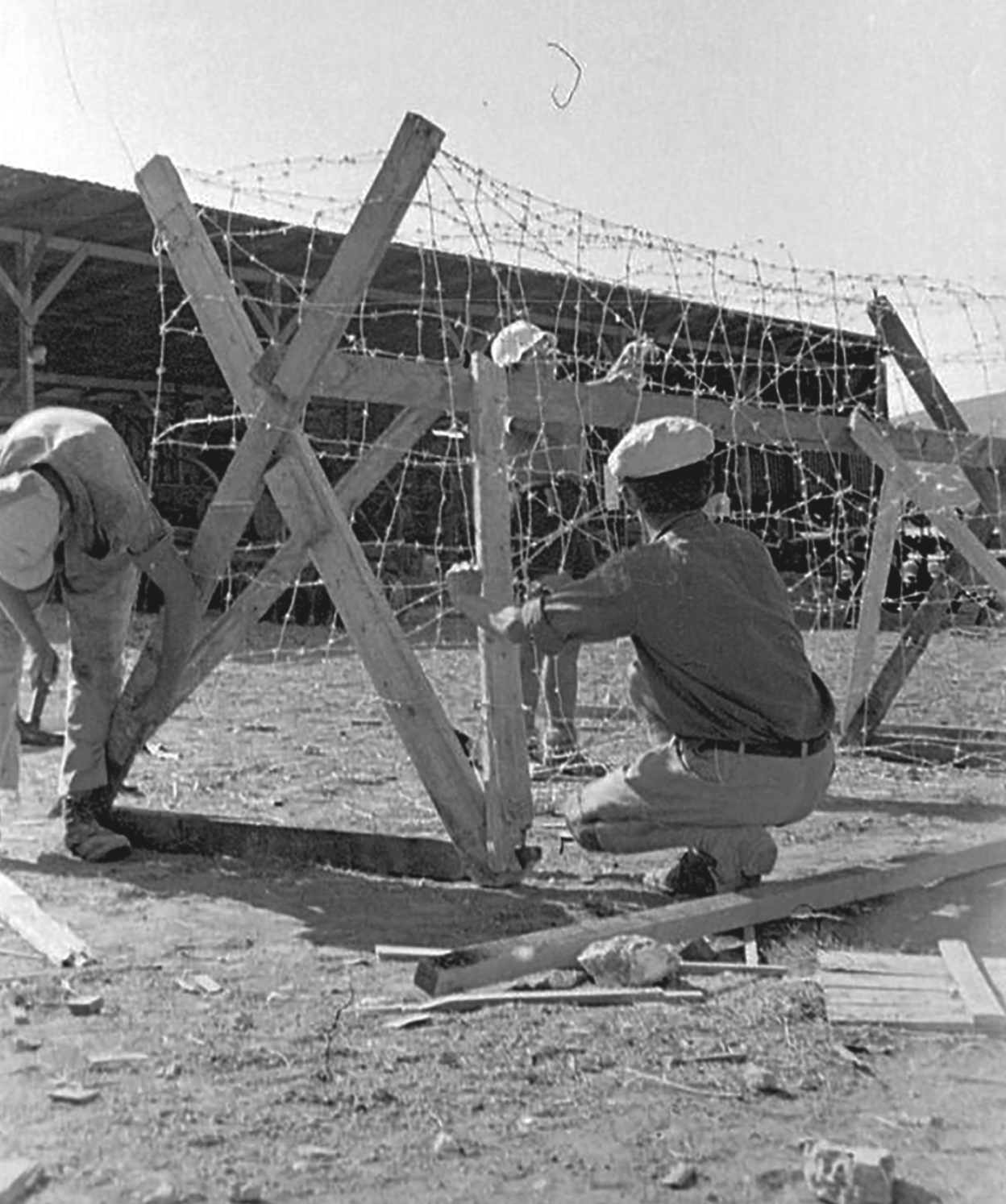

Hazorea settlers building a fence, 1938 (Source: Areej Sabbagh-Khoury, Colonizing Palestine: The Zionist Left and the Making of the Palestinian Nakba (2023, Stanford University Press), p.98)
As the British concluded, Zionist immigration and land purchases would continue to lead to displacement and violence, and that is exactly what happened from 1936–1939, when the Palestinian Arabs rose up in what became known as the Arab revolt. Its origins lie in alleyways of the urban slums that formed around Jaffa and Haifa to house the thousands of impoverished Palestinians pushed off their lands. Many found solace in the teachings of Shaykh 'Izz al-Din al-Qassam, a charismatic Muslim preacher who built a following and a militia among Haifa’s underclass.
The revolt opened with a six-month general strike demanding an end to Zionist immigration and land sales. National committees were formed and the Supreme Arab Committee, later known as the Arab Higher Committee, was established out of a coalition of the six major Palestinian political parties. Soon enough, it morphed into an armed rebellion led by farmers turned rebels. “Life-and-death” battles broke out in the streets of many urban centers while bands of Palestinians took control of much of the mountainous interior, the Galilee and the Jezreel Valley area, establishing a base of operations in Nablus. The rebels bombed British and Zionist positions, mounted hit-and-run operations, cut telephone lines and attacked road traffic, railways, bridges, oil pipelines, Zionist colonies and police outposts. They destroyed Zionist farms and orchards and forced Arab landowners who had sold land to Zionists to flee Palestine. Within six months, two hundred Arabs, eighty Jews, and twenty-eight British had been killed (1, 2).
Palestinian rebels were recruited from the ranks of landless farmers and were sheltered by villages whose lands had been taken over. The vast majority of the rebels were landless farmers even though they comprised less than a third of the cultivator population, as one study has shown. Al-Hajj Hasan Mansur called for revolt in the Jezreel Valley, where thousands of Palestinians had been uprooted. The village of al-Mansi on the western edge of the valley which had faced encroachment throughout the 1930s, became famous for its participation in the uprising. Abu Zureiq, which lost its lands to multiple Jewish colonies, offered shelter to a Palestinian rebel unit. Farmers in Qira, al-Kafrayn, Abu Shusha, Daliyat al-Ruha, and all three al-Ghubayyat villages sheltered and fed fighters as well. Colonization and resistance have a shared history.
Alas, the British eventually squashed the revolt. They killed, wounded, imprisoned or exiled 10% of the Palestinian adult male population. Altogether, some 5,748 Arabs, 300 Jews and 262 Britons were left dead. The British deported hundreds of Palestinian political leaders to Lebanon, Syria, Turkey and beyond. The British decimated Jaffa’s Old City, demolishing a thousand homes and forcibly displacing ten thousand Palestinians in the process. They also carried out mass destruction in Jenin, Lydda, Khan Yunis, Beisan, Majd al-Kurum, Wadi al-Hawarith, Baqa al-Gharbiyya, Kawkab Abu al-Hayja and Sha‘b, confiscating property, livestock and crops (1, 2, 3). By the revolt’s end, Palestine’s political leaders were in exile, its farmer rebels killed, injured or imprisoned, their bodies tortured, weapons confiscated and the country’s economy left in ruins.
If the revolt decimated the Palestinians, it emboldened the Zionists, whose leaders developed Plan Avner in 1937 to conquer Palestine in the event of a British evacuation. It called for a reorganization of the Haganah into divisions and the conscription of 50,000 men, plus a garrison force of 17,000 out of a total population of 370,000, some 20% of the total population. The plan was to transform the settler society into a settler fighting force. The security-before-all-else doctrine was born.
As was the buffer zone doctrine. The logic of the buffer zone doctrine was that Palestinians, by the nature of their very existence, were a security threat. Settlers in Yokneʿam lobbied the British to order the evacuation of the neighboring villages Qira and Abu Zureiq on “security grounds.” The “frontier regions” were “one of the biggest strategic and security questions of the Jewish state,” as Katznelson argued in June 1938. “If Arab villages will remain in the border regions then no guarding or army is useful.... And if the transfer is carried out, it is required first of all in order to clear the border regions.” Prescient, indeed.
Of course, the colonization of Palestine continued despite the uprising, or perhaps because of it, with some 57 new settlements established from 1936-9. Partition of the country was potentially imminent, as we shall see in a moment, and the Zionist movement had ambitious territorial goals, far more ambitious than their existing footprint in Palestine. And so, for the next decade, the Zionist movement bought land with partition and statehood in mind. The idea was to ensure contiguous settlement, secure roads and lines of communication, strengthen territorial depth and establish more expansive borders by putting civilians on the front lines as human shields, one of the movement’s most beloved practices from its origins in the late 19th century to the present day.
In the process, they continued to evict Palestinians. In 1937, Kibbutz Ein Hashofet replaced the village of Joʾara. In 1938, the kibbutzim of Ma’oz-Hayim and Kefar-Ruppin were built over the ruins of Ghasawiya and Mesil el-Jizil, Arab villages in the Baysan, and their 1,048 inhabitants were transferred to Transjordan. In 1938, Kibbutz Hazorea, southeast of Haifa, took lands of the village of Qira by force on the exact same day it obtained the legal rights to it. In 1939, Kibbutz Dalia, Ein Hashofet and Ramat Hashofet were built on the village’s land of Umm al-Dafuf, whose residents were pushed out to al-Sindiyana or al-Kafrayn.
The Peel Commission Report & Transfer, 1937
While Palestinians revolted for freedom in Palestine, Zionists bet on their transfer out of it. The transfer idea received renewed attention among Zionist leaders in March 1936 shortly before the revolt erupted when the 1930 Weizmann-Rutenberg scheme resurfaced at a meeting among Mapai leaders, the dominant Zionist political party. Moshe Beilinson, a leading Zionist ideologue, and Menahem Ussishkin, both came out in strong support of transfer. “I would very much like the Arabs to go to Iraq,” Ussishkin said in May 1936, but since that didn’t seem feasible, the British should “resettle” Palestine’s Arabs in Transjordan so the Zionist movement can take over their lands.
The Jewish Agency (JA) Executive met again in October 1936 and agreed on the principle that removing Palestinians from Palestine was moral. Yitzhak Ben-Zvi, the president of the Va'ad Leumi, the Jewish National Council, supported sending dispossessed Arab peasants to neighboring countries, including Transjordan, on a “voluntary” basis. Moshe Shertok, head of the JA Political Department, agreed, since Transjordan had large land reserves. As David Ben-Gurion, the leader of the Zionist movement, put it, “there is nothing morally wrong in the idea.” Afterall, it was no different than what the Zionist movement had already been doing as it bought up land in Palestine, a point he repeatedly made. “If it was permissible to move an Arab from the Galilee to Judea, why is it impossible to move an Arab from Hebron to Transjordan, which is much closer?” On October 29, 1936, 19 out of the 21 members of the JA Executive endorsed the “voluntary" transfer of displaced Arab farmers to Transjordan.
If Zionist leaders had settled on the righteousness of Arab dispossession, the next step was to convince the British of the same. And so, in May 1937, the JA submitted a transfer proposal to the British, who were “very impressed” by it, according to one source. The Zionist movement played a secretive and critical role in lobbying Reginald Coupland, author of the report, to include a recommendation to “resettle” Palestinians. As the leading historian on the topic wrote, “the proposal of Arab transfer that was ultimately made by the Royal Commission originated from, and had been secretly conveyed by, top JA leaders, including Ben-Gurion, Shertok, and Weizmann.”
Alas, the Peel Commission Report was published in July 1937, and the Zionist movement got what it wanted, an official British endorsement of transfer. The report called for the partition of Palestine and the “re-settlement” of Arabs living in the Jewish area, either to the Arab part of Palestine or Transjordan. "Compulsory" transfer was recommended in the coastal plains, the heartland of Zionist colonization. The report noted that, should the Arabs refuse to leave on their own, they ought to be transferred by force, although this was left deliberately vague (1, 2). The report cited the 1923 “population exchange” in Greece and Turkey as a model, perhaps because it legitimized forcible transfer at a mass scale. The key difference, however, was that Palestine was not a population exchange, it was a population eradication: 225,000 Arabs would be removed from the proposed Jewish State, and 1,250 Jews would be removed from the Arab State, a rounding error of a rounding error of the displaced Arab population.
For Zionist leaders, the Peel Report was exciting not because of partition, but transfer. Ben-Gurion believed the transfer recommendation was the most important part of the Peel Commission report and that it outweighed all of its shortcomings. For Weizmann, the only practical way to partition the country was through transfer. If there were lingering Zionist doubts about transfer in the early 1930s, few remained by the late 1930s.
The publication of the report had its predictable consequences. The ongoing rebellion, which had lost momentum quickly, intensified, and Palestine experienced an unprecedented wave of renewed violence, before it was eventually crushed, as discussed above.
Nevertheless, the Zionist movement remained committed to transfer. They negotiated with the Emir Abdallah of Transjordan, and allegedly persuaded him to endorse a proposal to set up a company to raise £2 million to uproot Palestinians farmers and expel them to Transjordan. Zionist leaders set up a Transfer Committee, headed by Moshe Shertok, which analyzed financial and procedural aspects of the depopulation scheme, estimated how many Arabs would need to be expelled, in which order, from which regions over which time horizon. They asked the British for a copy of all land registration and tax documents relating to all land in Palestine owned by Arabs. Shertok, who had explicitly said transfer would result in “rivers of blood," put aside his reservations to endorse the idea.
In the end, the British never implemented the Peel Commission plan. They concluded it was unworkable because there were too many Arabs living in the areas assigned to the Jewish state and there was no voluntary way to uproot them. The British were clearly not going to deploy the massive amount of violence that would be necessary to expel hundreds of thousands of Palestinians from their homes. The solution to that problem was either a Jewish State that had too many Arabs or a tiny Jewish State, neither of which were acceptable to the Zionist movement.
This is why Ben-Gurion would not let the transfer idea go. It emerged as the only solution to the core problem facing the movement. “The compulsory transfer of the Arabs from the valleys of the proposed Jewish state could give us something which we never had,” he wrote in his diary in July 1937. “A Galilee free from Arab population.” (1, 2) In December 1937, he proposed in his diary a transfer of Palestine’s Arabs to Syria. A year later, when the JA executive took up the question, Ben-Gurion said, “I support compulsory transfer. I don’t see in it anything immoral.” In 1939, he put forward another plan to raise ten million pounds to expel some 100,000 Arab families from Palestine to Iraq and Saudi Arabia. And even though the British were unlikely to execute on the plan, and even though voluntary transfer was also highly unlikely, at least as Ben-Gurion saw things, he insisted transfer could be done. “We must prepare ourselves to carry out" the transfer [emphasis in original], he wrote in his diary.
In July 1937, Ben-Gurion wrote a letter to his son concluding the same. “We have never wanted to dispossess the Arabs [but] because Britain is giving them part of the country which had been promised to us, it is only fair that the Arabs in our state be transferred to the Arab portion.” A few months later, he wrote another infamous letter to his son, one whose authenticity is debated (1, 2, 3), which nevertheless declared “we must expel Arabs and take their places...and, if we have to use force-not to dispossess the Arabs of the Negev and Transjordan, but to guarantee our own right to settle in those places-then we have force at our disposal.” Ben-Gurion understood that Jewish statehood and Arab transfer were inextricably linked and both would be achieved through force.
The Peel Commission report unleashed a transfer bonanza in the Zionist world. “This process involved unprecedented discussion of the transfer solution and its approval in principle by a majority in the most important Zionist policy-making bodies," as a leading expert on the topic put it. As another top historian wrote, “a consensus or near-consensus formed among the Zionist leaders [in the 1920s and 1930s] around the idea of transfer as the natural, efficient and even moral solution to the demographic dilemma.” The Peel Commission had given a false veneer of respectability to mass forcible transfer, and so Zionist movement seized the moment.
Soon enough, the fault line was not whether or not to uproot Palestinians from their homes. It was who to target, how to displace them, where to dump them, how much violence ought to be deployed in the process, and who would be doing the violence. In 1937, for instance, the delegates of the Twentieth Zionist Congress and the World Convention of Po'alei Tzion debated “maximum transfer,” i.e. the depopulation of all of Palestine’s Arabs and a rejection of any partition of the country, on the one hand, or a more tactical, short-term partial transfer of Palestinians out of the Jewish area, on the other, based on partition of the country (1, 2, 3).
The list of Zionist leaders who agreed on the moral righteousness of transfer is too long to mention in full, but, in addition to the key figures discussed above, also included Edward Norman, Eliezer Kaplan, Yosef Bankover, Aharon Zisling, Golda Meyerson (Meir) David Remez, Berl Locker, Shlomo Lavi, Eliahu (Lulu) Hacarmeli, Naftali Landau, Yosef Baratz, Rabbi B.S. Brickner, Berl Katznelson, Yitzhak Tabenkin, Rabbi Meir Bar-Ilan, Ze’ev Jabotinsky, Dr. Selig Eugen Soskin, Ya'acov Thon, Eliahu Epstein (Elat), Eliezer Kaplan, Arthur Ruppin, Avraham Granovsky (Granott), David Stern, 'Oved Ben-'Ami, Dr. Kurt Mendelson, Alfred Bonne, Fritz Simon, Yosef Nahmani, Dr. Bernard Joseph, Zalman Lifschitz, Yitzhak Ben-Zvi, Eliahu Berligne, Yehoshua' Suparsky, Felix Warburg, Lewis Namier, Shmuel Zuchovitzky, Eliahu Dobkin, Dov Joseph, Abraham Sharon (Schwadron), and Yitzhak Gruenbaum (1, 2, 3). Even the non-Zionist Werner Senator, one of the two dissenting voices in the October 1936 JA Executive vote noted above, eventually came around to the idea in October 1936. “We must aspire to a maximal transfer,” Senator said.
Displacements in the 1940s
Although the British adopted new regulations limiting Zionist land purchases in 1940, they had little effect. Since, from 1940-1946, the JNF had acquired an additional 238,000 dunams of land, 195,000 of which was located in zones ostensibly off limits to Zionists. Zionist institutions circumvented the regulations by registering the land in the name of an individual who would give the JNF an irrevocable power-of-attorney.
And so the evictions continued. The JNF worked to displace the hundreds of inhabitants of Ma'lul, west of Nazareth, throughout the 1940s. Zionist leaders including Ezra Danin, Yaacov Shimoni, Yehoshua Palmon and Tuvia Lishanski orchestrated multiple campaigns in the 1940s against Arab tenants who lived on land plots purchased by the JNF. As one historian put it, “Lishanski directed all his energy towards intimidating and then forcibly evicting these people from the lands their families had been cultivating for centuries.”
The militarization of Zionist settlements also drove Palestinians off their lands. By the 1940s, the village of Atlit had become a rare example of Arab-Jewish cooperation, with some 500 Jews and 1000 Arabs living together as miners in the nearby Atlit Salt company. But the Zionist militia, the Haganah, built a training ground in the village, effectively transforming the Jewish part of town into a military base. This intimidated the Arabs, whose population was reduced to 200 by the eve of the 1948 War.
Qira and Qamun, noted above, continued to face hostile settler encroachment, eventually boiling over into violence in February 1946. As one Palestinian newspaper described it, “about 150 Jewish men and women attacked these lands with armored tractors and barbed wire fences. They were divided into three groups: the first plowing, the second erecting fences, and the third intended to act upon any show of Arab resistance.” Then, at some point, about 30 Palestinian men, women, elderly people and children noticed the provocation, and “struggled with the Jews for two hours, stopped them, and forced them to retreat.” Over the next few years, the population of Qira declined from 410 in 1945 to 150 in 1948 as a result of the violence.
The conquest of land also continued in the 1940s. In 1946, Zionist forces established 11 outposts in the southern desert, including Tkuma, Be’eri and Nirim, with the goal of putting civilian settlements on the frontiers of the areas Jews hoped to control in an eventual partition of the country. The settlements, built on non arable land, were economically unviable, but were needed to extend the borders of the settler-society and gather intelligence about the Arabs in the area. They were built to serve as a human shield, a front line for the war the Zionists knew they would have to fight to establish a state in Palestine. [Tragically, on October 7, 2023, many of these communities served the purpose for which they originally built].
Meanwhile, Zionist leaders continued to fantasize about transfer. In 1941, Ben-Gurion thought that Druse, Bedouin tribes in the Jordan Valley and the South, the Circassians, the Shi’ites living in northern Galilee, tenant farmers and landless labourers, could all be transferred to a neighbouring country (1, 2). Throughout the early-mid 1940s, Shertok, Weizmann and Weitz kept proposing transfer to whoever would listen to them. “There is no room for both peoples in this country, " Weitz wrote in his diary in 1940. He was obsessed with expelling the Palestinians, and he led Zionist land purchasing activities. “After the Arabs are transferred, the country will be wide open for us … and the only solution is the Land of Israel, or at least the Western Land of Israel [i.e., Palestine], without Arabs. There is no room for compromise on this point (1, 2).” Zionist leaders continued to keep most of these ideas private, believing a public campaign for the forcible removal of the Palestinian Arabs would backfire.
Zionist emissaries were sent to Damascus, al-Jazirah, in northeast Syria, Transjordan, Iraq and elsewhere in the region to scout out dumping grounds for Palestinians. In 1943, for instance, the Zionist movement reached a land deal with Mithqal al-Fayez, a tribal chief in Transjordan, to buy tens of thousands of dunums of land in the Ghor al-Kabid of Transjordan to allocate to Palestinians who were to uprooted from Palestine. Weitz claimed al-Fayez received an advance payment in July for the land, to be registered in the names of Moshe Shertok and Yosef Stromza. In fact, Yosef Weitz, Zalman Lifschitz, the lawyer A. Ben-Shemesh and others visited the land in April 1944, but nothing seems to have come of the matter.
In December 1944, The JA Executive supported yet another transfer proposal, one that received official endorsement of the British labor party. “Let the Arabs be encouraged to move out as the Jews move in,” the resolution said. The JA described the draft as “very encouraging” and noted that it was received with “great satisfaction" by Ben-Gurion, although the language that tied Arab dispossession with Jewish immigration as a condicio sine qua non needed revision. It was too honest, since that’s exactly how Zionist leaders thought about transfer. "When we bring a plan for transferring one million Jews to the Land of Israel,” said Moshe Shapira, former director of the JAE Department of Immigration, “we cannot avoid the transfer" of Arabs out.
Alas, we have not even mentioned the revisionist Zionists, for whom neither partial transfer within the Jewish areas, nor a complete transfer within all of Palestine, was sufficient. Instead, they advocated for the transfer of all Arabs in all of Palestine and Transjordan, the latter of which had a Jewish population that rounded down to zero. “I suggest that the Arabs of Palestine and Transjordania be transferred to Iraq, or a united Iraq-Syrian state,” The revisionist leader Eliahu Ben-Horin wrote in 1943. “That means the shifting of about 1,200,000 persons. A larger number were involved in the Greco-Turkish exchange of population; many more in the internal shifts in Russia,” he added.
Conclusion
Zionist leaders understood the basic problem of Zionism: the Palestinians. There were too many of them. It would be impossible to establish a Jewish State in an area where Palestinians constituted a majority or even a large minority. And so Arabs needed to be removed from lands purchased by the Zionist movement.
This process involved a lot of violence, from deadly clashes in the 1900s and 1910s to nation-wide riots in the 1920s to one of the longest lasting revolts in all of colonial history in the 1930s, all driven by the same underlying force: Zionist colonization and Arab displacement. Meanwhile, the British continued to acknowledge the cause of the violence was Zionist immigration and land purchases, and continued to facilitate Zionist immigration and land purchases.
The Zionist movement obsessed over transfer from the mid-late 1930s onwards, since it was the only apparent solution to the core problem facing the Zionist movement. Indeed, as Zionist leaders told us over and over again, expulsion was merely an extension of eviction, a policy the Zionist movement already embraced. And that’s exactly what would happen in 1948, mass forcible expulsion.
Subscribe to the Palestine Nexus Newsletter: