
Storms without shelter: Gaza’s nightmare continues due to Israel’s blockade
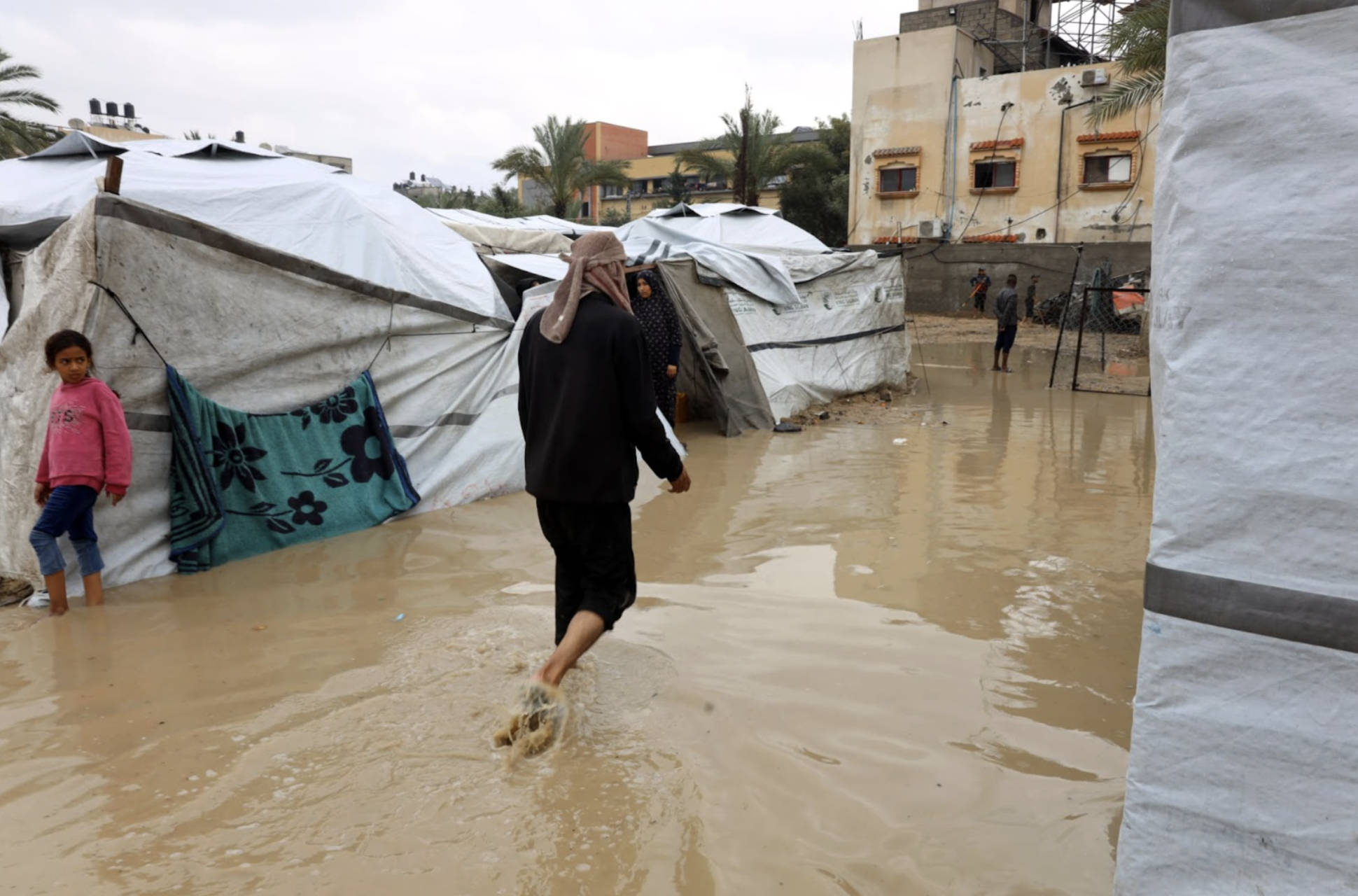
Flooding in Gaza following heavy winter rains, with damaged drainage systems leaving streets and temporary shelters underwater. December 2025. Photo by Louay Abu Khousa.
“Why are we forced to live like this?”
This was the question my friend Afnan asked me when I called her on December 14, 2025, from her tent in Al-Zawayda in central Gaza where she was displaced with her family. The relentless, rhythmic pounding of the rain on plastic drowned out her voice. Yet, the first thing that woke her that night was not the sound of rain, but the piercing cold.
When she stretched her foot out from under the blanket, she did not touch the ground, she touched water. Within minutes, it had risen to her mid-calf. They tried to stand, but the ground was no longer solid; every step produced a heavy, sinking sound.The blankets they had slept on absorbed water so quickly that they became too heavy to lift. The mattresses overturned, and there was no place one could sit or stand without getting even more soaked. Even the plastic bags they had used to store food floated; the rice mixed with water, the bread crumbled, and everything meant for the next day’s meal was ruined.
At dawn on December 11, heavy rain began falling across the Strip, flooding streets, shelters, and displacement camps. The root cause of the disaster, however, was not the storm, but more than two years of systematic bombardment, ground incursions, and the dismantling of civilian infrastructure. As temperatures dropped to 6°C, (42.8°F), at least 25 people have died , including 6 children who froze to death.
“We no longer know what to save first. Everything is essential and everything is soaked,” Afnan said. Standing was exhausting, sitting was impossible, and nothing warmed the body except movement, but there was not even enough space to move.
“Why are we forced to live like this?” She asked me again in a low voice. “Morning does not bring relief, but the start of another attempt to adapt to loss; possessions destroyed, small things lost without notice or recorded in any official statistics… but they have now become part of our daily life.”
Afnan and I are originally from northern Gaza. When I decided to move to the south, she chose instead to stay in central Gaza––not out of safety, but out of exhaustion. The fear of returning north or being forced to flee again had become heavier than that of staying. Our childhood friendship grew stronger over years at university. We once measured our lives by exams and deadlines, trusting that effort and knowledge would lead somewhere. Now, separated by war and survival, that promise feels distant, as fragile as the fabric of a tent stretched over muddy ground.
We talked about the past, when meeting each other required no effort at all, when Gaza’s streets could bring us together in minutes. We remembered how we used to love going out in the winter, seeking seaside cafés while the rain fell gently outside. Now, rain threatens to drown us.
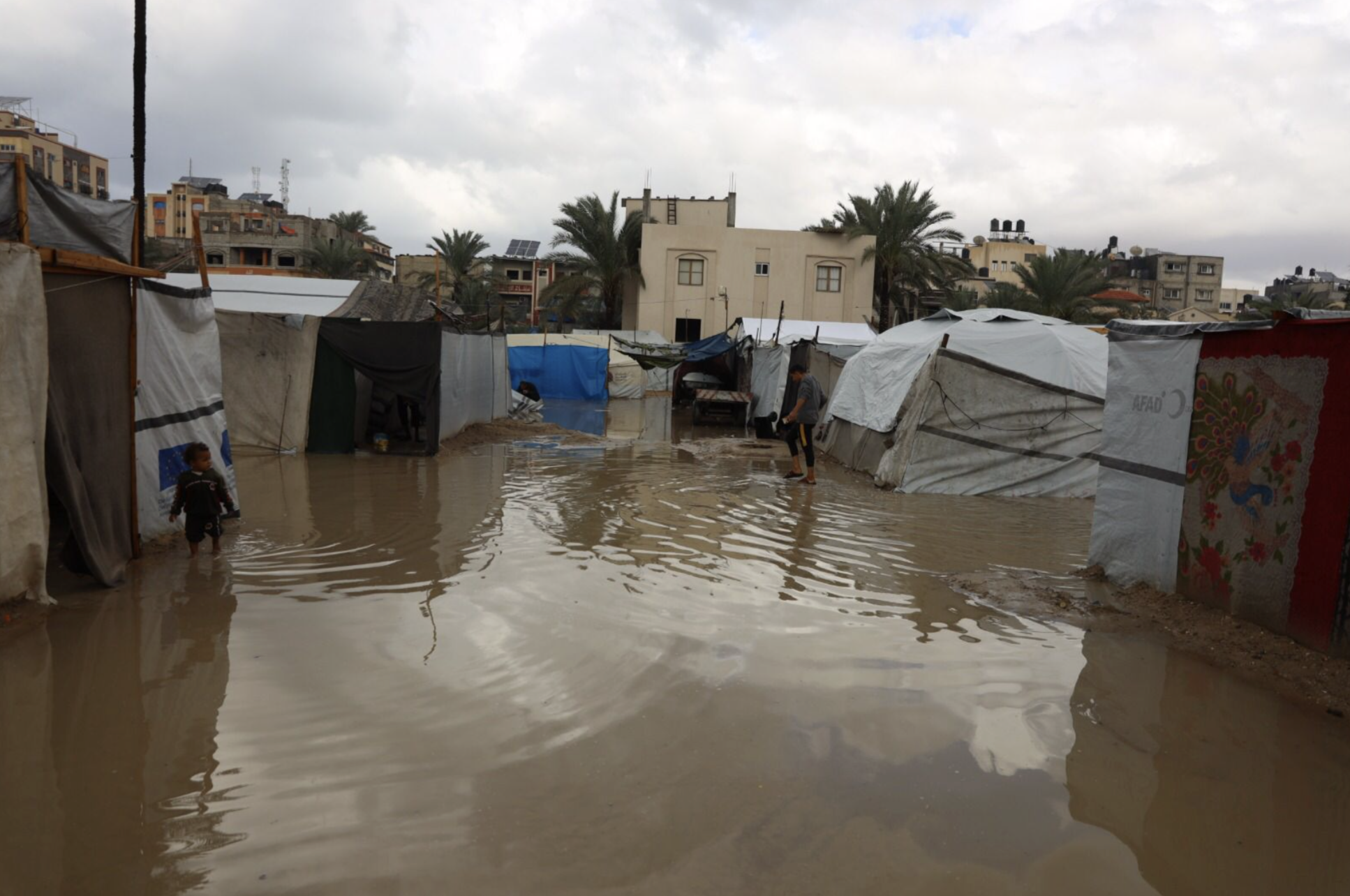
Flooding in Gaza following heavy winter rains, December 2025. Photo by Louay Abu Khousa.
On the morning of December 12, my cousin Rola, a mother of two, called me with a voice trembling from cold and exhaustion. After the ceasefire, she had returned to her home in Jabalia, which had been struck by an Israeli airstrike in November 2023 after their first displacement to the south. The family was safe but the missile had torn off the roof, leaving the house exposed and uninhabitable.
Because rebuilding was a distant dream, they replaced the roof with thin plastic sheets—a scene that has come to define rooftops across Gaza: homes covered in plastic or scrap metal. When the fierce winds hit that night, this fragile roof collapsed, flooding the house and leaving the family to face directly the biting wind and icy water.
As the storm raged on, there was no pause for recovery or safety. The family barely had time to confront the damage inside their home. Rain, cold, and fear merged into a single, unrelenting ordeal, erasing any boundary between natural disaster and siege. As the water continued to rise, most of the men stayed behind, struggling to block the flood and make whatever repairs they could. Women, children, and the elderly were sent away to areas the rain had not yet reached, searching for anything that resembled safety. Some were forced to sleep in the streets, while others sought shelter beneath the ruins of bombed towers, huddling under broken concrete to escape the rain and the threat of drowning. What should have been a night of coping with floodwater became another struggle for survival.
Rola’s voice was full of despair, and I could hear her children’s faint cries in the background.
I told her she could come to mine with her children, but my words almost stuck in my throat as I added: “But we don’t have enough blankets or winter bedding for all of you… can you bring some with you?” A hesitant silence followed. I imagined Rola looking at her children and the road that had turned into a lake of mud and darkness. How could she carry them through this storm, dragging wet blankets that had absorbed the rain and now felt like blocks of lead? In the end, Rola chose to stay in her damaged home.
Countless families across Gaza faced the same choice as Rola that night. They remained in unsafe homes or flooded tents, sometimes because they had nowhere else to go, others because moving, even for one night, had become a monumental and often impossible task.
Just meters from where I live, a displacement camp bore the full force of the storm. I saw tents torn apart by the wind, their plastic skins whipping violently, while others vanished entirely beneath floodwater. Families clung to whatever they could salvage, desperately trying to hold down the remaining tents or lift their few belongings out of the rising mud. I saw people carrying the youngest children and the elderly to slightly higher ground, searching for any spot that remained above water. Shouts for help filled the air as everyone struggled to find any way to survive the night.
Humanitarian organizations say that 65,000 more households need shelter after December’s storms. And cold and the lashing winds are not the only danger.
I grew up in Gaza so I experienced many winter storms before October 2023. The drainage and sanitation systems were able to cope with even heavy rainfall. Flooding did occur at times, but rain did not immediately become contaminated, and daily life was able to continue relatively normally.
But displacement has fundamentally changed this relationship with rain. In overcrowded camps built on sand, families live without drainage or protection. When storms arrive, people dig shallow trenches with their bare hands, not as a solution, but as a desperate attempt to keep filthy water away from fragile nylon tents.
With water and sanitation infrastructure destroyed, rainwater is now instantly contaminated when it mixes with sewage. In densely populated displacement camps where drainage systems have collapsed, standing water creates ideal conditions for waterborne diseases, including hepatitis A—a growing public health crisis documented by the World Health Organization.
I experienced this firsthand when I contracted Hepatitis A on November 26, a disease rampant in Gaza due to contaminated water. For two weeks, I faced intense pain, knowing that recovery depends on nutrition and hygiene: two resources that are almost impossible to find.
Afnan’s family faced the same risk. “My little nephew has a fever that won't break,” she said, her panic rising. “He has constant diarrhea from the filth left by the flood. Where do I take him? There is no medicine.” She told me they were searching for new plastic sheets and rope. “We will tie it down stronger this time,” she said about the tent, as her voice moved from defiance to despair. “What else can we do?”
Between those moments of resolve, families worked quietly against the storm. Plastic sheets were pulled tighter, ropes knotted again and again, and water was pushed away with whatever tools were at hand. These small acts offered no real protection—only the illusion of control in a situation where choices had all but disappeared.
Her question lingered in the air, unanswered, as the storm continued to strip away what little stability remained. Around her, the storm laid bare how fragile everything had become—tents that barely held, ground that no longer drained properly, and nights where the idea of safety felt increasingly abstract. What had once been temporary hardships had hardened into a daily condition, forcing people to confront not only the weather, but the slow erosion of any sense of normal life.
Despite the devastation, people still fight to survive. Neighbors share blankets and firewood, creating small pockets of warmth.. Amid all this, Afnan’s determination answers her daunting question. “Why are we forced to live like this?” When both the ground beneath you and the sky above have been turned against you, all that remains is the ongoing work of piecing together a shelter, a constant fight against the rain and the bombs.
“We will survive this,” Afnan said. “We have no choice but to keep going, to keep building, because giving up is not an option.”
Subscribe to the Palestine Nexus Newsletter: