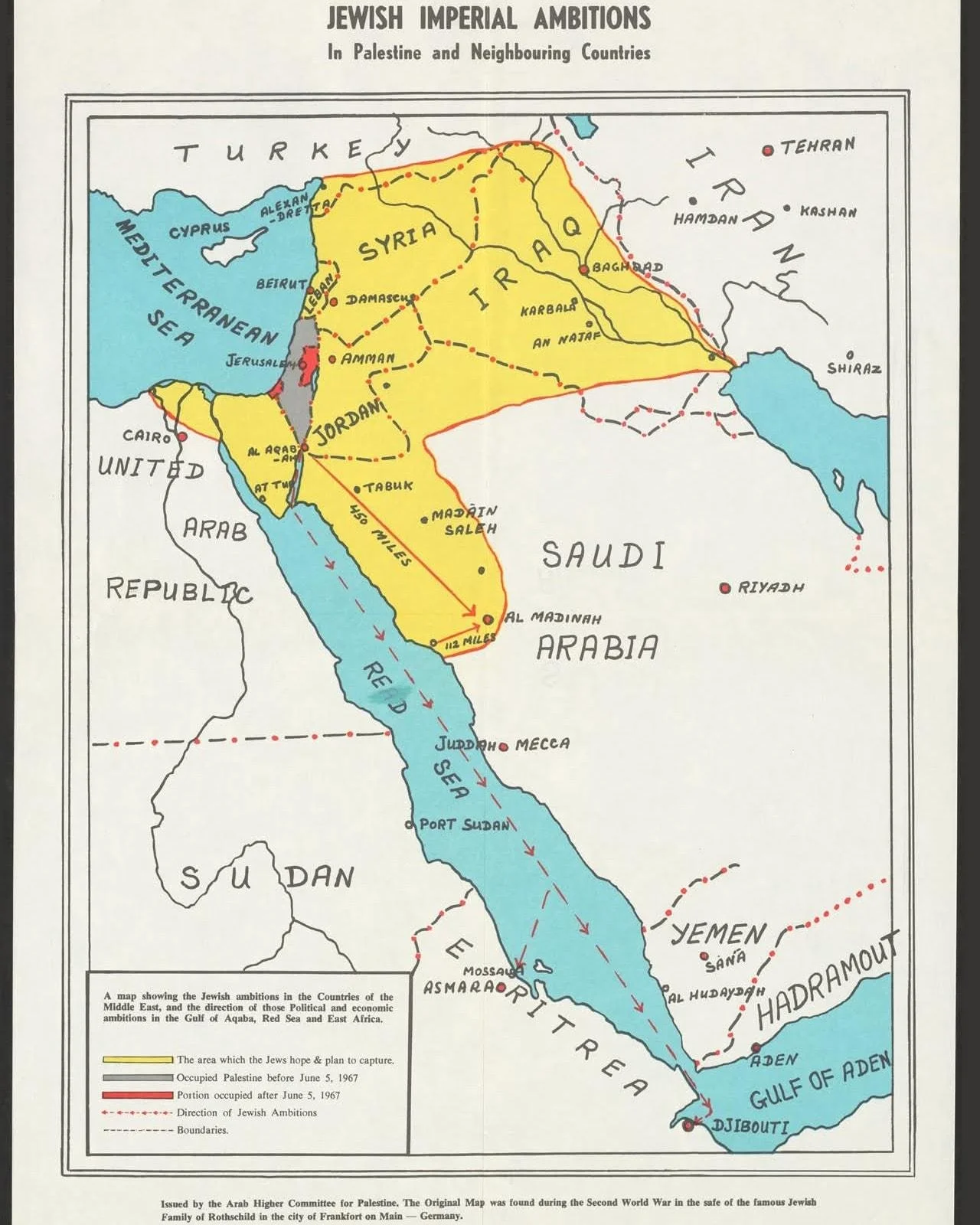
A Map depicting Greater Israel, date unknown source
May 11, 2026 — In February 2026, Tucker Carlson pressed U.S. Ambassador to Israel Mike Huckabee on the meaning of “Greater Israel.” Carlson cited Genesis 15:18, which describes a divine promise of land from the Nile to the Euphrates. “It would be fine if they took it all,” Huckabee murmured.
Israeli leaders across the political spectrum agreed. “This war must end with changing the borders of the State of Israel — in Gaza, in Lebanon, in Syria, and of course in the West Bank,” Israeli Finance Minister Bezalel Smotrich said. “If it were up to me, we would have annexed territory long ago.” It’s not just the Israeli right but also the “liberal” opposition leader, Yair Lapid, who agreed the Bible gives Israel the right to land from Egypt to Iraq
Greater Israel has been in the making for more than a century. It is not just the idea that Israel has no borders or that Israel’s borders should be in a state of forever expansion, but also that Israel should dominate the countries beyond its borders. And, indeed, every Israeli government since 1948 has either considered expanding the borders of the country, pursued military action to expand them or in fact expanded them. And while support for Greater Israel has ebbed and flowed, the project enjoys more support today than at any point in history. This, at a time when Israel’s regional footprint has been expanding at an accelerating pace, with no end in sight. This is a brief history of Greater Israel, 1948-present.
Greater Israel, 1948-1967
The Zionist movement was expansionist by definition. From the late 19th century, Zionist leaders imagined a Jewish Palestine with expansive borders, often inspired by the Bible. Of course, Zionist settlement patterns were dictated by the availability of land for sale, leading to a nucleus of Jewish colonies along the coastal plains, the Galilee, Jezreel Valley and the Beisan. Dozens of colonies were established by World War I and hundreds by World War II. By the late 1930s and 1940s, the point of Zionist land purchases was to strengthen the territorial depth of the Zionist settlement network and expand its borders. In one incident, in October 1946, Zionist settlers set out in the middle of the night to lay claim to 11 desert outposts. “Our goal was to conquer the Negev,” Miriam Bonim said, who participated in the operation. “So we had to settle it.”
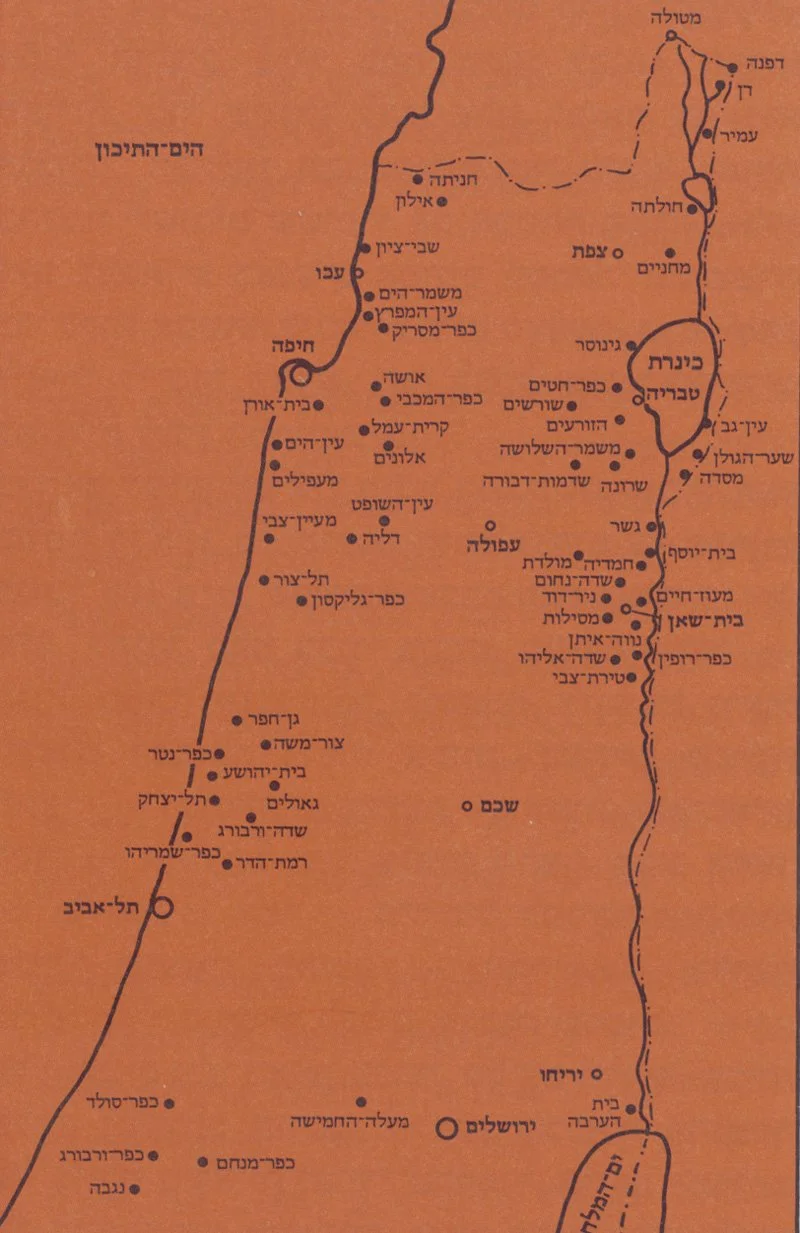
Map of the Zionist settlements established from 1936-9. Zionist settlers would arrive at a site and quickly build a watch tower and a few shacks with roofs in less than 24 hours in what was known as the “Tower and Stockade” method of colonization. source.
In November 1947, the United Nations called for the partition of Palestine, allotting 56% of the country to the Jewish State even though Jews were 33% of the population and owned 7% of the land. The Zionist leadership accepted the plan with the understanding that the borders would not be drawn by bureaucrats in New York but by armed militias in Palestine. And, indeed, Zionist forces, and then the Israeli military, conquered some 78% of Palestine during the war, and tried and failed to take much of the rest, including Jerusalem, Latrun, Bab al-Wad and other areas of the West Bank. In fact, the Israeli army nearly conquered Sinai and the Gaza Strip in late December 1948, but were forced to halt the offensive due to intense US and British pressure (1, 2, 3). In the process, they destroyed some 500 Palestinian villages and expelled 750,000 Palestinians from their homes, and have spent the last 78 years ensuring they never return. A garrison state was born.
Israeli leaders lamented the failure to conquer all of Palestine in 1948. “I never forgave the Israeli government under Ben-Gurion for not letting us finish the job in ‘48-49, both militarily and politically,” said then deputy prime minister Yigal Alon. Or, as the military leader Moshe Dayan put it in 1949, the “frontier of Israel should be on Jordan [River]... present boundaries [are] ridiculous from all points of view.” The feeling among many in the highest echelons of power was that “we had not completed the job in the War of Independence,” while the failure became known in Israeli folklore as the “weeping for generations.” Few Israeli leaders were as illustrative as Abba Eban, who once said the map of Israel from 1948-1967 “reminds us of memories of Auschwitz.” Anyone who believed Israel ought to exist within its borders apparently also supported another Holocaust.
Needless to say, Israel was unsatisfied with its borders after the war, and so it never declared them, insisting the armistice agreements resulted in armistice lines, not borders. As the Israeli government's Year Book put it in 1951, “only now have we reached the beginning of independence in a part of our small country," adding "to maintain the status quo will not do. We have set up a dynamic state bent upon ... expansion.” For most Zionist leaders, the conquest of 1948 was an extension of the conquest of 1946, which was an extension of conquests of 1936-9, which were extensions of five decades of Zionist colonization.
After 1948, Israel went to work to push Israeli control up to and beyond the armistice lines. It did this, first, by depopulating the border areas. From 1949 to 1959, Israel pushed out some 30,000-40,000 more Palestinians and Bedouins from the southern desert border region and the Lebanese, Syrian and Jordanian border regions. Then, in the 1950s, Israel built some 108 new settlement outposts in the ruins of the depopulated borderlands, including 26 new settlements along the Lebanese border, the Jordan river and the Gilboa foothills, 13 on the eastern border, 8 in the Jerusalem corridor and 25 in the so-called Gaza envelope. Many of the towns have tragically, if repeatedly, served the purpose for which they were built, namely, to place civilians on the front lines as a first line of offense and defense.
But Israel’s expansionist drive knew no borders. Israel grabbed a three kilometer strip along the eastern edge of Gaza after the armistice agreement with Egypt was signed, destroying Palestinian homes and cemeteries in the strip and cultivating the fields for Israeli use. Israel even proposed taking over the Gaza Strip in 1949 and worked to empty it of refugees in the early 1950s while it was under Egyptian occupation, albeit without much success.
Then, in October 1956, Israeli forces invaded and occupied the Sinai Peninsula and the Gaza Strip until March 1957 during the Suez Crisis. Israel tried and failed to expel the population during its short-lived occupation, even setting up a committee to consider proposals for how to empty Gaza of its Palestinian refugees. In the end, though, US President Eisenhower forced Israel to withdraw after five months, and so Israel’s plans for Gaza were shelved, although not forgotten.
Israel also sought to take over land beyond the Syrian armistice lines. In 1950, Israel started a project to drain Lake Huleh, encroaching on Syrian farmers. In 1951, Israel claimed exclusive sovereignty over the entire demilitarized zone (DMZ), spending the better part of the next decade pursuing canal construction, irrigation ditches and other water diversion projects in the DMZ. Israel also carried out countless violent military raids and assaults on Syria positions in the 1950s and 1960s. By 1967, Israel had announced its intention to cultivate the entire DMZ. Moshe Dayan later confessed that “more than 80%” of the clashes were instigated by Israel. “We would send a tractor to plow some area where it wasn't possible to do anything, in the demilitarized area, and knew in advance that the Syrians would start to shoot,” he said in in 1976. “If they didn't shoot, we would tell the tractor to advance farther, until in the end the Syrians would get annoyed and shoot. And then we would use artillery and later the air force also.” Alas, the origins of the 1967 War lie as much in Syria as they do in Egypt.
Although the Lebanese border was more stable, Israel flirted with expansion there too. Zionist leaders had set their eyes on the Litani River as a northern boundary from the 1910s onwards and even partnered with Lebanese Christians in the 1940s to build water diversion projections on the river. In October 1948, Israel invaded Lebanon and occupied 15 mostly Shiite villages in the south, although the armistice agreement forced an Israeli withdrawal. For the next two decades, Israeli leaders repeatedly mused over the idea of taking over south Lebanon up to and including the Litani River. Ben-Gurion proposed as much to the British and French in the lead up to the 1956 Suez Crisis, but was laughed out of the room. Alas, Ben-Gurion’s disciples took him more seriously.
After 1948, many Israeli leaders believed the country could realize its national aims within its 1948 borders, but many more supported their expansion in all directions should an opportunity present itself. This aligned with a new military doctrine gradually adopted in the 1950s, namely, “Israel must not leave the initiative in enemy hands.” Israel had to choose the conditions and timing of the fighting. That’s why Israel carried out countless cross-border raids into Gaza and the West Bank during the 1950s and 1960s, killing hundreds. That’s why the Israeli military refrained from large-scale investment in border fortification during this period, as military procurements were repurposed for offensive assault forces. And, as we shall see in a moment, that’s why Israel went to war in 1967, and many times since.
The June 1967 War
Levi Eshkol was elected Prime Minister in 1962, and shortly thereafter the Israeli military’s Deputy Chief of Staff, Yitzhak Rabin, outlined to him the ideal boundaries of the country: the Jordan River in the east, the Suez Canal in the south and west and the Litani River in the north. Plans were developed to occupy Jerusalem and the Latrun area, the entire West Bank, and a separate plan to conquer Qalqilya and destroy it. There was also a plan to carry out “a transfer” in Hebron to avenge the 1929 massacre. “The idea that the IDF might actively seek to expand Israel’s borders came up repeatedly during the mid-1960s,” as one scholar put it.
On 1 January 1964, Yitzhak Rabin was promoted to the army’s Chief of Staff and convened his subordinates to outline his military doctrine. For Rabin, the military would bring peace closer by “readying itself for war [through] a greater momentum for operational activity.” Over the decades, this has evolved into a core military principle: war is the gateway to peace. Rabin also discussed the possibility of an Israeli preemptive strike and the need to prepare talking points to support one. He saw “‘no moral flaw in thinking that the State of Israel must be large.” It was apparently a moral flaw to think Israel should remain within its borders.
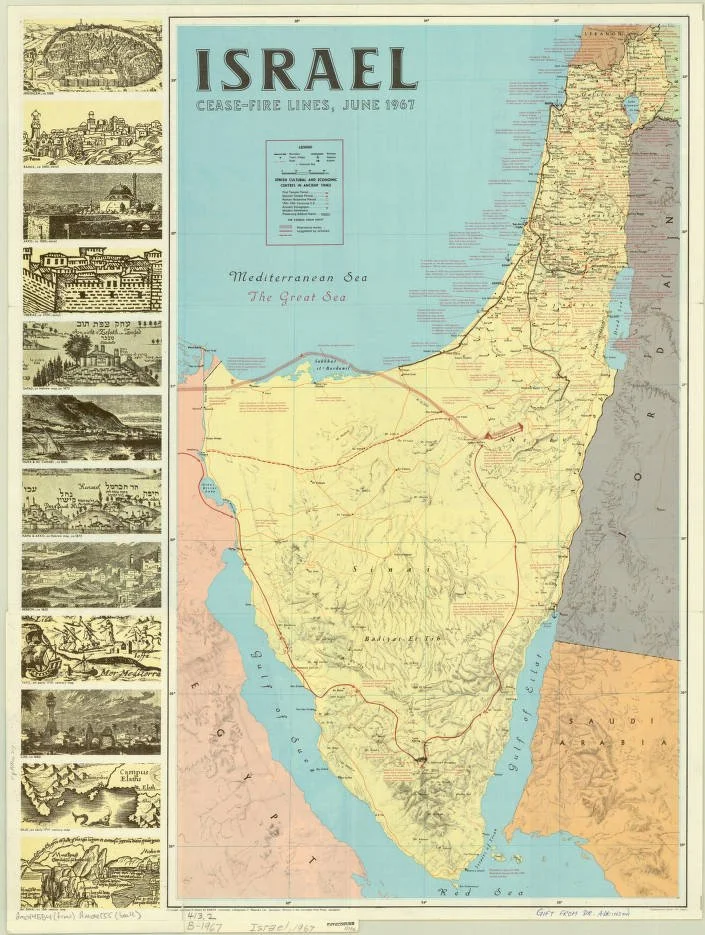
Israel cease-fire lines, June, 1967 source
We know what happened next. On 5 June 1967, Israel launched a surprise attack on Egypt. Within six days, it conquered the Sinai Peninsula, Gaza, the West Bank, including Jerusalem, and the Golan Heights. It was a stunning military victory that would turn into a strategic nightmare.
In the months and weeks leading up to the assault, Israeli leaders had made repeated threats to march on Damascus and overthrow its government if it did not cease support for Palestinian militant groups. That compelled Egyptian President Gamal Abdel Nasser to believe a false Soviet report of an imminent Israeli threat to Syria in May 1967, leading him to move troops into the Sinai. The Egyptian army expelled UN forces from the Peninsula and closed the straits of Tiran to Israeli shipping.
To Israeli leaders, this was not a crisis, but an opportunity. Israeli military leaders agreed with American intelligence assessments that Israel could easily defeat the combined Arab armies, even if attacked first. But the feeling was that Israel could transform the balance of power in the region and renew its deterrence capacity if it embraced its own military doctrine of preemptive action, and that’s what it did.
After the war, Israel’s apologists fabricated a narrative that Israel faced an existential threat and had to act first. Yet, zero Israeli leaders who went to war in 1967 believed that. The threat was contrived after the fact to justify what they described as a war of choice, and Menachem Begin, Yitzhak Rabin, Haim Bar-Lev, Ezer Weizman, Mordechai Bentov and Matityahu Peled all said as much in the years after the war.
Greater Israel went from idea to reality in a week. The Israeli cabinet met on 18–19 June 1967 and decided Israel should annex the Gaza Strip once the number of Palestinian refugees there was significantly reduced by “transfer” to other locations and also that Israel’s eastern border would now be the Jordan River, while the adjacent Jordan Valley would remain under Israeli control. They also secretly annexed some seventy square kilometers of the West Bank, calling it East Jerusalem. They also annexed the Golan Heights, although not until 1981.
During and after the war, Israel expelled hundreds of thousands of Palestinians from the occupied territories. Recall, Israel wanted the land, just not the people living on it. Israel expelled inhabitants of the Latrun area, the Qalqilya-Tulkarm region, the southern West Bank, the Jordan Valley, Jerusalem, the Gaza Strip and the Golan Heights. For Israel, these were areas of religious, military or political significance, and so needed to remain under Israeli control forever, and so needed to be emptied.
After the war’s end, Israel ramped up its depopulation efforts, rounding up Palestinians throughout the occupied territories and shipping them off to Jordan. They provided free bus service from Jerusalem and other parts of the West Bank and Gaza to the border with Jordan, where Palestinians were forced to voluntarily sign away their right to ever return. Within six months, Israel had destroyed thirty Palestinian villages and towns and pushed out some 300,000 Palestinians (1, 2, 3, 4, 5 ).
Disappearing Palestine, 1967-Present
From the earliest years of the occupation, Israeli policies reflected plans for a long-term stay. Israeli control required intimate knowledge of the population and so countless reports were produced by government bodies with “seemingly endless number of tables, charts, and figures,” as one scholar put it. The Israeli military quickly developed a permit regime that controlled all aspects of political, economic and social life. Within months, Israel declared large swaths of land in the West Bank closed military zones. They began issuing identity cards to Palestinians in 1968. Within months, Israel had developed the infrastructure of a forever occupation.
Then came the settlement enterprise. It was slow to take off but accelerated with a vengeance during the 1980s when Israel’s right-wing came to dominate. The 1977 election manifesto of the Likud party called for “only” Israeli sovereignty "between the sea and the Jordan.” Successive Israeli governments from the late 1970s onwards lived up to their promises, tripling the settler population in the Palestinian occupied territories from 1982-1988. From that period onwards, the Israeli left and the Israeli right alike expanded the settlement enterprise, almost linearly, during times of quiet and times of bloodshed. The project was subsidized by the state, and the population took advantage of it, home by home, dunam by dunam, year over year, for the past 58 years. Today, more than 750,000 Israeli settlers live illegally in the West Bank, including East Jerusalem.
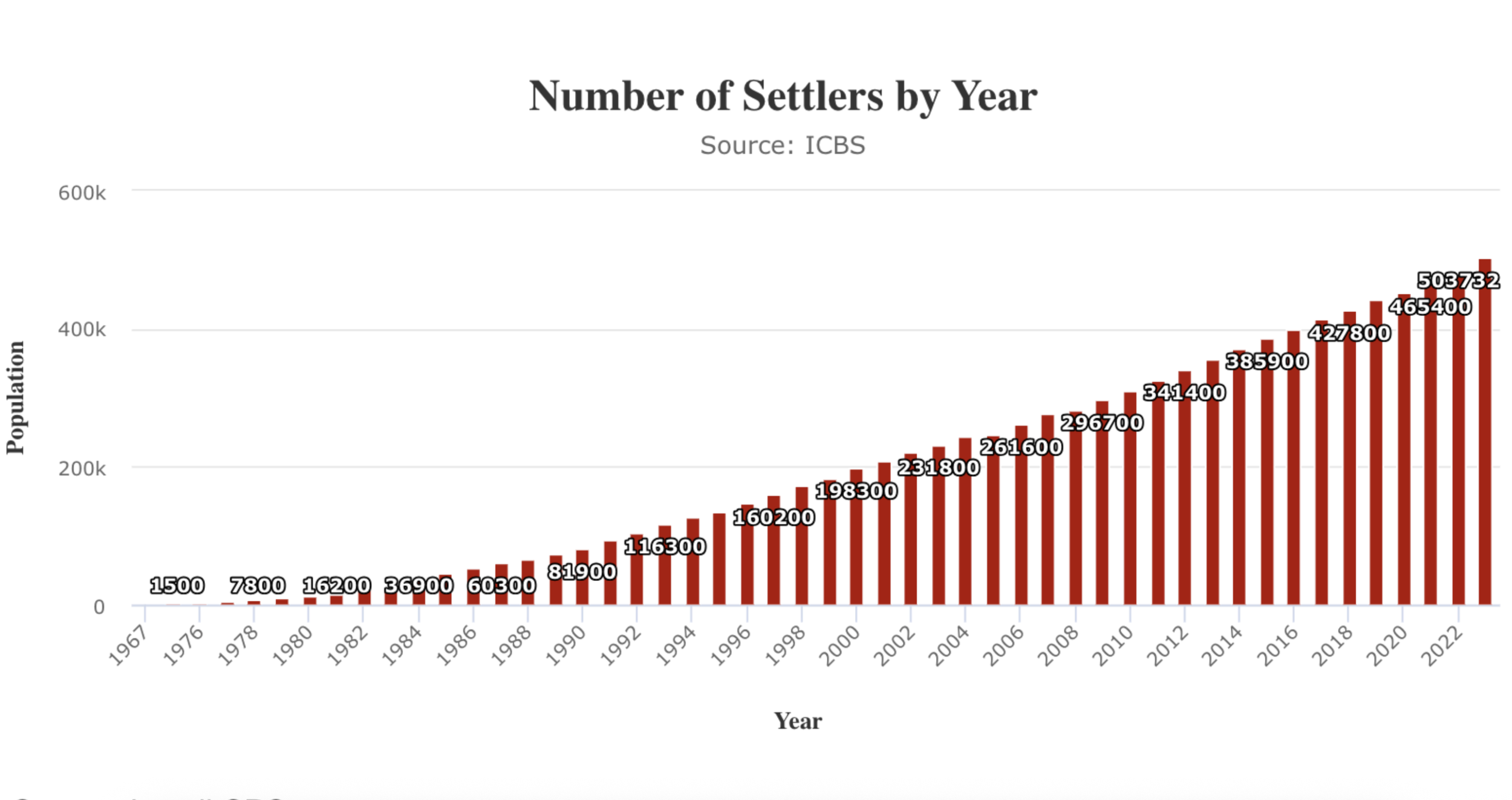
Source: Peace Now
Since 1967, Israel has taken over more than half of the West Bank. From 1967-1975 Israel declared some 27% of the West Bank closed military zones, 22% “state land”, much of which has been allocated for Jewish settlements, and 6% nature reserves, primarily from 1969-1997, all of which has been made off limits to Palestinians. Although the Oslo Process slowed the massive land grabs that characterized the first few decades of occupation, they continue to this day, such as in 2022, when Israeli authorities declared the largest nature reserve in the West Bank in decades. The Oslo process did not slow the project of Greater Israel, it redirected and refocused it on the 60% of the West Bank known as Area C. That’s where Israel declared its eastern border on June 19, 1967. That’s where the Jordan Valley was located. And that’s where Israel had already determined it would control forever. Oslo merely cemented that.
By the 2010s, Israeli leaders embraced not just the idea but also the language of Greater Israel. "The land of Israel is whole,” Minister of Welfare Haim Katz said in 2015. “There is no Palestine." In 2015, Deputy Foreign Minister Tzipi Hotovely added, "this land is ours. All of it is ours.” In 2016, Minister of Agriculture Uri Ariel agreed that "between the river and the sea will only be the State of Israel. There are not 2 states west of the Jordan" In 2021, then Israeli Prime Minister Naftali Bennett said “there is no room for another state between the sea and the Jordan…because of our right to the land." Or, in the words of the Minister of Justice Yariv Lavin in July 2023, "the entire Land of Israel will be ours.” On the eve of October 7th, Greater Israel was a settled matter.
October 7th and Beyond
The October 7th attacks transformed the meaning of Greater Israel, starting with Gaza. Israel was no longer content with blockading the Strip by land and sea and bombing it from the air. Beginning in late October 2023, Israeli forces invaded most areas of the Strip, repeatedly. Israel enlarged the buffer zones and declared large swaths of the Strip active combat zones for most of the genocide, forcing Palestinians into smaller and smaller enclaves. For months on end, some 85% of Gaza was off limits to Palestinians, with the entirety of the population having been displaced multiple times, as Israeli contractors worked round-the-clock bulldozing their homes. But resistance fighters kept reappearing and kept carrying out sophisticated and deadly operations in areas of Gaza where they had ostensibly been defeated. And so the war that accompanied the genocide dragged on.
The first ceasefire in January 2025 brought a temporary withdrawal of Israeli forces from many areas of the Gaza Strip, although not the perimeter buffer zones, the Philadelphi Corridor and the Rafah crossing. Israeli leaders were deeply unsatisfied with the outcome, and after months of low-level violations, Israel relaunched a full-scale assault in March that lasted until October 2025, when another “ceasefire” deal was reached, one which Israel has violated every day, killing nearly a thousand since.
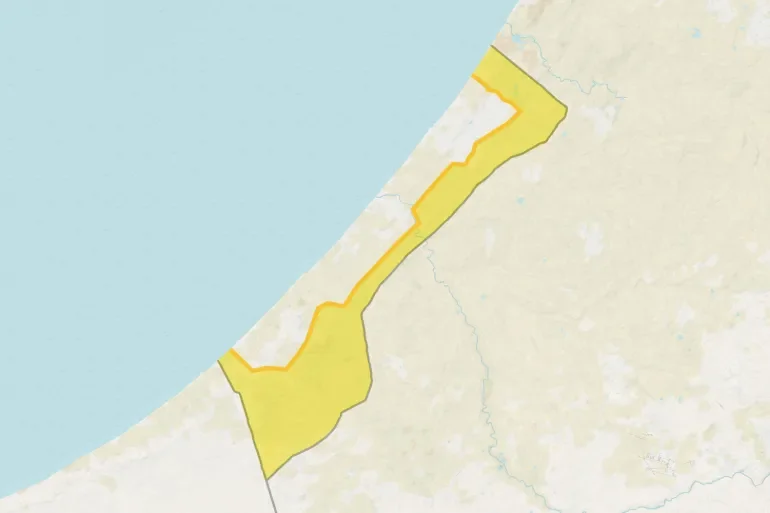
Map of the Yellow Line, Gaza Strip, source
The October 2025 “ceasefire” introduced a new line, a Yellow Line, dividing Gaza between east and west. Israel would in theory control 53% of the Gaza Strip, but in practice, Israel has been moving the Yellow Line, taking over more and more of Gaza, quite literally pushing the Palestinians into the sea. Palestinians have gone to bed on the Palestinian side of the line, and woken up under fire on the Israeli side. At the time of publishing, Israel controls roughly 63% of Gaza, and counting, with reports that Israel is planning to renew its ground offensive and intensify its genocidal slaughter of the Palestinians.
Meanwhile, calls to settle Gaza have only grown louder. Israeli politicians and settlers held a Gaza annexation conference last July, where they said the US had approved Israel’s plans to transform the besieged Strip into a "resort town" after it had been emptied of its two millions Palestinians, either through starvation, disease, incineration or forcible expulsion.
As for the West Bank, October 7th did not so much transform but accelerate Israel’s take over. Recall that, in December 2022, Greater Israel took a great leap forward when Benjamin Netanyahu formed the most right-wing government in Israeli history. Bezalel Smotrich was appointed lord of the West Bank and he placed the administration of the settlement enterprise in his own hands. He armed, funded and supported the settler militias, which carried out ever increasing waves of forcible expulsions and deadly pogroms with total impunity. He green lit settlement expansion and new settlement construction, apartheid roads and military infrastructure. All the while Israeli forces carried out some of the deadliest raids in the West Bank in decades. That was in July 2023.
Since October 7, Greater Israel has been coming to full fruition on live stream. Israeli soldiers and settlers have expelled 45,000 Palestinians from their homes in the Jenin, Nur al-Shams, and Tulkarm refugee camps, Masafer Yatta, Humsa, Wadi a-Siq, Maghayer a-Deir, Ras 'Ein al-'Auja, Susiya and dozens of other communities. In July 2024, Israel carried out its largest land seizures in decades, declaring thousands of acres as "state land" and approving dozens of new settlement outposts. In recent months, settler terrorists have been carrying out about a dozen terrorist attacks every day, seeking to drive tens of thousands of Palestinians from their homes. Greater Israel is not a declaration, it's a process, a very violent one, that has been on steroids for years.
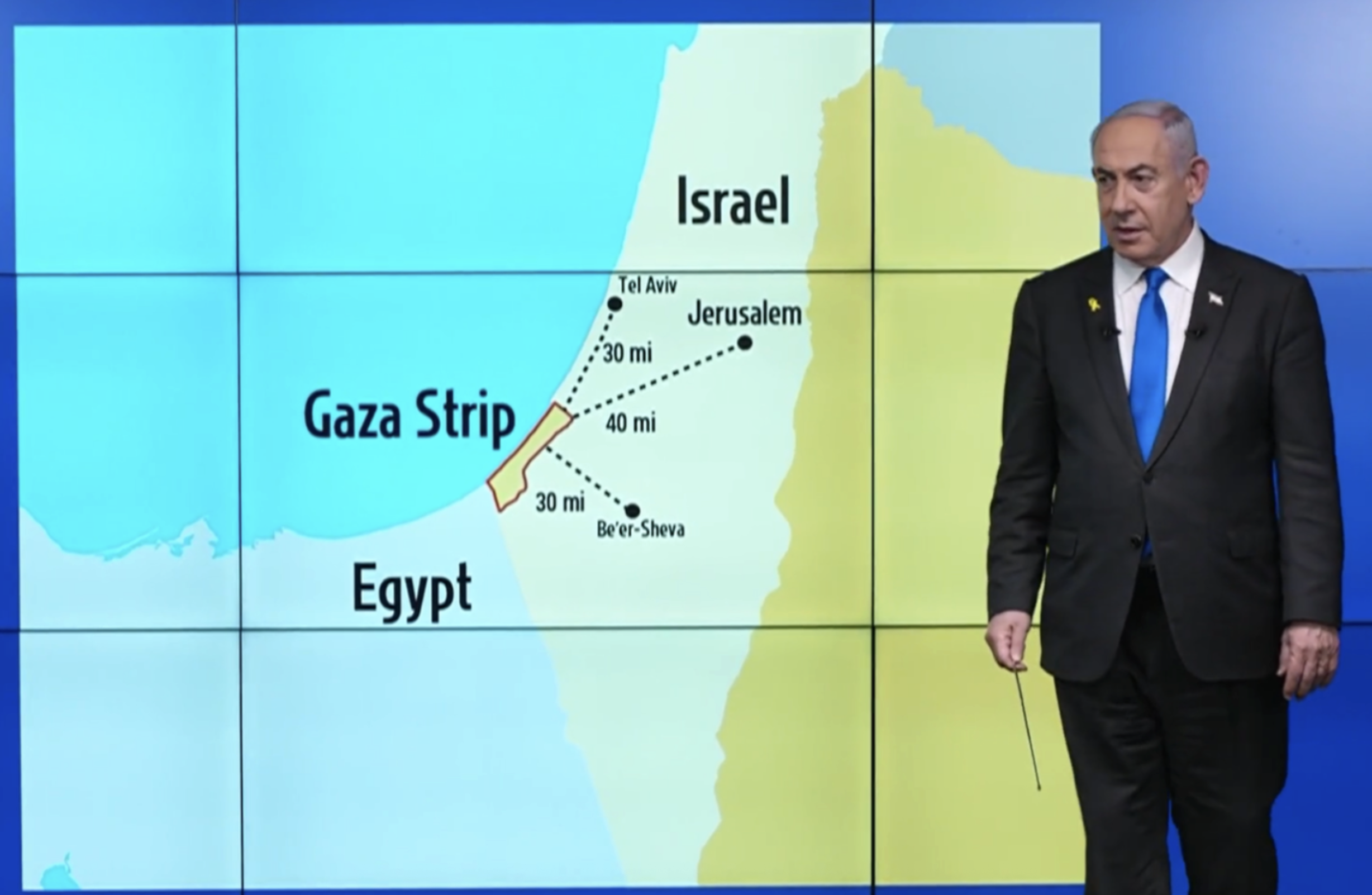
Israeli Prime Minister Benjamin Netanyahu stands before a map of Greater Israel, September 2025 source
October 7th also transformed Greater Israel from a Palestine project to a regional one. Of course, Israel has long sought to dominate Lebanon, as noted above, invading the country a half dozen times since the 1970s, each time seeking to push militant resistance out of South Lebanon, and each time discovering its re-emergence. Israel then occupied a southern strip of the country for nearly two decades after the 1982 invasion, only to discover that permanent Israeli presence in Lebanon, strengthened, rather than weakened, resistance to Israel. As the resistance grew in strength, the occupation became more costly. So costly that, by 2000, the Israeli public had lost patience and the army withdrew. Israel did not leave Lebanon out of the goodness of its heart, though, it left Lebanon in defeat.
For the next two decades, Israel and Hezbollah were in a constant state of preparation for the next round of fighting, including an all-out war in 2006. After October 7th, 2023, Israel and Hezbollah exchanged tit-for-tat fire until September 2024, when Israel exploded bombs in communication devices like pagers, killing scores across Lebanon, and assassinating Hezbollah leader Hassan Nasrallah. Israeli ground forces invaded Lebanon, but failed to occupy and hold much territory due to heavy resistance by Hezbollah forces (1,2). A so-called “ceasefire” deal was reached, one in which Israel continued to kill Lebanese and continued to occupy five military outposts in the country.
That was until the US-Israeli war on Iran. On March 2, 2026, Israel launched a full scale war on Lebanon, declaring its plans to occupy Lebanese territory south of the Litani River and issuing evacuation orders in southern Lebanon and south Beirut, displacing more than 1.2 million.Some called it a Lebanese “Nakba,” as residents of the south were told they “will not return to the area south of the Litani [River] until the safety of the residents of the north [of Israel] is guaranteed.” Later, Israel was compelled by Iranian pressure to allow at least a partial return.
Meanwhile, Israel’s Finance Minister Bezalel Smotrich declared “the Litani River must become our new border with the State of Lebanon.” Israel’s aggression in Lebanon has been moderated by the apparent US desire for a ceasefire with Iran, one which includes all fronts, including Lebanon. But Israeli attacks on Lebanon continue, and have escalated in recent days, with no sign of the US restraining Israel.
At the same time, “Greater Israel” fever is spreading across Israel. The Israeli academic Omri Abadi has made a Biblical case for retaking south Lebanon because of its Israelite and Jewish history. “Uri Tzafon,” an ultra-right Israeli activist group, is pushing for Jewish settlement in Lebanon while Israeli journalists and pundits demand that their leaders conquer the country’s south and stay there.
Greater Israel has also made important strides in Syria after the Assad regime collapsed in December 2024. Israel unilaterally declared the 1974 Disengagement Agreement void, seizing several hundred square miles of the demilitarized zone and Syrian territory, including the strategic heights of Mount Hermon and large parts of the Quneitra and Daraa governorates. Israeli forces conducted over 350 airstrikes to destroy Syria's armed forces, including its naval fleet, air defense systems, and missile stockpiles. Since August 2025, Israeli forces have carried out at least 1,672 violations inside Syrian territory, while Israeli forces are also intervening in internal Syrian affairs, backing the Kurds against the Syrian President Ahmad al-Sharaa’s forces, seeking to create a divided and destabilized country.
Now, they are waging an all-out war on Iran and trying to do the same there.
Conclusion
Israel’s military doctrine posits that no country, militia or population in the region can ever pose a military threat to Israel. Not Iran. Not the Lebanese armed forces, whose purpose is to wage a war on its own Shi’a population, not Israel. Not the Syrian armed forces, which needed to be eliminated despite al-Sharaa’s every attempt to avoid clashes with Israel. Not the Palestinian armed factions, who need to be eradicated the same way Amalek needed to be eradicated, with no man, woman, child or goat spared from the enemy population. Not even the Palestinian Authority, which recently had its funds frozen by Israel, yet which serves its Israeli masters with unwavering loyalty, can continue to exist.
Subscribe to the Palestine Nexus Newsletter: