

Between the Tent and the Blackboard: Education in Gaza After Two Years of Disruption
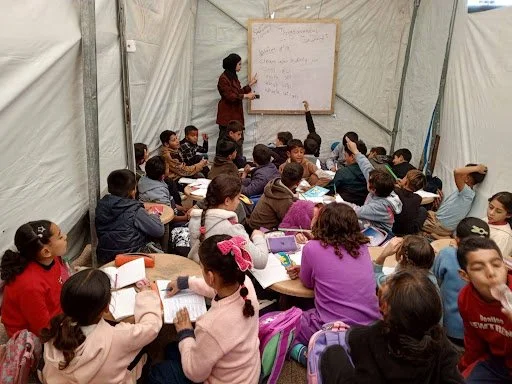
Students at the Delphine School in Gaza sit on the ground for their classes. Photo by the author.
May 8, 2026 — At the Delphine School in Dair Al-Balah, the school day starts under a white canvas. Tents held up by thin metal poles, tied down with ropes and patched in places where the fabric has worn thin, serve as classrooms for hundreds of children aged 6-12. The ground beneath is uneven, sometimes damp after rain, sometimes dusty when the wind picks up. When the weather shifts, the entire space responds, fabric flutters, poles creak, and lessons pause briefly.
Inside, a blackboard leans against the side of the tent. There are no perfect rows. Students sit close together on chairs, plastic stools or mats spread across the ground. School bags rest at their feet, and notebooks are held carefully on their small laps. Despite everything, it still resembles a classroom: a teacher at the front, a lesson in progress, a routine slowly being rebuilt.
This is what education looks like in Gaza after two years of disruption.
The Delphine School, a community-led initiative founded by Ms Olfat Abu Ramadan, emerged in January 2025 in response to the collapse of Gaza’s educational infrastructure due to Israel’s continued bombardment during a so-called ‘ceasefire’. With almost all schools destroyed or rendered inaccessible, there was an urgent need to create a space where children could learn again, even if that space had to be built from scratch and with walls made of fabric.
“We didn’t have the luxury of waiting,” Abu Ramadan Olfat told Palestine Nexus. “When schools were destroyed, we had to create an alternative immediately, even if that meant starting with tents. At first, the tents were a temporary solution. But very quickly, they became our classrooms, our only option to keep education going,” she said.
Schools in Gaza need to do a lot more than provide education. Teachers have had to rethink what it means to begin a lesson. Instead of opening directly with the material, many start with simple questions: ‘How are you feeling today? Did you sleep well?
These moments, small as they seem, have become essential because of the looming uncertainty of the future, even among the younger students.
“What is missing is the feeling that tomorrow will be the same as today,” Naya, a fifth-grade student, said. “Before, school was normal. Now it feels more important. I want to study hard because I feel education is the only thing nobody can take from us.” This awareness of both uncertainty and value has changed how students see education.
Teachers notice it in small ways: increased participation, more questions, a stronger sense of purpose. Attendance is no longer routine; it is intentional.
“When school reopened, I felt happy because I could see my friends again,” Hamza, a second-grade student in the tent school, said. “During the war, I stayed at home most of the time. I missed my teacher and our classroom. Now, when I sit in class, I feel a little safer.” For many students, that sense of safety is still fragile.
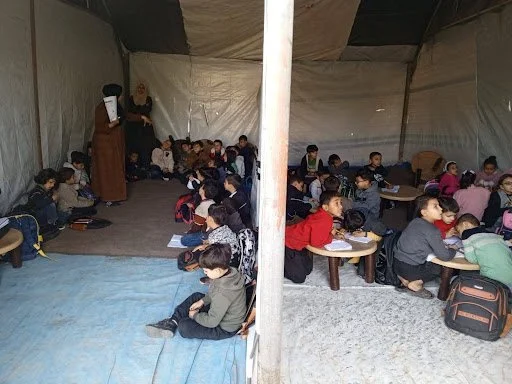
Students attend lessons in adjacent tent classrooms at the Delphine School in Gaza, where thin fabric sheets are the only separation between classes. Photo by the author.
Teachers have had to change how the curriculum is taught in these tent-classrooms. Lessons move more slowly. Teachers have to repeat themselves more often. There is space for silence, for questions, and for moments when students need to pause. Sudden noises, sometimes as small as the wind hitting the tent or something dropping nearby, can interrupt concentration. Some students pause, look up and wait for reassurance before continuing. Others try to push through, focusing on their notebooks.
“I used to finish my homework very quickly,” said Rawda, a third-grade student. “Now sometimes I cannot concentrate for a long time. I think too much. But I made a plan with my teacher. I study one subject at a time. Slowly, I am getting back to my routine.”
Another Delphine teacher, Rasha Muhammed, said that academic recovery must go hand in hand with emotional recovery. “We cannot expect students to learn the same way as before,” she said. “We have to meet them where they are.”
In some of the school’s multiple tents, the walls are no longer just fabric; they have become spaces of expression.
Drawings are pinned or taped along the sides: houses, trees, families, and sometimes scenes that reflect memories hard to describe in words. For many students in these tent schools, art has become a way to process what they have experienced during the war. Teachers encourage this. They said that it is not separate from education; it is part of it.
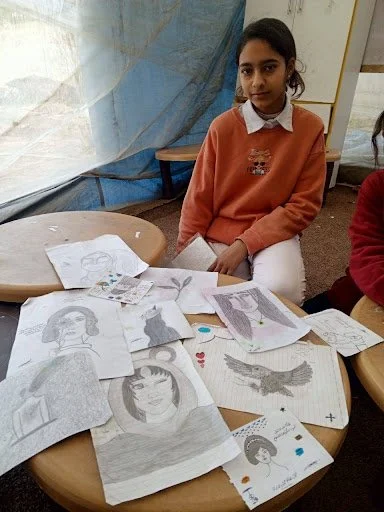
A student at the Delphine School in Gaza draws inside a tent classroom, using art to express emotions and experiences shaped by war and displacement while continuing her education amid ongoing disruption. Photo by the author.
Despite the challenges, moments of resilience appear throughout the school day.
Rahaf Sami Dawoud, a student at the Delphine School, returned after surviving an attack that killed members of her family and left her with a serious spinal injury. For a period of time, she was unable to speak due to trauma. Her return to school was not only physical, but emotional. Today, Rahaf sings during the school’s morning announcements.
Her voice carries across the tents, soft at first, then stronger. It is a moment that brings students together, not just to listen, but to feel.
In another case, four siblings who lost both parents during the war found a different kind of stability through education. Their eldest brother left school to support the family, opening a small business to provide for his younger siblings. Meanwhile, the younger children continued attending school. With access to free education and consistent psychosocial support, they were able to maintain their studies and achieve strong academic results. For them, as for many young students in Gaza, education is no longer separate from survival; it is part of it.
Parents understand this deeply. “Education has always been a priority for our family,” Om Mahmoud, mother of a student at Delphine, said. “Even during the war, I tried to keep my children reading and writing at home. Sending them back to school was not just about lessons. It was about giving them structure again, a reason to wake up in the morning.”
For many families, school represents one of the few remaining forms of stability. But that stability is not guaranteed.
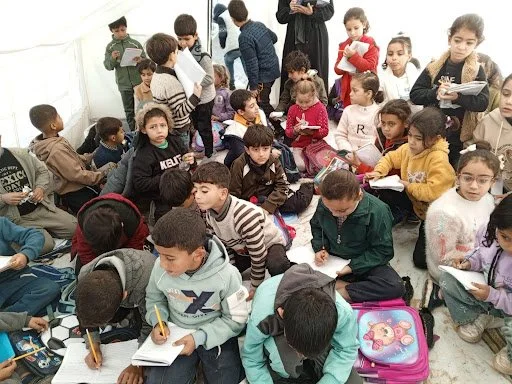
Students sit closely together on the ground inside a tent classroom at the Delphine School in Gaza. Photo by the author.
The challenges of a school like Delphine are endless, and the teachers navigate them in real time. The weather continues to affect the tents. Resources are limited. The future of these temporary classrooms is uncertain. And, needless to say, the children are struggling with mental and physical health issues after two and a half years of genocide.
During the winter months in 2025, heavy rain turned the ground beneath the tents into mud. Water seeped inside, soaking the edges of the mats and making it difficult for students to sit comfortably. Strong winds sometimes shook the structures, forcing teachers to pause lessons and secure the tent before continuing. On some mornings, volunteers arrived early to repair damage from the night before, tightening ropes or replacing sections of fabric. And yet, classes continued.
We had days when rain came in, when the wind made it difficult to continue. But stopping was not an option,” Abu Ramadan said.
Every day at the Delphine School, students return, they take their seats, open their notebooks, and begin again. Between the movement of the tent fabric and the steady sound of a teacher’s voice, something important is happening: education in Gaza isn’t simply continuing, it's being redefined. Not in ideal conditions. Not with stability. But with persistence.
Subscribe to the Palestine Nexus Newsletter: