

A Friendship That Survived a Genocide
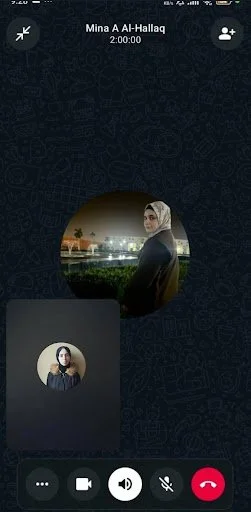
As the genocide separated my closest friend and me, we found new ways to keep our friendship alive across borders— messages, video calls, pictures, shared study routines, and memories. Photo provided by the author.
May 6, 2026 — On April 1, 2026, Minatallah called me from Egypt. Her voice relayed something I wasn’t used to hearing from her: hesitation. “Someone proposed to me,” she said.
Minatallah wasn’t sure at first. On the phone, I could still hear her thinking, weighing everything out loud. Then she told me she had prayed istikhara, a prayer for guidance. And then she said yes to the proposal.
I was the only one of her friends to know.
We stayed on the call for a long time, laughing, going quiet, then speaking again. I was in the middle of preparing for my sister’s wedding on April 6, the same day Minatallah’s engagement contract would be signed. Two major life events would unfold at the same time, in two different countries.
When I first met Minatallah Alhallaq in September 2023, we were in our first year at the Islamic University of Gaza. It was an ordinary day in Arabic grammar class. She was sitting alone, eating thyme biscuits, a calmness about her.
I was sitting with friends, explaining that I knew the university buildings so well because my father, a professor, used to bring us to work.
She turned around to look at me. “What’s your father’s name?”
“Ahmed.”
Her face lit up. “Are you Sojood’s sister? My sister Salma is her friend! And my father knows your father—they’re friends. My father is also a professor here, in the English department. His name is Ayman. He’ll teach us.”
She held out her biscuits. “Do you want some?”
I don’t even like biscuits, but I took one anyway.
Our friendship grew through the cultivation of small habits. We built a shared study routine. “I’ve never been able to do that with anyone before,” Minatallah told me. “Only with you.” We shared things most people would keep to themselves, and, even in our silences, we understood each other. “I love that we share everything,” she said. “Even the small things I’d be afraid to tell someone else, in case they think I’m silly.”
We were just settling into these habits and routines of our friendship when the genocide started.
I learned later that, on October 8, Minatallah’s family was forced to leave their home in Khan Younis. After their first displacement, they sought shelter at her grandfather’s house in Sheikh Radwan. But they were forced to move again and again—six times in total—until they ended up in tents, where food was scarce, and illness spread.
Eventually, the seventh displacement took them to Egypt, and the struggle for survival replaced everything.
I didn’t get to say goodbye to Minatallah. When she left, I had almost no internet. Days passed without connection. Then six months.
In Egypt, Minatallah continued to struggle with the basics of life: finding an apartment, buying furniture, building a life from nothing.
The ongoing genocide in Gaza affects her deeply; she has anxiety and insomnia. She never turns off her internet, afraid that something might happen at any moment.
The university announced classes would begin online, and so we resumed our study routine, using it to escape reality and structure time that had lost meaning in its emptiness. After exams, we bought snacks and sent pictures to each other. We talked of graduating in August 2026, and dreamed of the near impossibility of celebrating together, taking photos together.
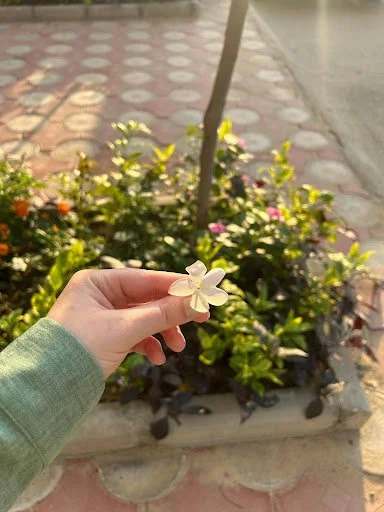
Whenever Minatallah went out in Egypt, she would always send me pictures she captured, and most of them were flowers because she knew how much both of us love them. Photo provided by the author.
We are separated by borders, but there have been moments when Minatallah has held me together without being physically present. She once told me exile is not only about borders, but about the distance from everything familiar. “Being far from the people you love is exile in itself,” I remember her saying. When the day came for her engagement contract to be signed in early April, Minatallah made sure I was there, as present as possible, despite borders, checkpoints, and the occupation. She kept sending me photos from the day: her outfit, the flowers, the details of the venue, and even the small things no one else would think to share. Voice notes filled in everything the photos couldn’t document. And, despite distance and chaos, I tried to be there in return.
From Gaza, I searched for florists in Egypt. I coordinated the delivery with Minatallah's sister, Salma, so she could place the bouquet on their table for Minatallah to find.
The arrangement was beautiful—soft pink juri roses wrapped amidst ferns and other greenery, wrapped in delicate tulle, and tied with a fuchsia ribbon. Inside the bouquet was a card filled with words from my heart, handwritten on my behalf. Signed, “Forever your friend: Taqwa Ahmed Alwawi.”
I wanted to send more than an engagement gift, more than a bouquet. What I wished for was to have been there myself.
Immediately, Minatallah took photos of the bouquet and sent me messages and voice notes expressing amazement, laughter, and disbelief. She told me that she kept looking at it, that day and the next, smiling, still in disbelief.
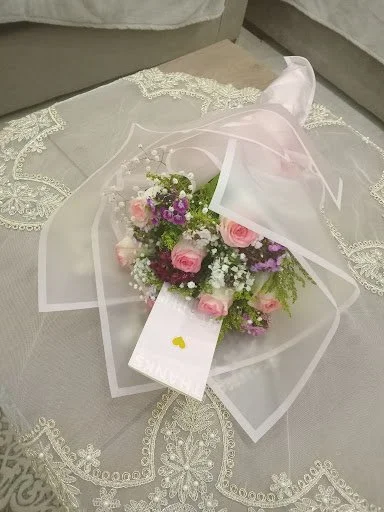
A photo taken by Minatallah in Egypt on April 8, 2026, of the bouquet I sent her as an engagement gift. Photo provided by the author.
The hardest part of our friendship is what we can’t share. We want to see each other, to be together. We want to hug, drink tea, sit in a restaurant, and go for a walk.
In Ghassan Kanafani’s “Letter from Gaza,” the protagonist leaves and returns to Gaza, calling out to his friend to come back as well. The first time I read it, I immediately sent it to Minatallah: “Come back, my friend! We are all waiting for you.” As the genocide tightens its grip, I’ve begun—half-joking, half-crying—to say instead, “Take me to you, my friend.”
“It’s okay, ya sahbi,” we tell each other—on phone calls, over text, in voice notes. “We are under the same sky and the same moon.” We repeat it often, almost like a prayer. Not because it fixes anything—it doesn’t. It doesn’t shorten the distance, or erase the fear, or give back what has been lost. But it reminds us of the friendship between us, something the genocide has not been able to take away from us.
I asked Minatallah once what she imagines it will look like when we’re finally able to see each other again. She didn’t hesitate: “We’ll go somewhere full of flowers. We’ll bring snacks and noodles, sit on the grass, eat, laugh, and talk about everything except studying.”
“And then?”
“I’ll hug you tight,” she said, “and I won’t stop crying.”
Subscribe to the Palestine Nexus Newsletter: