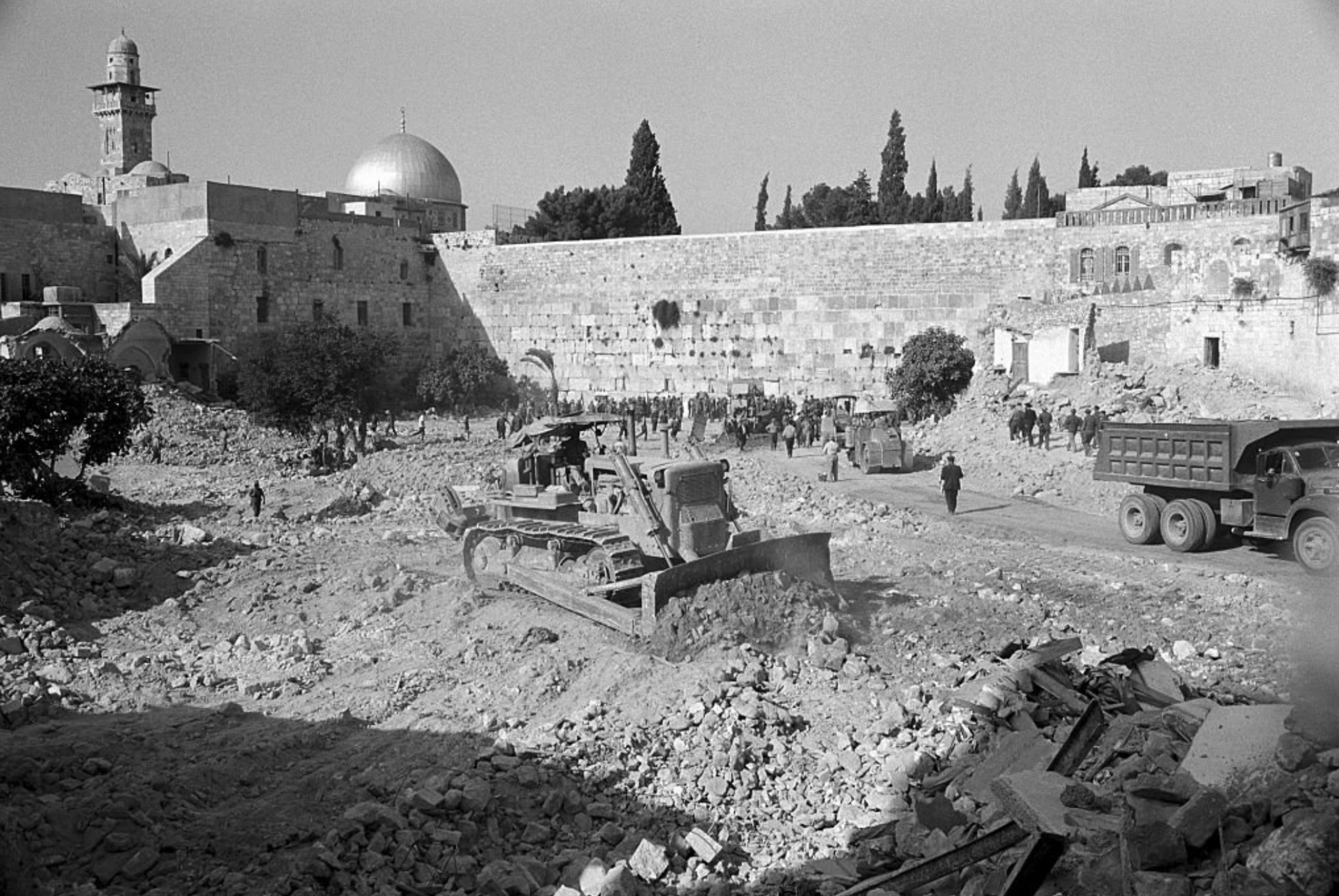
Israeli bulldozers destroying the ancient Moroccan Quarter in the Old City of Jerusalem on June 10–12, 1967 source
Introduction
In June 1967, Israel invaded and occupied the West Bank, Gaza Strip, Sinai Peninsula and Golan Heights. During and after the war, they depopulated the Golan, Latrun, Jordan Valley, Gaza’s refugee camps, and villages near Hebron and destroyed large swaths of the Golan, Qalqiya, Tulkarem and Jerusalem. Palestinians in Gaza and the West Bank were loaded onto buses with varying degrees of coercion and shipped off to the border with Jordan, where they were forced to voluntarily leave Palestine forever.
Altogether, Israel pushed out 300,000 Palestinians and 130,000 Syrians from their homes, leveling 131 Syrian villages and destroying 30 Palestinian villages, hamlets, herding communities, and refugee camps in whole or part (1, 2, 3). Israel wanted the land it conquered, just not the people living on it, the core principle of the Zionist movement, past and present. This is a brief history of Israel’s ethnic cleansing of the Palestinians and Syrians in 1967.
The Origins of the June 1967 War
Israeli leaders lamented the failure to conquer all of Palestine in 1948. “I never forgave the Israeli government under Ben-Gurion for not letting us finish the job in ‘48-49,” once said deputy prime minister Yigal Alon. Or, as Moshe Dayan put it in 1949, the “frontier of Israel should be on the Jordan [River]... present boundaries [are] ridiculous.” The feeling among many was “we had not completed the job in the War of Independence." Or, as Abba Eban once said, the map of Israel from 1948-1967 “reminds us of memories of Auschwitz.” Anyone who believed Israel ought to exist within its borders apparently also supported another Holocaust.
Israel never declared its borders after 1948 since it was unhappy with them, insisting the armistice deals resulted in armistice lines, not borders. That’s why Israel repeatedly crossed the lines, pushing Israeli control beyond the lines in Gaza, the West Bank and Syria, if at the margins. Although many Israeli leaders believed the country could realize its national aims within its 1948 borders, many also supported their expansion should an opportunity present itself. This aligned with a new military doctrine gradually adopted in the 1950s, namely, “Israel must not leave the initiative in enemy hands.” Israel had to choose the conditions and timing of the fighting.
In 1962, Levi Eshkol was elected Prime Minister of Israel, and in 1963, his deputy IDF chief of staff, Yitzhak Rabin, outlined to him Israel’s ideal boundaries: the Jordan River in the east, the Suez Canal in the south and west and the Litani River in the north. Many high-ranking army officers wanted to avenge their losses in 1948 in Jerusalem, Latrun, Bab al-Wad and other areas of the West Bank. Plans were developed to occupy Jerusalem and the Latrun area, the entire West Bank, and a separate plan to conquer Qalqilya and destroy it. There was also a plan to carry out “a transfer” in Hebron to avenge the 1929 massacre. “The idea that the IDF might actively seek to expand Israel’s borders came up repeatedly during the mid-1960s,” as one scholar put it.
On 1 January 1964, Yitzhak Rabin, now the army’s Chief of Staff, explained his military doctrine. For Rabin, the military would bring peace closer by “readying itself for war [through] a greater momentum for operational activity.” War was apparently the gateway to peace. Rabin also discussed the possibility of an Israeli preemptive strike and the need to prepare talking points to support one. He saw “‘no moral flaw in thinking that the State of Israel must be large.” It was apparently a moral flaw to think Israel should remain within its borders.
The Road to War in 1967
After the 1966 military coup in Syria, Israel repeatedly threatened to overthrow the new government in Damascus if it did not cease support for Palestinian militant groups. The Soviets, worried their ally in Damascus would fall, sent a false report to Egyptian President Gamal Abdel Nasser of an imminent Israeli threat to Syria in May 1967 to shore up support for the Syrian regime, leading Nasser to move troops into the Sinai. The Egyptian army expelled UN forces from the Peninsula and closed the straits of Tiran to Israeli shipping. Israeli and US intelligence assessments agreed Israel would destroy the combined Arab armies with ease even if Egypt attacked first.
But to Israeli leaders, this was not a crisis, it was an opportunity. The feeling among Israel’s military leadership was that Israel had a narrow window to act. Israel could transform the balance of power in the region and renew its deterrence capacity if it acted first.
After the war, Israel’s apologists claimed the country faced a threat of annihilation and had to strike first. Yet, zero Israeli leaders who went to war in 1967 believed that. The existential threat was contrived after the fact to justify the war of choice. Menachem Begin, Yitzhak Rabin, Haim Bar-Lev, Ezer Weizman, Mordechai Bentov and Matityahu Peled all confessed as much in the years after the war.
And so, beginning on 5 June 1967, Israel launched a surprise attack on Egypt and then invaded and occupied the Egyptian-occupied Gaza Strip, the Egyptian Sinai Peninsula, the Jordanian occupied West Bank and the Syrian Golan Heights. Within six days, it conquered the Sinai Peninsula, Gaza, the West Bank and the Golan, tripling the size of the country. It spent the better part of the year trying to uproot as many Arabs in the territories conquered as possible. This is a history of Israel’s crime of forcible displacement, from June 1967 to December 1967.
The Latrun
During and after the war, Israel depopulated large swaths of the territories occupied. The expulsions were born out of the wartime goal and the post-war principle of no Arabs in border areas. Israel focused on seven regions: the Latrun area, the Qalqilya-Tulkarm region, south Hebron area, the Jordan Valley, Jerusalem, the Gaza Strip and the Golan Heights. These were areas of religious, military or political significance, and so needed to remain under Israeli control forever, and so needed to be emptied. The campaigns began during the war itself and continued for weeks, months and in some cases years after the war’s end.
On June 6, Israeli forces invaded the Latrun area, the region situated along the highway connecting Israel’s two most important cities, Jerusalem and Tel Aviv. Israeli troops forcibly expelled the entire populations of Imwas, Yalu, and Beit Nuba, about 10,000 people. Palestinians were given hours, sometimes minutes, to leave and ordered by gunpoint to march dozens of kilometers eastwards towards Ramallah. “There were old men hardly able to walk, old women…babies in their mother’s arms … small children weeping, begging for water,” as one soldier who took part in the atrocity wrote. “One man was carrying a 50-kilogram sack of flour on his back, and that was how he had walked mile after mile.” As one of the victims, Nihad Thaher Abu-Ghosh recalled, they “told us not to return to our houses and threatened to kill us if we did.”
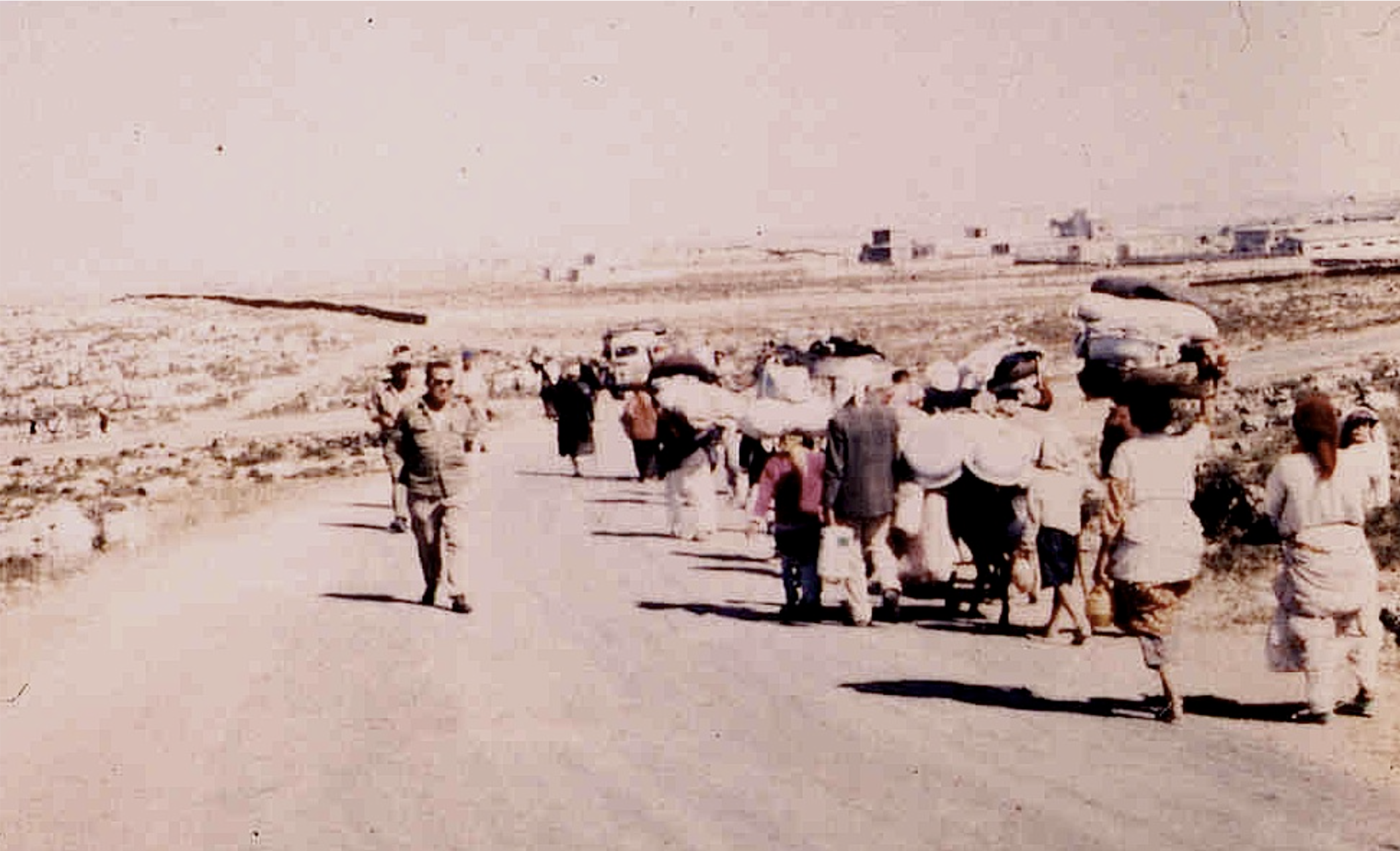
IDF soldiers expel the residents of Imwas from their village during the 1967 Six Day War.
The journey was perilous. Some Palestinians wandered for days without food or water and perished. Some eventually returned to their villages having found no other option, only to be met with gunfire. As one Israeli soldier later wrote, “we did not allow them to go into the village to pick up their belongings, for the order was that they must not be allowed to see their homes being destroyed.” He asked his officer, “why were the refugees being sent back and forth and driven away from everywhere they went?” The officer responded: “it would do them good to walk … why worry about them, they’re only Arabs?”
The towns of Imwas, Yalu, and Beit Nuba were wiped off the map. Some buildings were demolished with their elderly inhabitants still in them. The land was appropriated by Israel, the rubble was cleared and the area forested by the Jewish National Fund (JNF) of Canada. The goal was to cover up the crime scene and create a fait accompli to ensure no diplomatic pressure could result in return. Today, the area is a popular picnic destination.
The West Bank
Qalqilya, home to 15,000 Palestinians, and Tulkarm, home to 25,000 Palestinians, were also targeted for demolition, not just because they were border towns along the Green Line, but also because they lie at the country’s narrowest stretch of land. There were simply too many Palestinians concentrated too close to Israel for Jewish comfort. Their very existence posed a problem for Israel’s security doctrine, which, as noted, called for Jewish-only border areas.
And so the Israeli army stormed Qalqilya in the early hours of June 6 after a night of artillery shelling and aerial bombardment, driving out thousands eastward towards ‘Azzun and Nablus. The army compelled the mayor to call on the remaining residents to gather at the municipal square, where they were ordered onto buses, expelled to various cities in the West Bank and forced to listen to the infamous anti-colonial song of defeat, “Tell the sun not to shine so brightly.” Israel then tried to dump them across the Jordan River but encountered Jordanian resistance.
For the next five weeks, Israeli bulldozers reduced Qalqilya to rubble, demolishing homes, shops, bakeries, wells, schools, the police station and the municipality. Between 40%-66% of the city’s 2,000 dwellings were either demolished or set ablaze, including homes with elderly or disabled people unable to evacuate. The kibbutzim near Qalqilya pressured Eshkol to empty the town entirely, while Israeli authorities proposed building a camp near Nablus for its refugees.
Minister of Finance Pinchas Sapir objected on the grounds that Qalqilya would probably be part of Israel soon enough anyways. “It will create a lot of noise,” he warned, and for nothing. He was correct on both accounts: both Nablus and Qalqiya remain under Israeli control to this day, while the fate of the Qalqilya refugees was raised by the Soviet Union, the US and the UN. Israel heeded to the pressure and begrudgingly allowed about 9,000 residents to return a few weeks later (1, 2).
The Israeli military shelled the Tulkarm for days and then invaded the city, expelling about 7,000 people. “The earth shook like an earthquake,” Ghuzlan Yusuf recalled, who lived through the assault, as “the firing didn’t stop all night.” She said we wouldn’t “dare lift our heads up and look out the window because we were afraid we would be hit. Those were the most frightening moments of my life because I was afraid they would come in and kill us indiscriminately.” On June 9, in the morning, Israeli soldiers went door to door, entering homes and ordering families to the town center. “‘Each one of them was carrying a machine gun and hand grenades, so we got out,” Ghuzlan said.
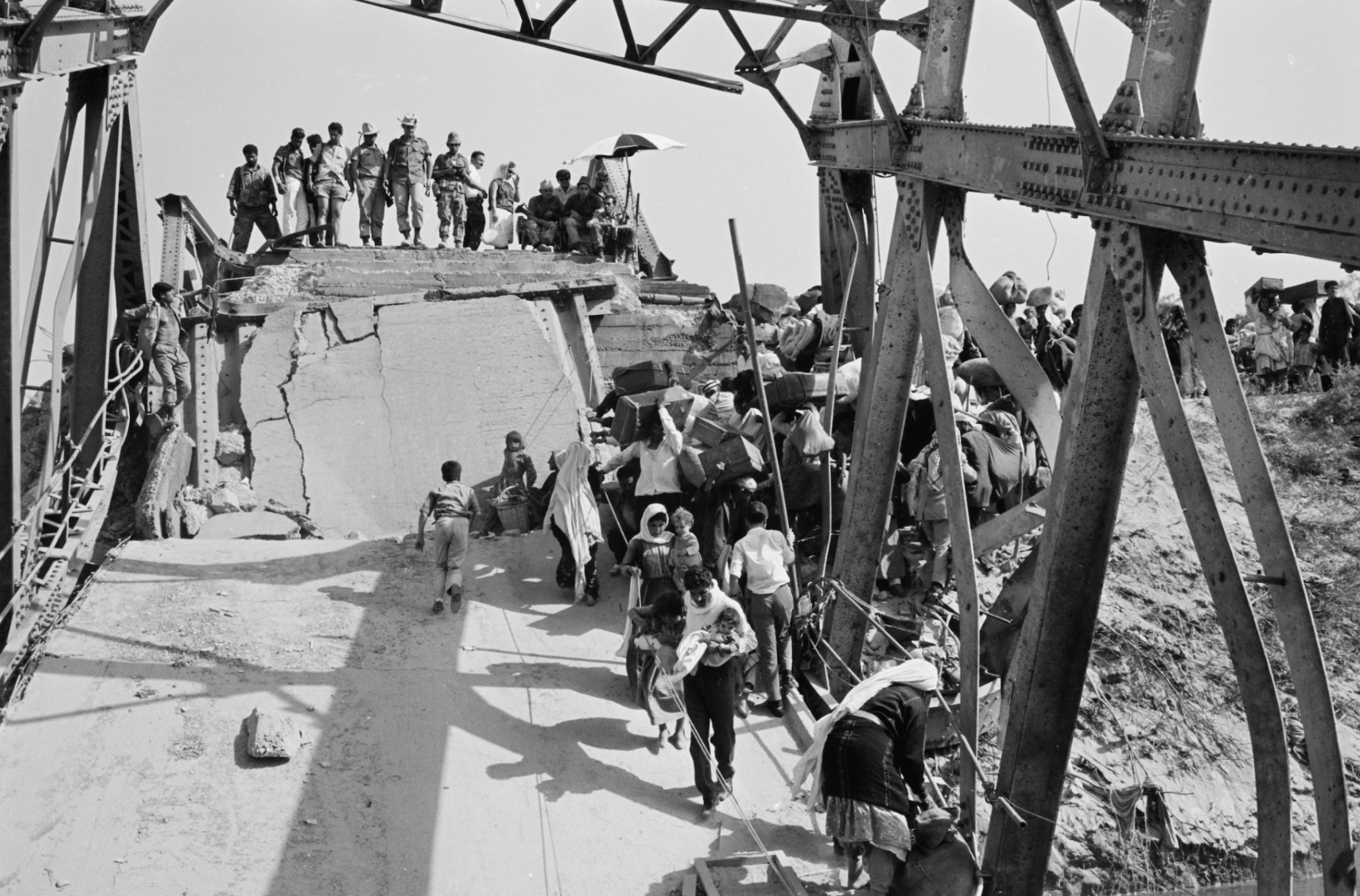
Hundreds of thousands of Palestinian refugees fled to Jordan, including many across the Allenby Bridge, seen here destroyed after Israeli bombing. 1967. Source
Israeli soldiers loaded them onto buses and drove them to the border with Jordan. Israeli war planes had bombed the bridge, though, forcing Palestinians to climb across the dismembered concrete. “I remember seeing a family where the young men were carrying their grandmother on a blanket,” Ghuzlan recalled. “We saw people from wealthy families in a very poor state … it was desperate. Lots of people were walking around the country looking for relatives who got lost along the way.” A French journalist described “terrible scenes of thousands of refugees fording the river Jordan with their livestock under the indifferent eyes of the Israeli soldiers.” The refugees were in “appalling” condition, “at the end of their tether.”
The Israeli military went on an expulsion and demolition spree throughout the West Bank border areas. In many villages, residents took shelter in caves, orchards or villages in the mountainous interior and were met with Israeli force when they tried returning home. Israel turned the village of Nabi Samu'il, north of Jerusalem, into a military base, telling its residents they would not return. On 16 June, the villages of Beit Awa, with its 2,500 inhabitants, and Beit Mirsim, with a population of 500, were forcibly expelled. The Israeli army occupied Habla and expelled its inhabitants in late June to Rafdiyah, near Nablus, later blowing up homes in the village, including the mosque. al-Burj was destroyed on 28 June; and Jiftlik, home to 6,000 Palestinian refugees, was completely erased in late November 1967, with army bulldozers razing 800 buildings in two weeks. The village of Nusairat was also demolished and a large area along the Nablus-Amman road up to the Jordan River evacuated.
The Jordan Valley
The epicenter of the forcible expulsions in Palestine, however, was the Jordan Valley. Recall that the Jordan Valley’s land mass was expansive, its soil rich, location strategic and Palestinian population small. It provided “maximum security and maximum territory for Israel with a minimum number of Arabs.” It was a part of historic Palestine and a buffer zone with Jordan without too many Palestinians in it. It was a match made in heaven for the Zionist project, which is partly why Palestinians in the Jordan Valley have been living on the front lines of Israel’s forcible expulsion efforts for decades.
And so, on June 19, 1967, one week after the war, Israel’s cabinet decided to demarcate the Jordan River as Israel’s eastern border, while the adjacent Jordan Valley, which constituted more than half of the West Bank, would remain under permanent Israeli control. That put Palestinian refugees in the Jordan valley in a triple whammy: they were refugees, and thus, automatic targets for dispersion, they lived in a border area, but not just any border area, the one Israel decided a week after the war it would keep forever.
And so Israel emptied out the Jordan Valley’s refugee camps of ‘Aqbat Jabr, ‘Ayn al-Sultan, al-Nuway‘ima and al-‘Ajajra, home to more than 120,000 Palestinians. Israel bombed the area extensively with napalm, triggering mass flight. One woman, describing her state of mind during the assault, said that she "picked up a pillow instead of a child." The Israeli army mounted loudspeakers on cars blasting out calls to leave. Israeli helicopters flew overhead dangling dead Palestinian bodies as a scare tactic, while Israeli soldiers dynamited Palestinian homes to incentivize flight. By September 1967, many tens of thousands had crossed into Jordan.
Israel also expelled two-thirds of al-Jiftlik, in the northern Jordan Valley. Jiftlik native Mohammad Masa’eed was displaced with his three brothers and their families to the Jordanian village of Ma’addi. Although Masa’eed was one of the lucky few allowed to return home, his brothers were not. When he returned to al-Jiftlik, Israeli soldiers ordered him to mark the windows of his homes with white flags. Then, within days, Israeli forces demolished all buildings in the town without white flags, about half the village. By the year’s end, Israel had expelled some 88% of the population of the Jordan Valley. Most would never be allowed to return.
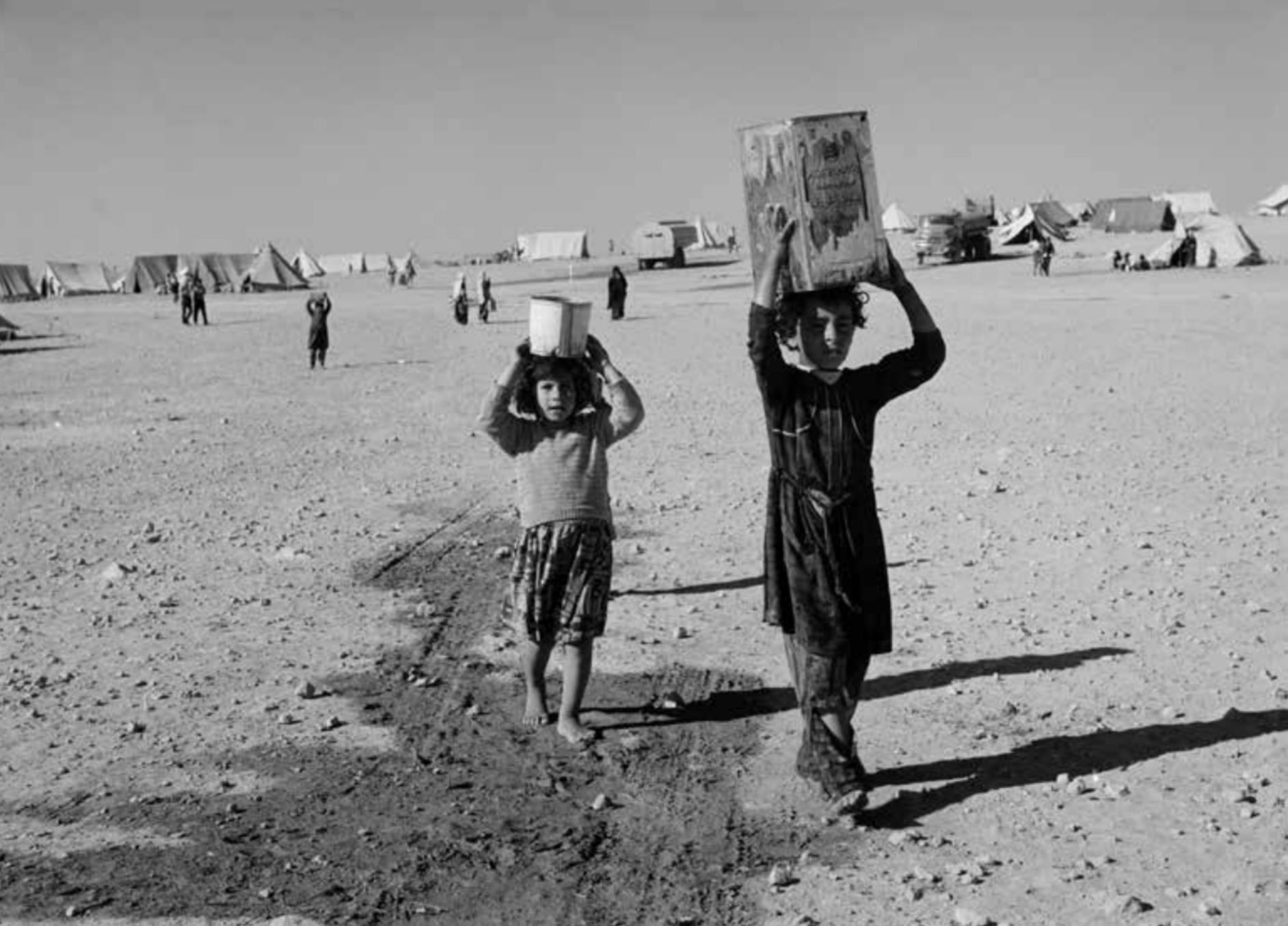
The Wadi al-Dulayl camp, an emergency camp set up by UNRWA in Jordan to accommodate the refugees displaced from the West Bank, 1967. source.
Jerusalem
Since the late 19th century, the Zionist movement had sought to take over the Moroccan neighborhood of Jerusalem and expel its residents because of its close proximity to the Western Wall, the Jewish holy site. The dream came to fruition on June 10, 1967, only hours after a ceasefire was declared. Jerusalem Mayor Teddy Kollek ordered 650-1,000 Palestinians living in the Moroccan neighborhood of Jerusalem to evacuate their homes, given only a few hours. Israeli bulldozers then worked around the clock to level the entire neighborhood, destroying 135 houses, two mosques, and several religious shrines. At least one elderly woman, Rasmiyya Tabaki, was reportedly buried alive in the rubble because she did not hear the evacuation order.
Then, on June 19, Israel’s cabinet decided to annex Jerusalem, including some seventy square kilometers of the West Bank, later called East Jerusalem. After the war, Israeli occupation forces imposed curfews and arbitrarily detained Palestinians throughout Jerusalem, pushing out another 5,000-7,000 from the city, or about 7% of the population. Israeli forces then expelled another 4,000 Palestinians from the Jewish Quarter of Jerusalem, replacing them with Jews, and continued to deport prominent residents of Jerusalem, Ramallah and elsewhere in late 1967, including ‘Abd al-Hamid al-Sa’ih, Ruhi Alkhatib, Sheikh 'Abdul-Hamid, Faiq Warrad Beitin, Ibrahim Bakr al-Mazra'a al-Sharqiya, Kamal Butros Nasir and many others (1, 2, 3). Israel then conducted a census to determine who would be provided a “Jerusalem ID.” Some 26,000 Palestinians, about 37% of the population, happened to be outside the city at the time of the census and lost the right to live in their own city.
But Israel had grander post-war plans. For weeks, Israel provided free bus service from Jerusalem and other parts of the occupied territory to the border with Jordan. “For days and weeks, lines of buses ran from the Damascus Gate [in Jerusalem] to the Allenby Bridge [on the River Jordan],” as Israeli President, Chaim Herzog, revealed publicly and proudly years later. The buses were labeled “To Amman -- Free of Charge,” itself untrue, as Israel offered transportation to the border with Jordan, not to Amman.
Those departing were required to sign documents stating they were leaving of their own free will. A payment of 50 Israeli pounds, or $14, was made to each family that “agreed” to leave for Jordan. Nevermind that Palestinians were departing under the boot of an invading and occupying army, the same army that violently expelled them from their homes less than two decades ago.
The process of bussing Palestinians to the border itself involved coercion. "There were also not a few people who were simply expelled,” an Israeli soldier confessed. “We forced them to sign. They did not want to leave, but were dragged from the bus while being kicked and hit by revolver butts. By the time they arrived to my stall, they were usually already completely blurred at this stage and did not care much about signing. It seemed to them part of the process.”
The Israeli soldiers turned violent in cases of disobedience. “When someone refused to give me his hand [for fingerprinting] they came and beat him badly,” the same Israeli soldier reported. “Then I was forcibly taking his thumb, immersing it in ink and finger printing him. This way the refuseniks were removed. . . I have no doubt that tens of thousands of men were removed against their will.” Nothing screams “voluntary decision” quite like a beating if you say no.
Some Israeli leaders obsessed over the departures. Finance Minister Pinhas Sapir would phone the Israeli General ‘Uzi Narkiss “twice a day” asking, “how many [Palestinians] got out today? Is the number of the inhabitants of the West Bank diminishing?” He was worried because the number of Palestinians boarding the buses declined from 600-700 a day in the first few weeks to only a few dozen a day, with the operations ceasing within two or three months.
Israel established a process to allow some refugees to return from Jordan. It was just enough legal cover to shield Israel from accountability and to ensure the vast majority would never return. Only 7% of the 200,000 refugees displaced to Jordan were able to return home.
The Gaza Strip
Israel occupied the Gaza Strip on June 6, 1967 and decided less than two weeks later it “would be annexed to Israel once the number of refugees there was significantly reduced by transfer to other locations of countries." “Transfer” was Israel’s term for forcible displacement dressed up as voluntary departure. A consensus emerged after the war that “the Gaza Strip should never again be separated from the State of Israel,” as one Israeli diplomat later put it. Even Mapam, Israel’s “far-left” party, announced its opposition to returning the Gaza Strip to Egypt. That meant a solution was needed for its Palestinian refugees.
At first, Israel used brute force, expelling many thousands, particularly in Gaza’s largest refugee camp, Jabalia. The Israeli army rounded up men there and herded them into the Jaffa school, as one eye-witness described it. “Two local elders were asked to tell the soldiers each man’s profession – ‘he’s a labourer, that one’s a teacher and so on.’ The Israelis picked out the ones they wanted, put them on trucks and sent them to Jordan.” In other cases, the army would arrive in the early morning, and grab random young men from the streets. “We never saw those young men again. As soon as the work had been done, their identity papers were confiscated and they were forced to cross the canal into Egypt.”
The forcible expulsions were accompanied by military policies designed to minimize the number of Palestinians eligible to become subjects of Israel’s occupation regime. In September 1967, Israel conducted a census in the occupied territories to determine who would have the right to be occupied. Muhammad N., for example, born and raised in Gaza, was studying at the University in Cairo at the time of the census. “My father told me that when the [Israeli] soldiers came, he said that I was studying in Egypt … the soldier said, ‘So forget about him, he’s not here.’” The census counted some 954,898 Palestinians, but excluded some 270,000 not present, either because they were forced out or fled during the fighting or happened to be abroad for whatever reason. Those not present at the time of the census were denied the right to return home.
Meanwhile, Israeli authorities also offered free bus rides from Gaza, across Israel and the West Bank, to the Jordanian border. The deportations had a material impact on the population size of the Gaza Strip, which fell from 450,000 on 1 June 1967 to 346,000 in December 1967. The efforts to depopulate Gaza continued in 1968 and beyond, discussed here.
The Golan Heights
Israel began bombarding the Golan Heights on June 8 and invaded on June 9. The Israeli army used napalm against multiple Syrian villages and ransacked Qunaytra, causing 35,000 of the 139,000 Syrians in the Golan to flee the violence. Then, over the next six months, Israeli forces violently expelled another 95,000 Syrians, demolishing entire villages, denying residents food and water and threating to torture or execute anyone who refused to leave. The Syrian refugees were forced to leave behind everything: their shops, sheep and goats, household possessions, homes, vineyards and apple trees. Only about five percent of the population, about 6-8,000 Syrians, remained in six villages. It was the most complete of all Israel’s campaigns of forcible displacement during and after the war.
The Expulsion Debate in 1967
After the war, Israeli leaders debated which Palestinians to focus on expelling and where to expel them to. Gaza was the focus of discussion. A consensus emerged around depopulating Gaza, rather than the West Bank, because Gaza was a much smaller territory with a smaller population, making it easier to depopulate. In matters pertaining to ethnic cleansing, feasibility was key. Moreover, more than 60% of Gazans were refugees, compared to less than half in the West Bank, and Israel was totally obsessed with the refugees. Gaza also bordered Egypt, Israel’s greatest military rival.
Recall that, only two decades earlier, Gaza’s refugees were expelled from their homes just across the border. Israel stripped them of their means of livelihood and confiscated their property, land, animals, books, manuscripts, furniture and bank accounts. They were now stateless and separated from their families. They had just spent the better part of two decades in abysmal conditions without political rights, freedom of movement or economic opportunity. They wanted to return home, and that was and is their right under international law. That’s why Israel desperately wanted to expel them.
And so Israeli leaders debated how to make Gaza’s refugees refugees once more. One of Prime Minister Eshkol's favorite ideas was to compel Jordan to accept their forcible transfer to the West Bank in return for a partial return of that territory on condition it remain demilitarized. Yigal Allon, Minister of Labor, and Menachem Begin, Minister without Portfolio, suggested al-‘Arish, in the northern Sinai in Egypt as a suitable option. Pinhas Sapir, Minister of Finance, Ze’ev Sherf, Minister of Commerce as well as Eshkol himself also entertained more distant destinations. Many of these were later pursued in 1968 and beyond.
There was a consensus on encouraging Arabs to emigrate. A bureau was established to manage the “transfer” and was active from 1967-1971, compelling tens of thousands to leave. Eshkol emphasized the whole matter should be dealt with “quietly, calmly and covertly,” another core tenet of Zionism, what I called doing Zionism quietly.
The Israeli general public also weighed in. Economists proposed 250,000 Palestinians in Gaza be relocated to the West Bank over a longer time horizon. Yosef Weitz, one of the key architects of the 1948 Nakba, wrote an article in the newspaper Davar entitled “On the Necessity of Expelling All Palestinians” in September 1967, arguing that the country could not accommodate both Jews and Arabs together, and Arabs therefore had to be expelled, with the exception of Bethlehem and Jerusalem (1, 2). Alas, perhaps dragging priests and monks out of the Church of the Holy Sepulchre would have been a spectacle too damaging even for Weitz.
Analysis
Israel’s expulsion of the Palestinians in 1967, just as the Nakba before it, was not a single incident, but it was and remains an ongoing process. The process began on the first day of the war, continued during the weeks and months after the war and fizzled by the early 1970s.
Of course, the process had to ensure those expelled never returned. That required border fortifications and a surveillance regime to monitor Palestinian movement forever. Call it the domination trap.
And so those who tried to slip back in without permission were either deported again, if they were lucky, or shot dead on the spot, as was the case after the 1948 War. From June to September 1967, more than 1,000 were arrested and deported trying to cross the River Jordan westward, while 146 people were killed (1, 2).
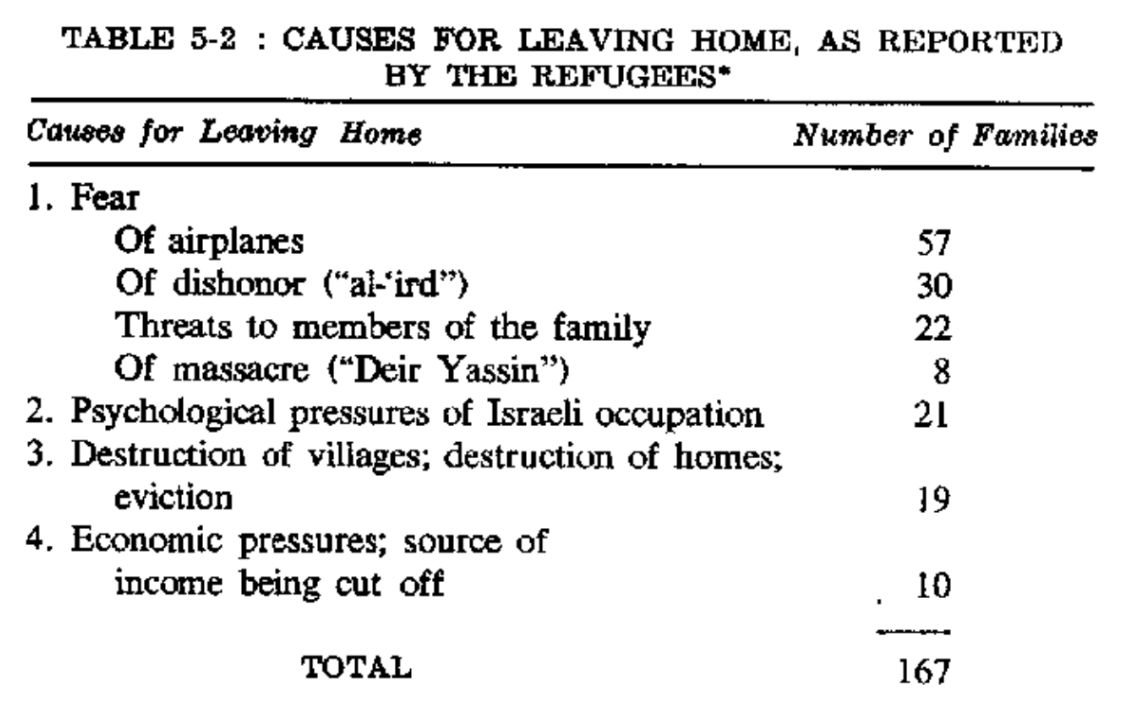
In 1968, two researchers interviewed hundreds of Palestinian refugees in Jordan to better understand the cause of the flight. Refugees who encountered Israeli soldiers described a reign of terror and violence which led to their exodus. Some 15% reported they had relatives who were injured or killed by Israeli forces. Many reported Israeli bombs dropped from warplanes, the eviction of civilians from their homes, looting, the destruction of houses, the rounding up and detention of male civilians, the deliberate shaming of older persons and women, and the shooting of persons suspected of being soldiers or guerrilla fighters. Only 8% of the refugees interviewed described the behavior of the occupying Israeli forces as neutral.
By December 1967, Israel had moved 800 settlers into 10 settlements in occupied Palestine and built settlements in the occupied Golan Heights. Today, there are nearly a million Israeli settlers spread out across hundreds of colonies conquered through the 1967 War.
Shortly after the war, Israel’s security cabinet determined that official Israeli maps would no longer be marked with the Green Line, but rather with the new, post-war cease-fire lines. As Israeli Prime Minister Levi Eshkol put it, Israel would never return to the pre-June 5, 1967, situation. Here we are, 59 years later.