Gaza is Too Graphic For Community Standards
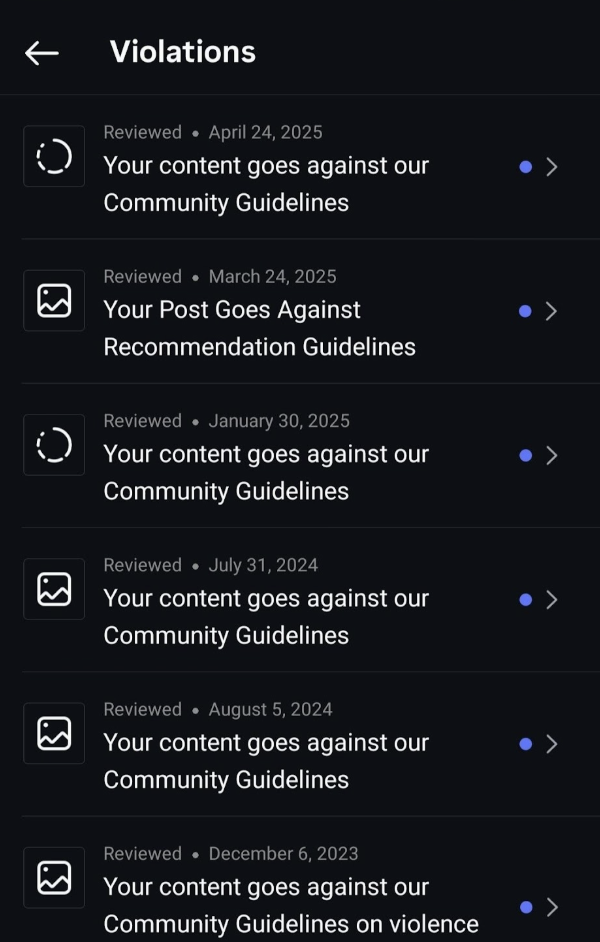
Screenshot of Meta’s “Community Guidelines”
On January 30, 2025, I uploaded a video to Instagram I filmed in Gaza showing a mother sitting beside the bodies of her children after an airstrike. She was not screaming. She was silent in a way that felt heavier than any sound. Within minutes, the post disappeared from both Instagram and Facebook. The notification read: “This content violates Community Standards on graphic violence.”
There was no context in the message, no acknowledgment of where the video came from, and no distinction between documentation and harm. Only erasure. And then, silence.
On social media platforms, freedom of expression is promised as a universal right wrapped in friendly interfaces and pastel-colored notifications.
A story was removed for being “too graphic.” A post was restricted for “sensitive content.” A warning arrived seconds after I uploaded a video, before anyone could possibly have reported it. At first, I thought the problem was technical. A glitch. A temporary misunderstanding between my words and the machine reading them. That it would correct itself, but it never did.
According to Human Rights Watch, Meta has systematically restricted Palestinian content across Instagram and Facebook, documenting over 1,050 cases of censorship across more than 60 countries. The report identifies recurring patterns including content removals, account suspensions, reduced visibility, restricted live features, and “shadow banning”—often without notification or meaningful appeal mechanisms. Social media, which once promised to amplify marginalized voices, becomes instead a system that quietly filters them out.
This practice is known as shadow banning: a form of invisible censorship where content is not explicitly removed, but its reach is reduced without informing the user. Your post still exists. Your account still functions. But your voice does not travel. There is a particular kind of violence in being allowed to speak while not being heard, in watching your words disappear into algorithmic silence while other narratives circulate freely.
Over two years, I watched journalists, activists, and ordinary Palestinians lose accounts precisely when violence escalated—when documentation mattered most. Livestreams were cut. Posts were removed. Reach was restricted. At the same time, reports have documented how openly dehumanizing or violent rhetoric against Palestinians often remains online without comparable enforcement. This imbalance raises questions not only about moderation, but about whose grief is made visible and whose suffering is erased.
I, too, treated social media as a witness, as a space where truth could survive even when the physical world was collapsing. It took me two years of posting, seeing my photos and words deleted, reposting them, and watching them disappear again to understand that some voices are muted precisely for revealing unwanted truths.
What it did instead was train me. Slowly, quietly, efficiently, I was told which images were forbidden, which words carried risk, which truths needed to be softened or disguised to survive. It taught me that a destroyed home must be blurred, that a dead body must be cropped, that grief must be abstracted into language so vague that it no longer threatened anyone. I learned that naming genocide and ethnic cleansing in Palestine is not the same as naming it elsewhere, and that clarity, in this digital ecosystem, is treated as provocation.
Meta has stated its moderation system is neutral and policy-based, yet independent investigations and human rights organizations have repeatedly challenged this claim, pointing instead to uneven enforcement patterns that disproportionately affect Palestinian users.
Meta insists that so-called neutrality is designed to protect users. Violence is not allowed. Graphic content must be removed. Dangerous organizations must not be promoted. These guidelines, when read in isolation, sound compassionate and necessary, even. But experiencing them while documenting genocide reveals their true function: They do not remove violence; they remove context. They do not protect users; they protect comfort. They do not silence everyone; they silence selectively.
Over time, I learned that certain words triggered the censor. “Occupation,” “apartheid,” and “genocide” when paired with Palestine, were treated as violations. The message was clear: the system of violence itself should not be named. Only its aftermath can be shown, garbed in necessary filters, not its structure.
One of the most violent outcomes of this system is how it strips meaning from suffering. Palestinian pain is treated as excessive, indecent, inappropriate for public consumption. A ruined home is “too much.” A dead child is “graphic.” A body becomes a violation of community standards. A statistic, however, is acceptable. A vague headline is safe. An aerial image from far away passes moderation with ease. The body must disappear for the story to remain. And when the body disappears, so does accountability.
We have been witnessing a livestreamed genocide—documented in real time through social media platforms where images, videos, and testimonies from Gaza circulate globally, even as they are repeatedly filtered, delayed, or removed. For the first time in our generation, mass violence and ethnic cleansing of this scale have not only been reported after the fact but recorded as it unfolds, frame by frame, post by post.
Journalists such as Bisan Owda, Wael Al-Dahdouh, Plestia Alaqad, Anas Al-Sharif and others have used social media as a primary archive of survival, turning their phones into tools of testimony when international media access was heavily restricted. Their presence reveals a contradiction: even as platforms attempt to regulate and suppress content, they remain one of the few spaces where fragments of reality still break through.
The internet was once imagined as a digital version of a public square, a place where marginalized voices could bypass traditional gatekeepers. For Palestinians, this promise briefly felt real. Smartphones turned civilians into witnesses. Social media became a lifeline when borders were sealed, journalists were barred, and electricity was cut. For a moment, it felt like truth could travel faster than bombs. But as platforms grew more powerful, so did their control.
There is something absurd about being told that footage of your destroyed neighborhood violates community standards, while the destruction itself continues uninterrupted. Something darkly funny about an app warning you that your post about a massacre is “too violent,” as if the violence begins with the image and not the act. The platform is offended—not by death, but by its documentation.
What we are witnessing is not a failure of content moderation. It is its success. Platforms are doing exactly what they were designed to do: minimize disruption, protect dominant narratives, and ensure that certain truths remain inconveniently invisible. Freedom of expression in the digital age often feels like an apparition. Bias, omission and suppression is not a bug. It is a feature.
And still, Palestinians continue to speak. Even when posts are deleted. Even when reach is reduced. Even when words vanish into algorithmic silence. Because for those living through violence, speaking—even into emptiness—remains an act of defiance.