

Finding a ride in Gaza: the collapse of transportation
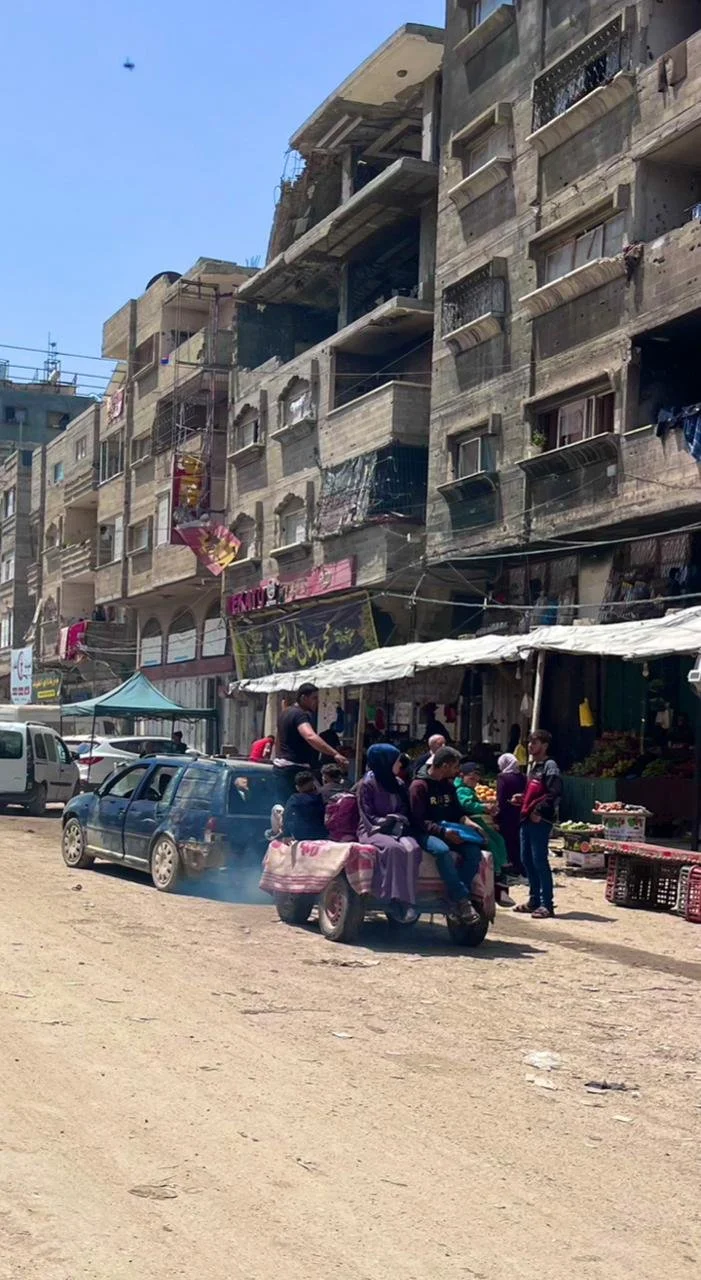
Passengers crowd into the back of a vehicle as transport shortages force many Gazans to travel in unsafe and overcrowded conditions. Photo courtesy of the author.
June 14, 2026 — On a February afternoon this year, I was on my way to visit my sister, Heba, in Deir al-Balah. I was going to check on her three-year-old daughter, Zeina, who had been sick for days, when I noticed an elderly woman. She looked exhausted, as if she might collapse at any moment.
“Are you okay, khaltu?” I asked her.
“I went to the clinic to get my blood pressure medication, but now I do not know how I will get back. I cannot walk,” she said in Arabic. “I have been standing here for an hour and a half, waiting for a car to take me home.”
For us in Gaza, transport has become a daily struggle shaped by economic collapse, fuel shortages, and damaged infrastructure as Israel continues to bomb the enclave.
A United Nations Satellite Centre report concluded that 77% of the total road network has been damaged (including destroyed, affected roads and roads restricted by obstacles), across the Gaza Strip, based on images collected through September 2025.
This disruption can be seen across multiple major thoroughfares and streets in Gaza. At around eight in the morning, Al-Mawasi al-Qarara Street should be bustling with movement. People heading to their daily routines, a patient trying to reach the hospital to follow up on their condition, an employee on their way to work, and others simply trying to get through their day.
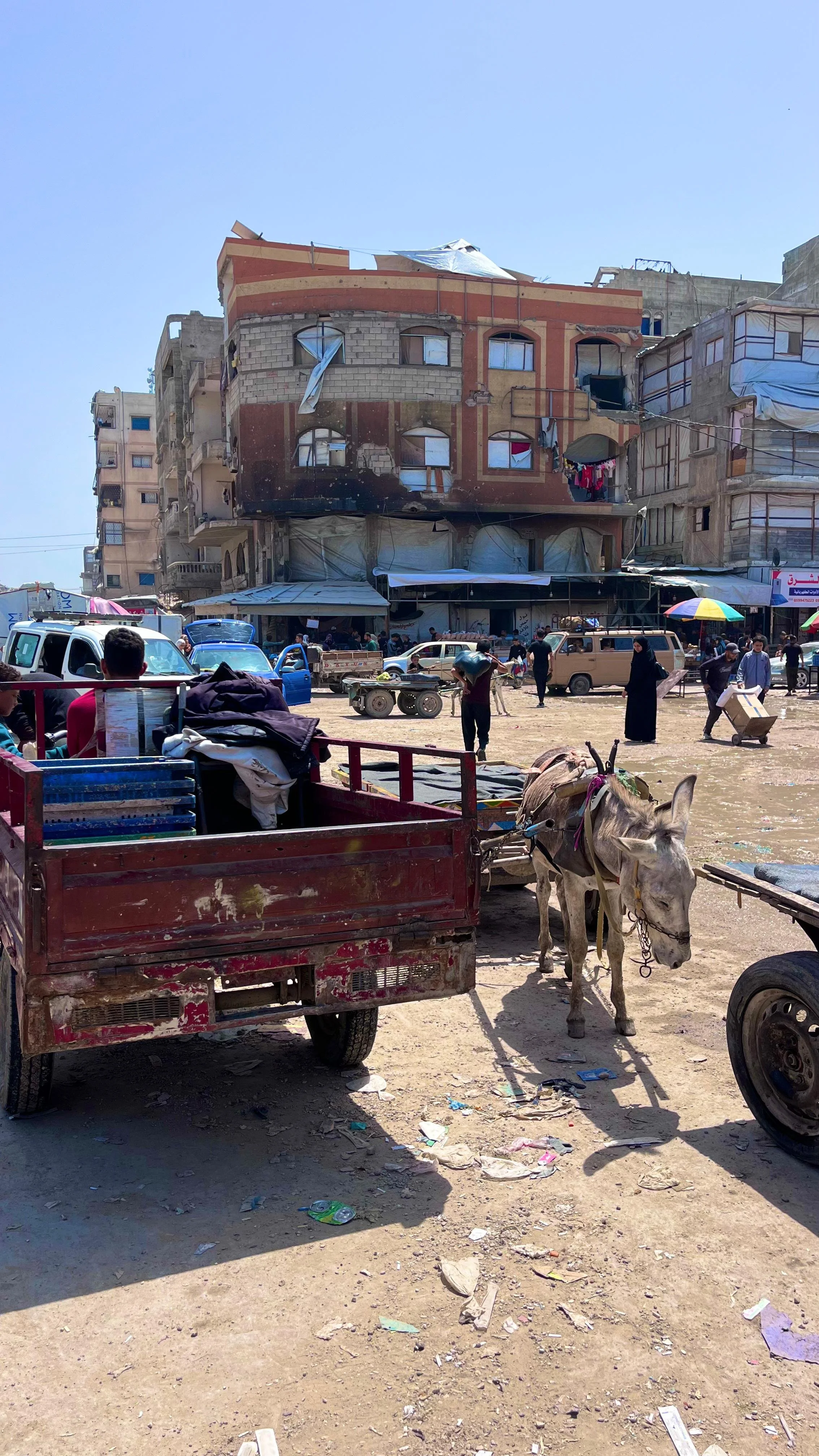
Tuk-tuks and donkey carts have become essential means of transportation in Gaza amid fuel shortages, damaged roads, and the scarcity of public transport. Photo courtesy of the author.
I stand by the roadside, like dozens of others, waiting for one of the few remaining shared taxis (private cars operating informally as transport), or tuk-tuks to stop, watching every vehicle with the same silent question: Will this one stop?
Most of us wait for shared taxis or private cars that now work as informal transport, since public transportation has become scarce and unreliable.
Sometimes, it takes over an hour. On worse days, two.
There is no system anymore; no schedule, no guarantee. You simply wait. Men, women, elderly people, and children stand along broken pavements or dusty roadside edges, scanning the horizon.
‘It feels suffocating’
I met Mahmoud Ajrami, a 42-year-old father of three, at Al-Ahramat Street in Deir Al-Balah, where he was waiting for a means of transport for nearly an hour and a half. “If I do not find a car soon, I will miss my shift completely,” he said.
On al-Nasr Street, one of Gaza’s most familiar and widely used roads, this change is impossible to ignore.
It used to be full of life, taxis moving constantly, students crossing from one side to the other, people going about their day.
Just a week ago, I went to visit my friend Amira, and I could not find any transport to take me. The damage to the road had made movement extremely difficult, and cars were either unavailable or unable to pass through certain areas.
I ended up walking instead under the sun, navigating uneven and rough paths with piles of rubble and craters that cut through the asphalt.
In some places, the road is barely recognizable under layers of dust and debris left behind by over two and a half years of Israeli bombing.
When a car finally stops, there is no calm or order, only urgency. People move quickly, sometimes pushing forward, trying to secure a seat before it is gone.
If you manage to get in, the struggle does not end; it simply changes form.
Vehicles are overcrowded beyond their intended capacity. A front seat meant for one person now carries two. The back seat, designed for three, holds four. A car that should carry four passengers ends up carrying six.
Bodies press tightly against each other. There is barely space to move, barely space to breathe.
“It feels suffocating,” said Huda Sukkar, a 27-year-old teacher. “You cannot move. You cannot even sit properly.”
In a conservative society like Gaza, this creates an additional layer of discomfort. There is no distance between men and women, no personal space.
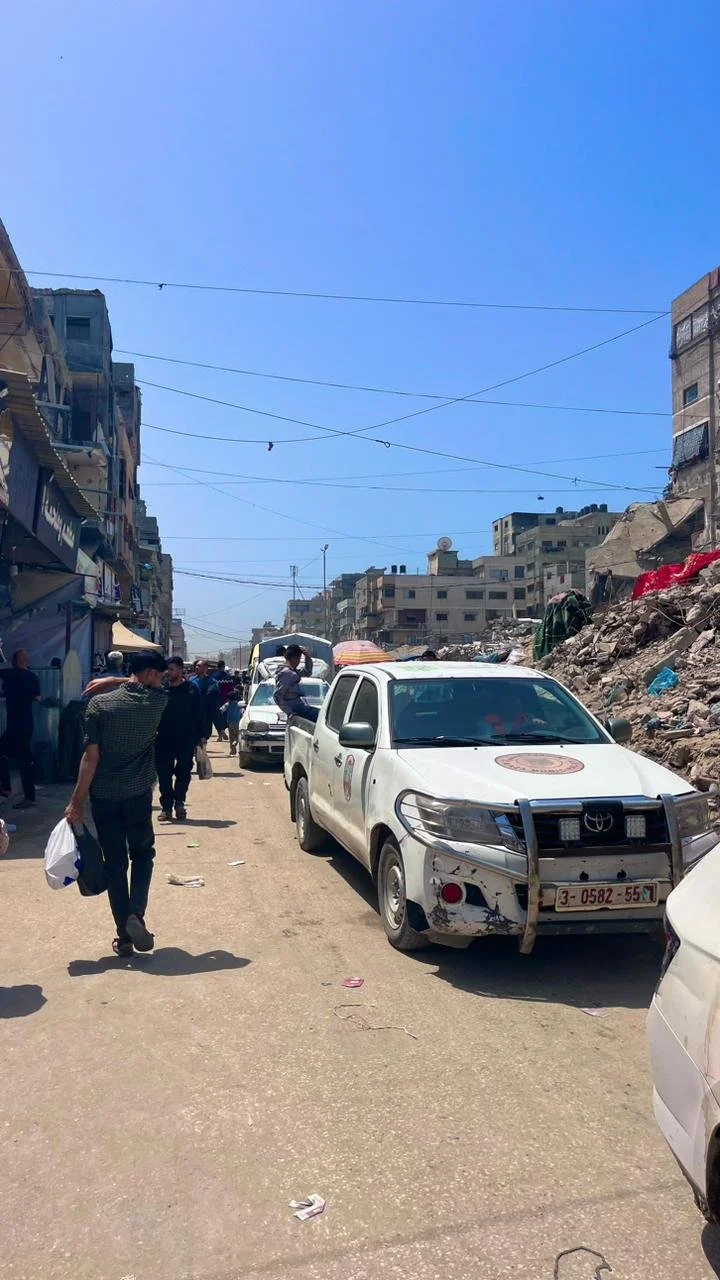
Residents walk under the sun carrying their belongings through a heavily damaged street after failing to find transportation to their destinations. Photo courtesy of the author.
“It is not just uncomfortable,” she adds quietly. “It does not feel appropriate. It is not something we are used to.”
And if the car is already full, some passengers are left with no choice but to sit in the trunk, a space meant for belongings, not people.
They squeeze themselves in, crouching awkwardly among bags and dust.
“It is like being piled up like sacks of potatoes,” Aziz Serria, a 19-year-old student, said. “Your clothes get dirty, your bones hurt, and every bump hits your whole body.”
The roads are full of potholes, debris, and uneven surfaces, making every journey rough and unpredictable.
Some drivers have tried to adapt by attaching small carts to their cars to carry more passengers. But this only introduces new risks. These additions slow vehicles down, especially on already damaged roads, and make them harder to control.
Passengers sit in these carts alongside bags and belongings, exposed and vulnerable.
“From the smallest bump, someone could fall,” Mohammed Zayed, a 25-year-old worker, said. “It is dangerous.”
Children, especially, are frightened by the experience. Everything feels unstable: people, objects, movement, all crowded together in one fragile setup.
Triple the price
Fares for these rides have increased exponentially since October 2023. Cash is hard to find, and internet transfers are not always viable. “There is no small change anywhere,” people say, meaning that even when you have money, it may not be usable. Either you do not have smaller denominations, or the notes you carry are so worn out that no one wants to accept them.
Ayman Khaldi is a 37-year-old driver who has been working as a driver since 2012. It is his only source of income to support a family with four daughters.
“Most of the time, I refuse 20 or 50 shekel notes,” he said. “Not because I want to, but because they are worn out. No one accepts them anymore. And I have a family, four daughters. I need to provide for them and buy what they need.”
Mobile payment apps could offer an alternative, but reality interferes.
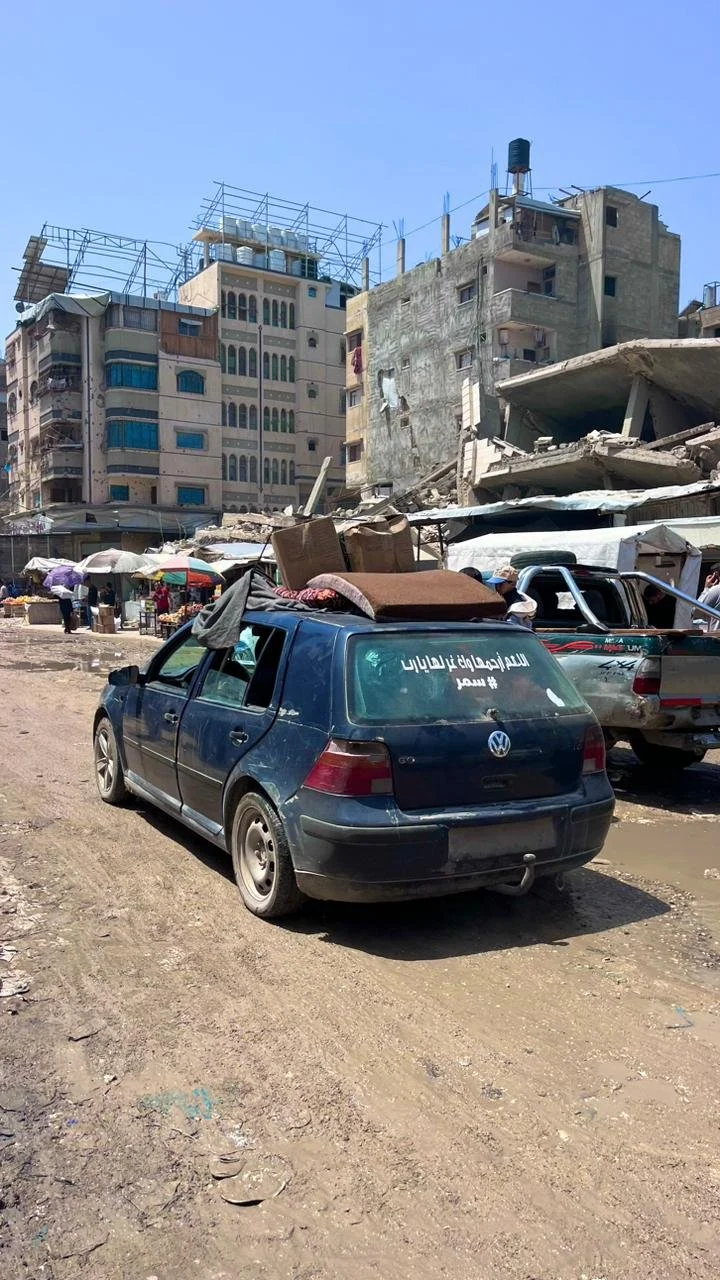
A car is overloaded with belongings as transit options shrink in Gaza. Photo courtesy of the author.
“Even if the driver agrees to a transfer, we need internet connection,” Dina Ahmed, a nursing student at Al-Israa University, said.
“Most of the time, there isn’t any. We end up waiting, sometimes more than ten minutes, just trying to get the transaction to go through.”
When nothing else works, people turn to donkey carts or, worse, walking impossibly long distances.
“I walked for nearly two hours just to reach my university,” Ahmed Abu Shamala, a medical student at the Islamic University, said. On the day I spoke to him, he ended up walking to his university after failing to find transport. “By the time I arrived, I was already exhausted. And then I had to think about how to get back home.”
For people with disabilities, these struggles are exacerbated beyond belief.
At least 22,000 people in Gaza are now living with mobility-related injuries, including limb injuries, amputations, and spinal damage. This doesn’t account for the invisible disabilities that a battered healthcare system can no longer account for.
They often wait longer than anyone else, struggling to find a driver willing to stop. If they need extra room, they are often expected to pay for two seats.
“In this situation, I can barely afford one,” my father, Samir Serria, shared. “How can I pay for two?”
I have lived this reality myself. On March 15, 2025, my father and I were on our way to see an orthopaedic doctor after an injury to his foot.
We did not have change, and we were trying to use a payment app instead. The driver agreed, but there was no internet connection.
We waited. And waited. Eventually, the driver asked us to get out halfway through the journey. We continued the rest of the way on foot, walking two hours to the hospital.
There is a particular kind of exhaustion in moments like that, not just physical, but emotional. The feeling of being stuck, of having no control over something as basic as reaching your destination.
And yet, people continue. They wait. They adjust. They endure. Because there is no alternative.
Subscribe to the Palestine Nexus Newsletter: