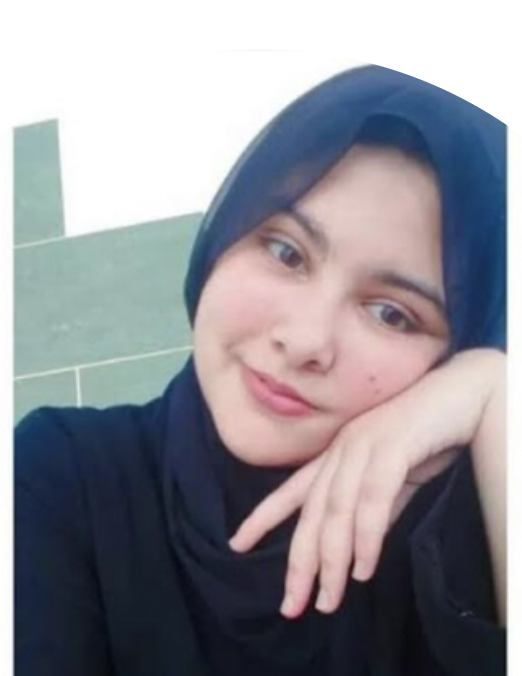

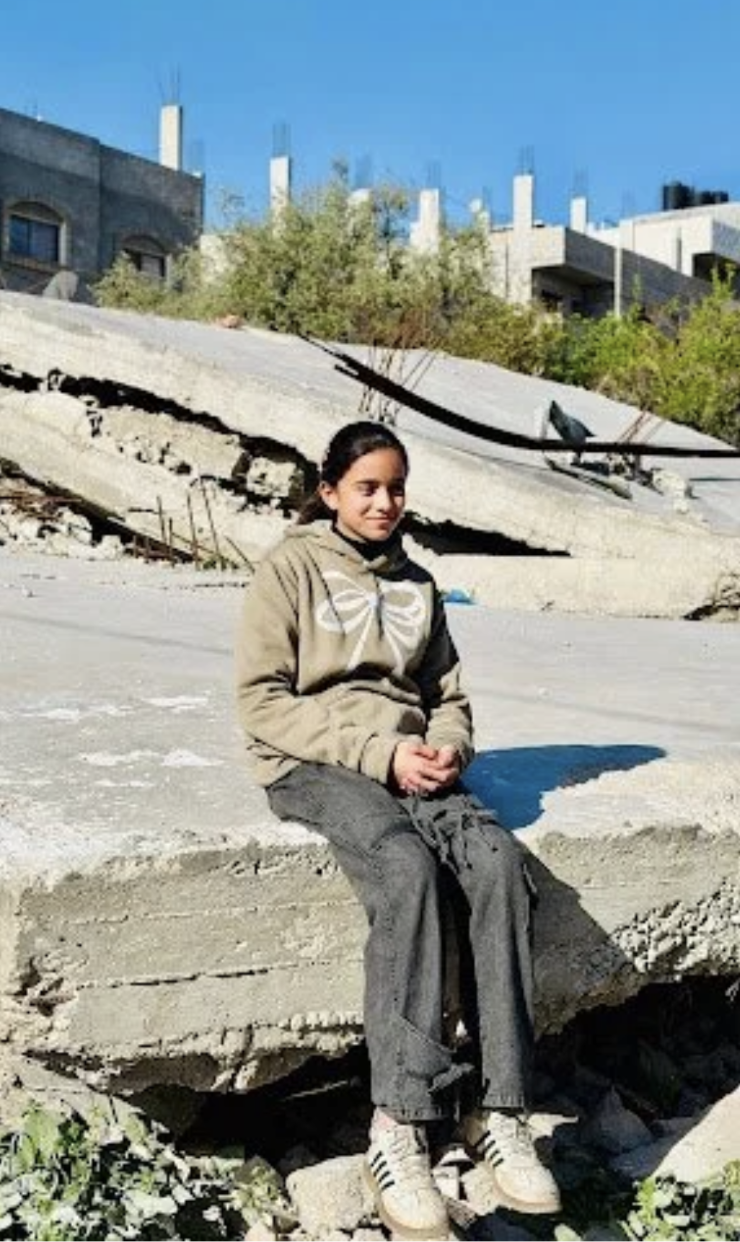
Jana Ahmed Abdel Hai Al-Mutouq, 13, photographed in February 2026. Photo by Ghaydaa Kamal Alabadsaa.
May 14, 2026 — Jana woke up terrified by what sounded like a blast tearing the sky apart. It was a cold morning on November 17, 2023. The clock read 5:25 am. Four rockets had struck their neighborhood in Jabalia al-Balad, north Gaza. Dust filled the place. Jana grabbed her grandmother's hand and rushed into the street. People were running and calling their loved ones' names, with no answer. Initially, she says that she felt lost, but she also knew that something tragic had happened. That night, Jana had asked to spend the night with her sick grandmother near Al-Rafi'i School, just a few minutes away from her parents’ house. A small request that made the difference between life and death.
When she realized that her house had been bombed, she ran towards it, but she didn’t find a house. She just found rubble. Stones, dust, stunned faces. She walked over the rubble looking for the corner of her room, for the bed she used to sleep on with her sister Saja. Eventually, she sat down and started calling: "Mama... Mama Heba..." "Baba Ahmed..." "Saja... Saja, my soul mate..." “Mohammed... Hossam..." She called the names of her family one by one, in a hoarse voice that trembled as if it was caught in her throat. Every name was like a piece of soul snatched out of her chest. She kept calling, waiting for someone to come out from under the rubble, to hear a response, a whisper, the movement of a stone. But the silence was heavier than the rubble itself. Jans says there were about twenty-five people in the building. Five of her immediate family members were martyred.
Jana Ahmed Abdel Hai Al-Mutouq, 13, became the only survivor of her family. I sat down with her on February 10, 2026, in Yarmouk Market, a camp for displaced families near Yarmouk Market in central Gaza City, where she now lives with her mother’s family — her grandmother, aunt, uncle, and cousins. The room where she greeted me was tiny. The walls were dim. On the floor were two thin mattresses and some carefully folded sheets. She sat very close to her grandmother, holding the tip of her dress between her fingers, as if she were afraid that yet one more loved one would disappear. Slender, calm, she stared at me long before speaking, as if her words were crossing a path full of rubble before reaching her lips. She was just 13, but in her eyes was something much older, something no child should ever have to see.
Jana was born in an ordinary house in Jabalia al-Balad, near the Al-Omari Mosque, next to the Al-Rafi'i school. A multi-story house, inhabited by a family of six: father, mother, and four children. When I asked her about her father, Ahmed Abdel Hayy Al-Mutawaq, she calmed down a bit and said in a low voice, her eyes shining with tears that she tried to hide: "He treated me with love and friendliness. He was very affectionate toward Saja and me.” I asked her about her brothers, and she let out a half smile that was soon overcome by sadness. My loved ones are many,” she said, repeating her siblings' names.
Her life before the war was "very sweet”, she said. Her mother, Heba, would wake her up in the morning, comb her hair in front of the mirror, prepare breakfast, and tell her that she should pay attention in school. Her father gave her money, asked her about her studies, and laughed if she complained about a difficult assignment.
What she liked most was for them to break their fast together and then sit in front of the TV. "And Mama was teaching me," she says proudly. Her normal day would begin by going to school with her sister, "Saja and I are soulmates, we study together." Once in school, what she liked the most was "when Saja and I were going to see each other and talk to each other."
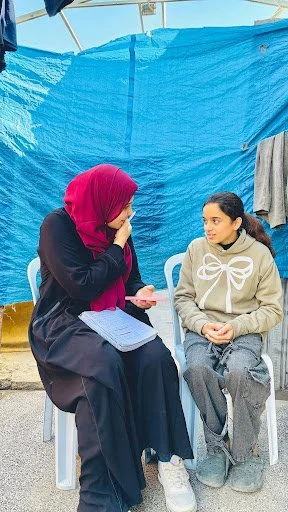
The author with Jana in the Yarmouk Market area in February 2026. Photo by Ezz Dabaa.
She likes playing with her friends, and loves eating anything “that has the most shawarma”. "The happiest day I've ever had with my friends and my grandmother. I wished my parents were with me. I was happier and happier with them,” she added promptly. "All those times were full of happiness, joy, and pleasure." She couldn't choose a single memory, as if the joy was just in being with her family, not in a single moment. Friday was their favorite day. The family would gather around food, laugh, and chat. Friday had the smell of her mother's cooking, the sound of the laughter of her brothers, and of her father's voice calling for them all to sit down.
Little did she know that another Friday would bring the end of it all.
Israel’s strike on her family home left her alone. She didn't get to see her family one last time. She can no longer hold her mother's hand. She can no longer stand near her father. She didn't get to see Saja's face one last time. What hurts the most, she said, is that she didn't get to say "goodbye." Her tears were streaming down her cheeks. She hid her face in her grandmother's lap and cried in a long silence.
The first night after their martyrdom, Jana slept with her grandmother at the school she used to attend before the war, which later became the place where she and her family were displaced. Every time she closed her eyes, the explosion came back. Sometimes she imagined that Saja would stretch out close to her. Sometimes she felt that her mother's hand would adjust the cover over her. Sometimes she had nightmares, her uncle said, but today she has fewer.
"Before the war, she was a normal child and loved to play like other children," her uncle, Naser, said. After the loss, "she became very quiet and tended to be isolated at times.” She used to call her parents' names a lot at first. Her most recurring memory is how her mother, Heba, was affectionate to her and taught her and her sisters. "We are by her side. We hear [her cries]. We assure her that her family is alive in Paradise." Her uncle said that they try to support her by giving her space when she needs it and showering her with love. He stressed that they provide her with a space to play–to have fun despite her loss, and the ongoing genocide.
A UNICEF report published in February 2026 said that more than a million children in Gaza require psychosocial support. Humanitarian organizations are still providing psychological first aid, psychosocial sessions, and some specialized mental health services, but these services reach only a fraction of those in need. Jana is not one of them. She only receives support from her grandmother and uncle. Their biggest fear is Jana’s future. They wish her dreams to come true, for her to live as normally as possible, and to grow up to build a safe and stable future. "She needs to support herself, she needs to feel reassured, she needs help to complete her education and live her life like the rest of the world's children," her uncle said.
I spoke to her during the holy month of Ramadan. “I miss them a lot”, she said. I hope they will be with me on such an occasion so that we can live the moment together." When asked about the future, Jana said, "God willing, when I grow up, I will become a doctor. I hope to achieve my goals and dreams and be a happy and strong person." She took a deep breath. "I need someone to stand with me and support me... Psychological support."
She memorizes the Holy Qur'an and dreams of completing it so that her parents can wear the crown of dignity on the Day of Judgment. Jana is more than just a young teen who lost her family. She is the living memory of a house that used to exist in Jabalia al-Balad, near the Al-Omari Mosque, next to the Al-Rafi'i school. The memory of Fajr — the hour of dawn, just before sunrise — at 5:25 am, when four rockets changed everything.
In Gaza, the word "orphan" is no longer an exceptional case, but a reality that is repeated in every street, camp, and school. Children grow up all at once and learn the meaning of loss before they learn the meaning of the future. Children are not defined by toys or schoolplay, but by the names of the people they have lost.
Sometimes, Jana still waits. She walks through the camp with small steps, but she carries a whole house in her heart, and names that still call out to her in the silence of the night.
Subscribe to the Palestine Nexus Newsletter: