

In Gaza, strength no longer means lifting weights — it means surviving another day
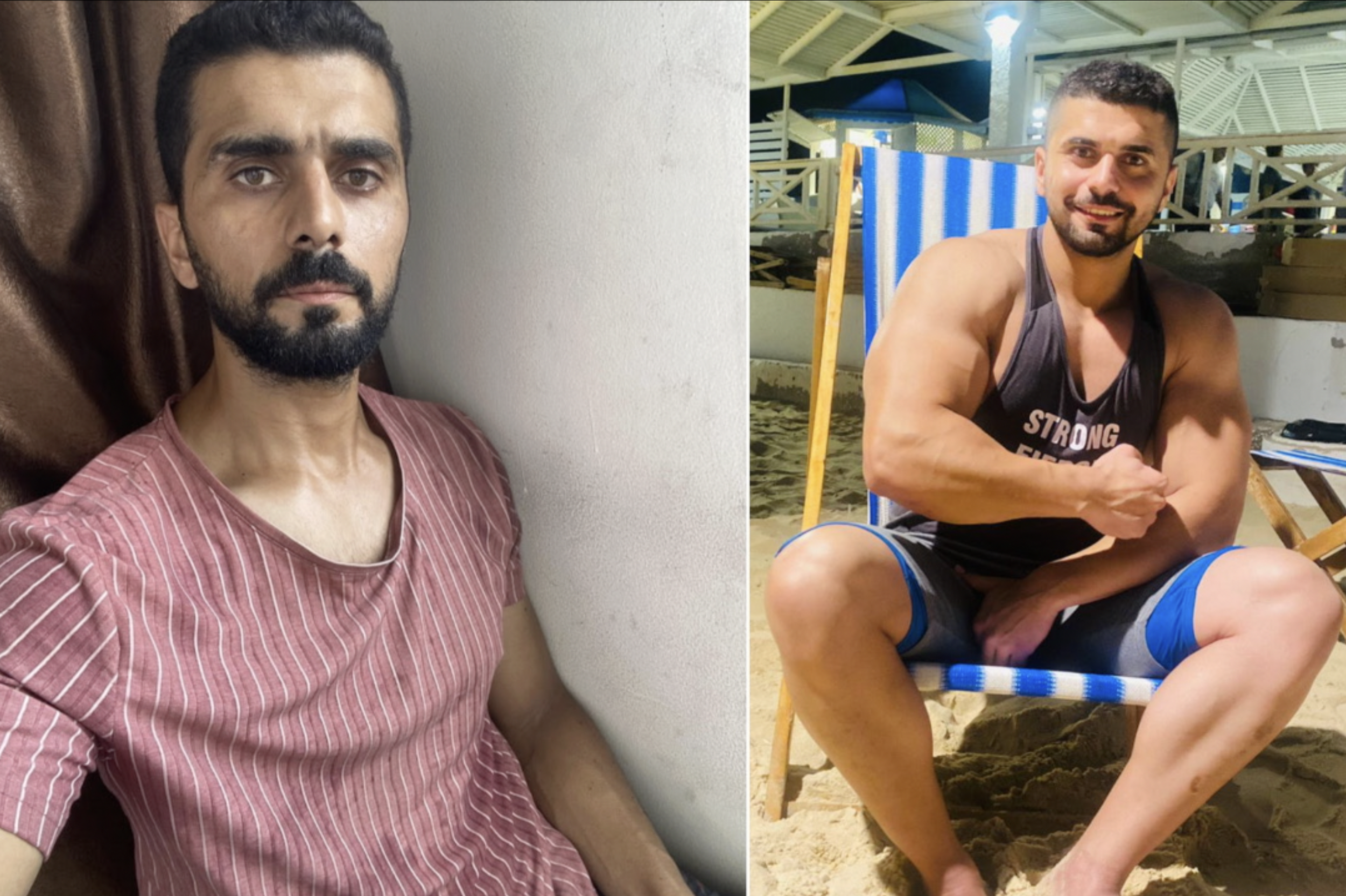
Left: Mohammed Suleiman in south Gaza, August, 2025. Photo provided to the author; Rigth: Mohammed Suleiman at a café in Gaza’s port on August 21, 2023. Photo courtesy of the author.
December 30, 2025 — Mohammed Suleiman was once a bodybuilder known across the Strip. At 108 kilograms, he carried not just muscle but pride – of discipline, winning competitions, and his gyms.
Now, after two years of genocide and hunger, his strength is at a fraction of what it used to be.
When I met him in Nuseirat camp in early September, we were both displaced. He looked frail - an outcome of Israel’s forced starvation, the fate of many in Gaza. His T-shirt hung loose on his shoulders, veins showing under paper-thin skin. “I used to weigh 108 kilos,” he told Palestine Nexus. “Now maybe less than 80.”
Mohammed, 33, was one of Gaza’s most recognized bodybuilders. A graduate of Al-Aqsa University’s Faculty of Physical Education, he had trained for more than a decade under his brother, Saeed Suleiman, a national bodybuilding champion. By his mid-twenties, he had become one of the youngest certified fitness coaches and referees in Palestine.
His reputation grew with every competition he won and with the three gyms he opened across Gaza City, named Golden Gym — one in the Al-Nasr neighborhood, another in Al-Tuffah, and a third in Al-Shati Camp. He wanted to inspire other young men, and prove that it's a sport for everyone. People used to call him ‘Captain Mohammed Suleiman’ out of respect.
I, too, used to train at Mohammed’s gym before the genocide. It was a second home to many of us. People of all ages came — a man my grandfather's age, ambitious young men chasing muscle, and others who just wanted to stay fit. During cardio sessions, Mohammed would play Palestinian folk music, turning workouts into dance sessions. “We built everything from nothing,” Mohammed said. “It wasn’t just work — it was how we lived.”
I had stopped going for some time, and promised myself I’d return when I could. When I finally saw Mohammed again during the war, he laughed and said, “Do you remember when you used to come just to lose weight? Now the war did that for you.” We laughed, but there was pain behind it.
In 2023, he was expanding again with plans of bringing modern, high-end machines that Mohammed said would have made his gyms among the best in Gaza. The payment for those was made on 5 October 2023, two days before Israel started its assault on Gaza. “If those machines had arrived,” he said, shaking his head, “we would have been number one.”
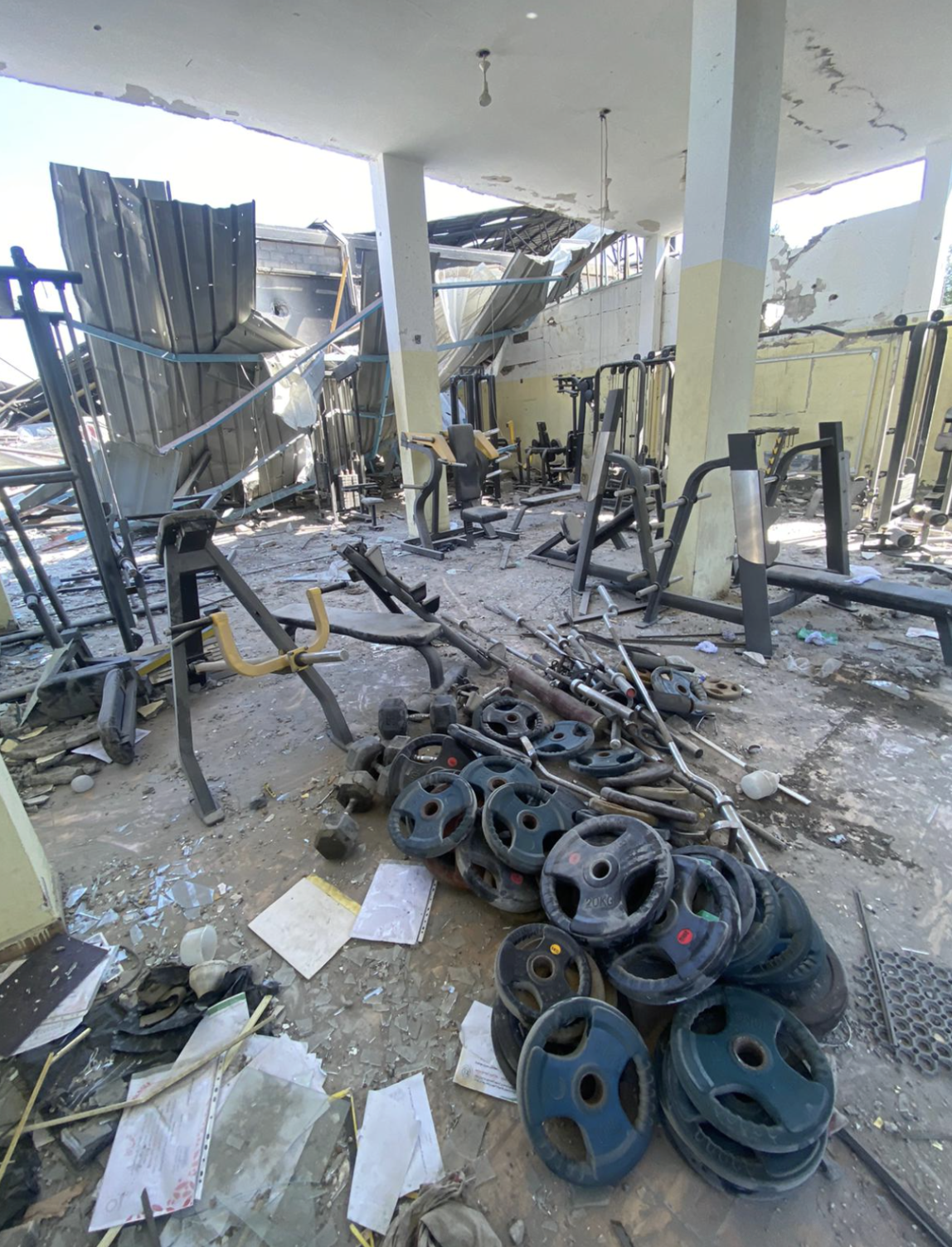
The the Al-Shati branch of Mohammed’s gym in western Gaza in March 2025. Photo provided to the author.
Mohammed’s world folded in hours. The newest branch in Al-Shati camp in western Gaza was bombed at the end of October 2023, even before the plastic wrapping could be removed from the new machines. “That night I cried myself to sleep,” he said. “It was years of work gone in a second.”
Within a week, he and his family fled their home in eastern Gaza. “Leaving the house was like the soul leaving the body,” he said. “We thought it was for a few days – a week at most. We have been displaced more than ten times since.”
During displacement, his discipline that once kept him strong was replaced by navigating food scarcity, and eventually, forced starvation. His weight – a bodybuilder’s metric for strength – dropped by more than 30 kilograms. “Before the war, you needed three things – nutrition, training, and rest,” he said. “Now there is none of them. No food, no sleep, no gym, no mind.” Still, Mohammed tried to train using buckets of sand. It was far from the workout routine he knew, but he wasn’t ready to give up.
Sources of protein – essential for building muscle – were some of the first food items to disappear from Gaza’s markets. Sometimes he found a can of tuna, mixed it with powdered milk, and pretended it was a meal. “But your muscles can’t live on imagination,” Mohammed said.
Mohammed, along with his 21-year old nephew Mohammed al-Maqousi, who used to train with him, would walk for hours across the camps, searching for sources of protein— a few cans of tuna, powdered milk, or even animal feed. “Sometimes we found nothing,” al-Maqousi told me. “Other times we found a little, but the prices were impossible. We shared whatever we found just to keep going.”
Every skipped meal, lost kilo, and every day without a gym chipped away at who Mohammed once was. “You don’t notice it at first,” he said. “Then one day you look in the mirror and can’t find yourself anymore. I stopped shaving. I stopped looking at myself. My confidence broke,” he said. “One day I met a friend – a guy I trained years ago – and he didn’t recognize me. He stared at me, shocked. He said, ‘I was happy to see you but sad for what the war did to you.’ That sentence stayed in my head for months.”
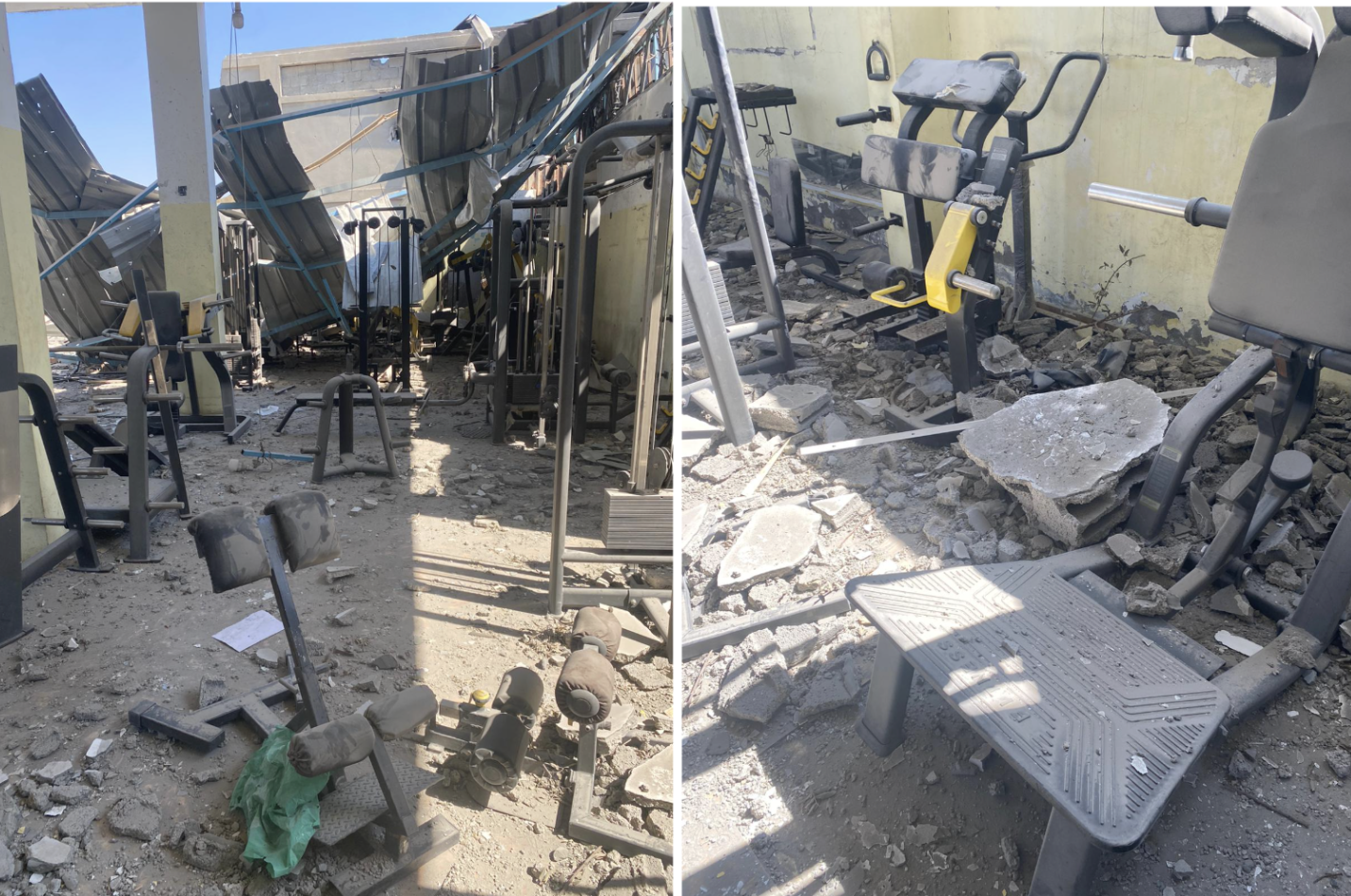
Mohammed’s gyms after they were bombed. Photo provided by the author.
When a fragile ceasefire came into effect on January 15, 2025, Mohammed returned north and tried to reopen his gyms. While two of the three had been flattened, the one in the Al-Nasr neighborhood still stood, its walls cracked and windows shattered. He gathered whatever equipment remained and opened the doors again. To his surprise, people came.
“They weren’t there for training—they came to breathe. To release the negative energy. They just wanted to remember life before October 7.”
For a few months, the gym throbbed again with the sound of rusted dumbbells, music, and laughter – an illusion of normal life. But the ceasefire effectively collapsed by March 2025, with Israel resuming intensive military operations. Mohammed tried to keep the gym running, but on September 15, as the bombing intensified, he was forced to close it once more. “I couldn’t keep it open,” he said. “It was too dangerous. The floors above the gym were full of people. I couldn’t risk their lives.”
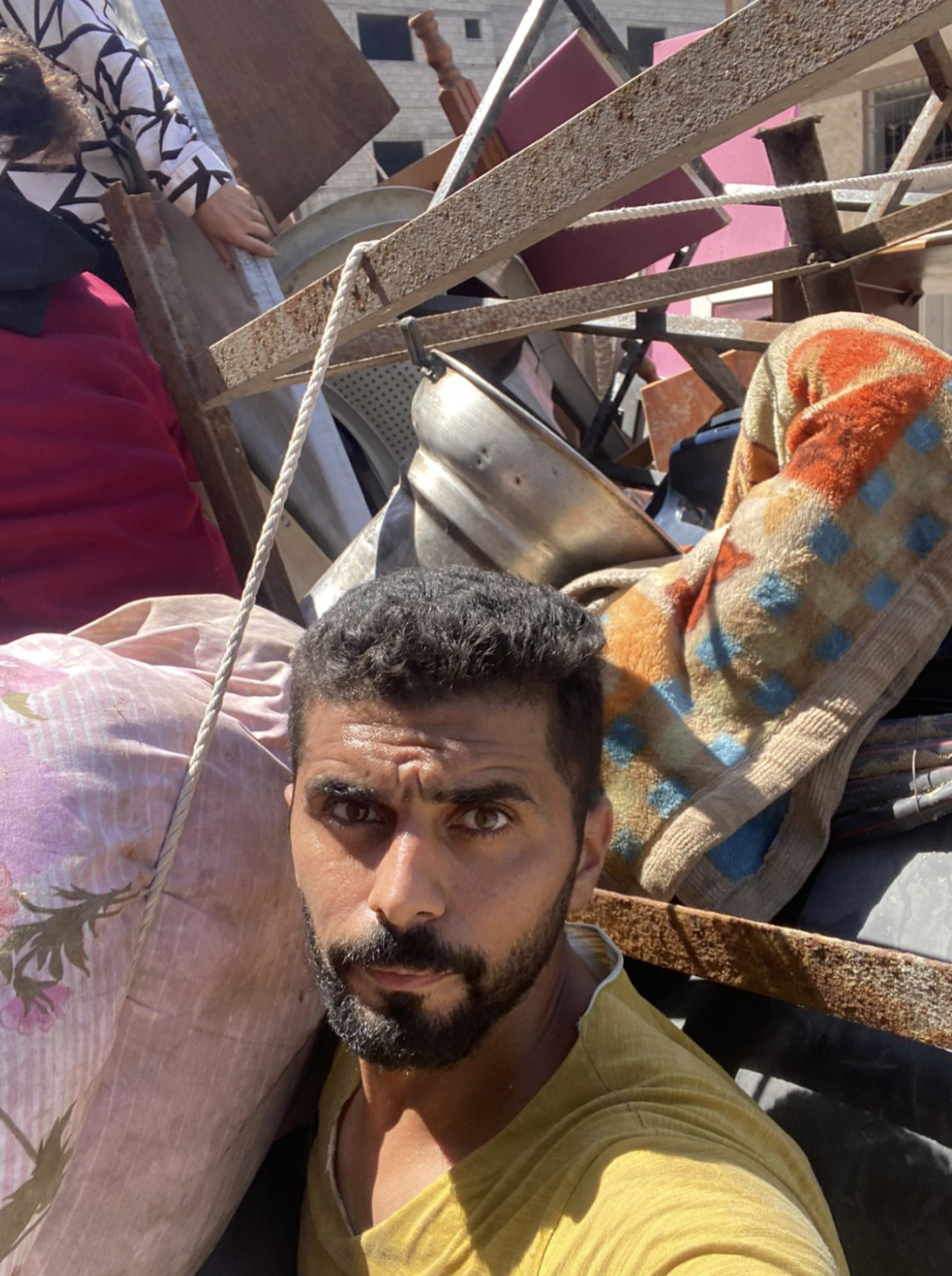
Mohammed with his belongings in a truck during one of the many times he was displaced. Photo provided to the author.
When the Israeli army advanced deeper into Gaza City, his home neighborhood in Al-Nasr became one of the most dangerous zones. Bullets pierced his kitchen wall; a shell exploded meters away, almost killing his wife. “We lived three months in constant fear; we slept dressed, ready to run.” Mohammed stopped counting the displacements. “We moved from east Gaza to the middle, then Rafah, then back again – more than ten times,” he said. “I lost the number. I only know we survived each time by chance.”
In time, his surviving gym turned into a shelter. The equipment now stood among people’s mattresses, pots, and smoke from cooking fires. “Imagine seeing the place that gave you life become a refuge of pain,” he said. “But at least it protected people from the rain. Maybe that’s what strength means now.”
He sometimes dreams of training again, but even the idea feels distant. “Your body remembers, but your life doesn’t allow it,” he said. “Now when I lift something, it’s not a weight – it’s a water tank or a bag of flour.”
When he first spoke to Palestine Nexus, there was anticipation of a US-brokered ceasefire. But Mohammed had little hope. “They say a truce is near. People start packing, hoping to go home. But we’ve learned what these words mean – they mean nothing.”
Now that the fragile ceasefire has been in place for over two months, Mohammed is relieved, but he still has mixed feelings about it. Israel has already violated it countless times and killed many Palestinians.
But even with doubts in his heart, he clings to the idea that one day this war will end. “Maybe when it’s over, I’ll start from zero again,” he said. “I built three gyms once. I can build a fourth.”
“Until then, we wait – me, my family, everyone. Waiting for the truce, waiting for the end of this nightmare. But sometimes,” he said, lowering his voice, “I think the nightmare is all that’s left.”
Mohammed is currently renovating his remaining gym to begin anew.
If you enjoyed this article, check out our online courses on the history of Palestine and Israel, Zionism, the Palestinians and Jewish anti-Zionism.
Subscribe to the Palestine Nexus Newsletter: