

“Evacuating Gaza was my greatest heartbreak”
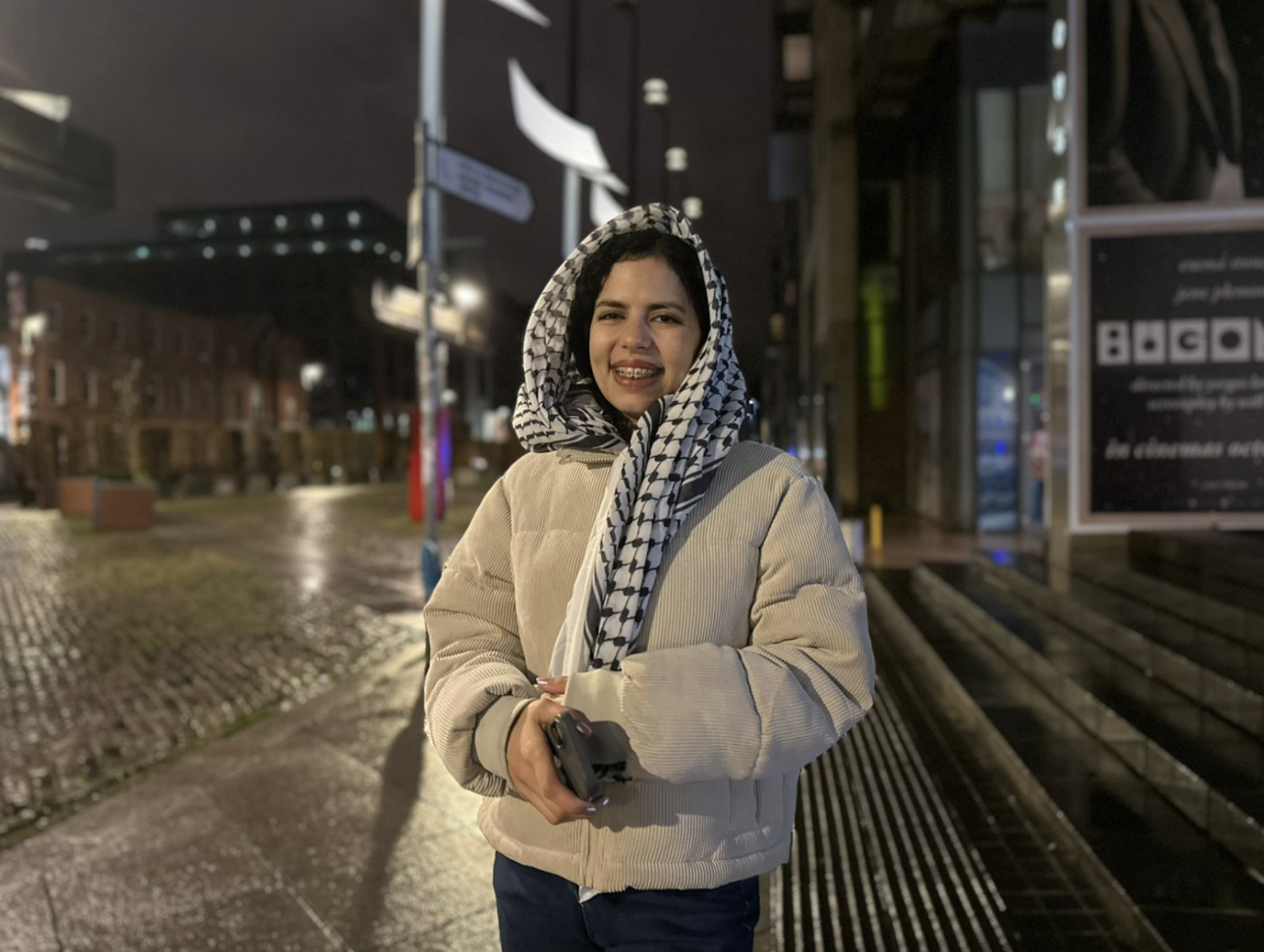
The author in Ireland where she is now studying after evacuating Gaza earlier this year. Photo courtesy of the author. October 2025
January 2, 2026 — I was wondering what my words of goodbye would be on my last night in Gaza. But when the time came, I fell silent. No words in the world could express what I felt about leaving without knowing if I would ever have my Gaza back.
I couldn’t help but think: If all of this had not happened, where would I be? How would the 24-year-old Heba be? And the question that echoed most was simply: Why? Why did all of this happen? Why did they do this?
That night, I wasn’t as happy as I thought I would be. I realized that what I had longed for over the past 2 years was not simply to escape the genocide, but to return to my life before it — to my land, the Gaza I once knew, my home, and my memories. I know that is impossible now, and that pain is something I will carry with me forever.
By late May this year, my energy began to fade. Everything I did felt hollow. I was exhausted from waiting for the genocide to end. I stopped counting days, stopped counting the deaths, and I stopped dreaming. I kept working on writing and translating just to stay busy so my thoughts and the sound of bombs wouldn’t haunt me.
At the time, I was working on a small project as a research assistant with Matthew, a historian living in the UK. His thesis is about the child fatalities in Gaza, and I was helping him find evidence of the listed children’s deaths in Gaza.
Somehow, despite my fierce resistance to hope, he convinced me to start exploring options to pursue my studies abroad, something my twin, Hadi, and I had always planned to do.
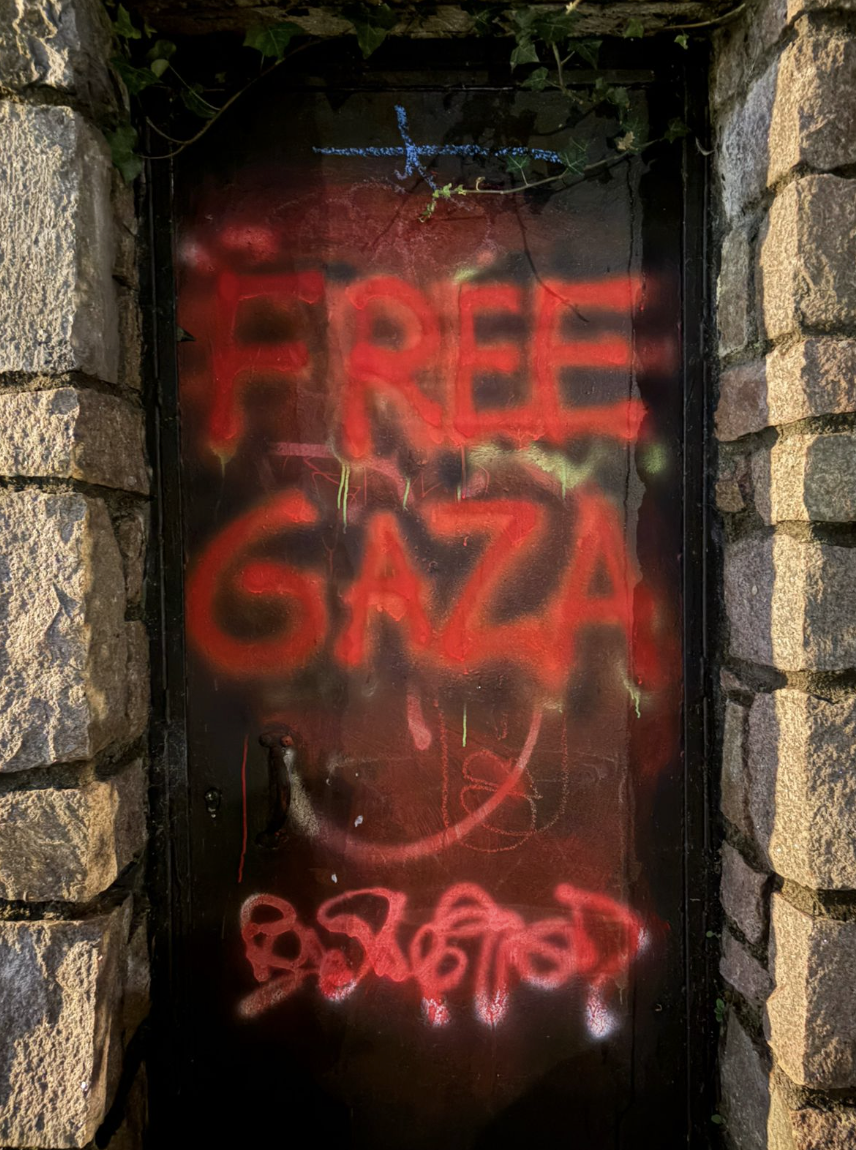
A graffiti in Galway, Ireland. Photo courtesy of the author.
Matthew, now a dear friend, helped me through every step of my university applications. He believed in my potential and was always there to answer my endless questions. Together, we worked on applications, and I eventually received my tuition fee waiver. Many people were involved in making this happen, offering support and writing letters.
I was accepted in all the three universities I had applied to, but chose the University of Galway in Ireland to study Global Media. I was always curious about Ireland, and I wanted to visit it, enjoy its nature, but I never imagined I would have to evacuate to Ireland away from the genocide of my people and my land. The experience of studying abroad is something I have always been curious about. I know its effect on someone’s personality and that it will always be memorable, but I never thought it would be my survival plan. I wanted to come back to my dear city after I finish my studies, to gather with my family in our home, and tell them stories about my experience.
From July to September, while I was waiting for any good news about my evacuation. I was living life on repeat. Every day felt the same — the same helplessness, a small flicker of hope, more death reports, the sound of bombs, threats of displacement, and fear, anxiety, and exhaustion everywhere. I was unsure if I would even be alive to make it out.
But the day to leave Gaza eventually came, and I remember it vividly. I knew I would be leaving at 3 a.m. I got into a car, and my thoughts raced again: What if a bomb lands on this car? What if I die after surviving all of this — right on my way to survival? These questions became a knee-jerk response after my family and I were inches away from a bomb explosion.
But I made it. I reached the gathering point to board the bus that would start my journey. My heart was pounding. I was torn between the pain of and the joy of leaving. I couldn’t speak.
The moment I got on the bus — on September 17, 2025 — guilt began to consume me. During the long, exhausting 24-hour bus journey from Gaza to Jordan, my heart felt heavier with every mile. When I finally reached the hotel, I felt life again: electricity, lit streets, unlimited water, and all kinds of food. Many might imagine that after enduring starvation, we would be eager to eat our favorite meals again. But I could barely eat. Everything made me nauseous. The guilt of having all this while my family had nothing was unbearable.
Leaving Gaza was painful, but leaving my family behind during a genocide was the most painful thing I have ever done. I left with my twin, Hadi while my mother, my older brother and his family, and my two younger brothers, Mohammed and Adam, stayed behind. The hardest part was leaving Adam, our paralyzed little brother.
I had promised myself that when I survived the genocide and left Gaza, I would celebrate with ice cream. But I didn’t. I still haven’t. It used to be one of my favorite things, but now, even that joy feels empty. That’s what Israel did to us — stripped us of our dreams, dimmed our souls. Even the things we once loved no longer feel the same, because life itself doesn’t feel the same after the genocide.
Days passed. Hadi and I arrived in Ireland on September 19, 2025, but the feeling didn’t change. I try to live every day to the fullest — I study, attend lectures, hang out with my friends, eat, exercise — yet guilt follows me like a shadow. I lived a year and eleven months under genocide, and now, watching the news from afar, I can’t shake the feeling that I’m betraying Gaza — simply because I am alive, and my city is not.
It took me more than two weeks to be able to go out at night again. My subconscious was still trapped in the urgency of getting home before dark, because in Gaza, night equals death. I found myself rushing back home every time the sun began to set, until one evening, while hurrying again, I suddenly stopped and asked myself: ”Why am I rushing?”
Out of defiance of the habits I developed during the genocide, I began forcing myself to take a walk every night.
But even now, the fear and anxiety I carried from Gaza hasn’t left me. I know that life exists on the other side of fear, yet I can’t seem to cross it. Even when I don’t feel the fear, it’s buried deep inside, whispering questions I can’t escape: Will I ever find what I lost again? Will Galway’s sea ever make up for the Mediterranean sea back home?
My first couple of weeks in Ireland were the hardest. I don’t know if it was the culture shock of being in a different country or the guilt of leaving my family who is still living in a genocide. But with time, I have started trying to love life here again. I see Palestine’s flag everywhere, I see people here supporting us. I saw them, day and night, talking about us, standing in protest even under heavy rain. For me, this was the most touching thing to witness.
My healing journey has its ups and downs, its moments of strength and weakness. Each day, I feel a little better. Having Hadi here protects me from loneliness, and we support each other. Even on my hardest days, I keep moving forward, because that’s who I am, and that’s who we are as Palestinians.
To my family in Gaza — Mom, Said, Mohammed, Adam, Aya, and Sara — I am so sorry for leaving you there. Please know that you are always with me. I see you in everything I do. I pray every day that you, too, find safety, that you, too, get to live a normal life — and that we will be together again soon, hopefully in a free Palestine.
If you enjoyed this article, check out our online courses on the history of Palestine and Israel, Zionism, the Palestinians and Jewish anti-Zionism.
Subscribe to the Palestine Nexus Newsletter: