

My 12th displacement: How survival become a commodity in Gaza
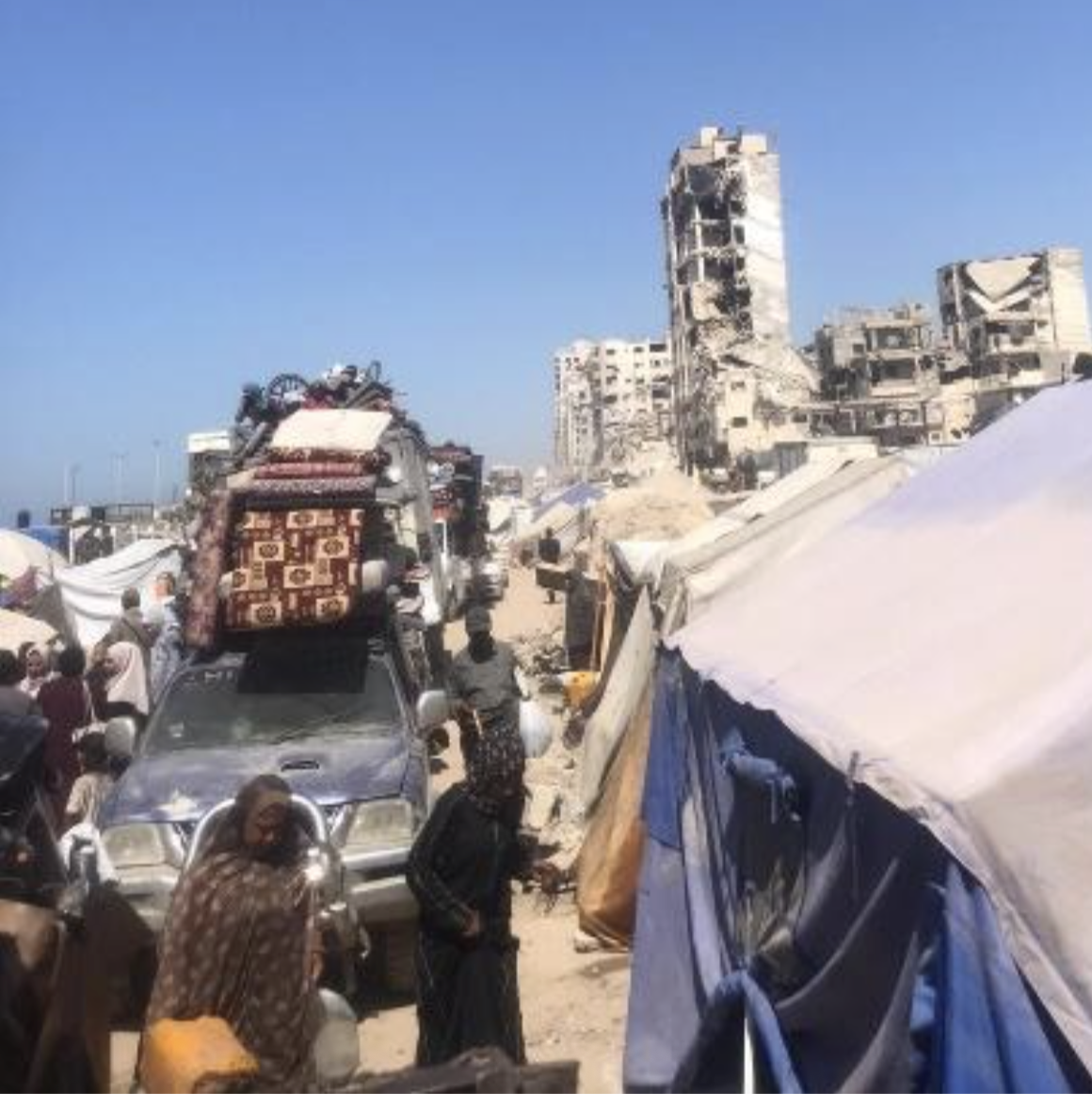
Moments from our journey south — people carrying whatever they could, moving between rubble and makeshift shelters, trying to hold on to a sense of safety in a place where survival has become the only goal. Photos courtesy of the author. September 12, 2025.
December 8, 2025 — Our journey to the south of Gaza began on September 14, 2025. It was our 12th displacement.
A few days earlier, on September 12, the residents of the Towers area had received a phone threat from the Israeli army forces warning that the building complex in northwest Gaza, where my family had been living, would soon be targeted. As the situation rapidly worsened, we left the area two days later, on September 14. There had originally been thirteen towers, but only three remained; the rest had been reduced to ash and rubble by Israeli airstrikes since the beginning of the war.
Around 1 am, an aerial vehicle hovered so close to our window that I could see the sunlight reflecting off its metallic body. It was a quadcopter, a miniature helicopter, one of the most terrifying and frequently used Israeli weapons for surveillance and targeting.
Moments later, smoke grenades filled the area around our home—thick, choking clouds that burned our eyes and left us gasping for air. My heart pounded so violently that I could hear it above the drone’s whirring. We crouched behind a wall, holding our breath, clinging to one another in silence, while the sound of gunfire echoed through the narrow streets. Every second felt like an eternity, trapped between a mechanical eye watching us from the sky and the suffocating smoke closing in from every direction.
We had resisted the urge to leave, having already experienced the bitterness and hardship of displacement, but as flares lit up the night and tanks kept advancing, we decided to head south.
Leaving northern Gaza was not a choice, it was a roll of the dice. We took Al-Rashid Street, a 40-kilometer road connecting the north to the south, which we thought was our best chance of survival. Every kilometer came at a cost--physical exertion, dignity and money. A car ride to the south that used to cost 20 shekels ($6 USD) before the genocide has soared to nearly 4,000 shekels ($1,300 USD).
Many people were forced to sell their possessions, such as a relative of ours, who sold all the furniture in his house to gather about 4,100 shekels ($1,335 USD) the full cost to rent a truck, an amount that represented everything they had left to survive.
The price of the fare was completely beyond our means, too. We had no choice but to share a single truck with our neighbors, each family contributing what little they could. Even as we packed our belongings in those final moments, the occupation offered no respite; a nearby house was shelled, and shrapnel scattered through the air.
The drivers demanded immediate payment, leaving those without money to walk or wait for a miracle that never came. And so, with no other options left, families began to move south on foot, walking for hours under the scorching sun, pushing strollers, pulling carts or clutching whatever fragments of their lives they could carry. They were guided by a faint hope that, beyond the devastation, safety might still exist.
Israeli forces remained stationed along al-Rashid Street from the outbreak of the war in October 2023 until January 19, 2025, transforming this once vital passage into a wasteland of craters, burned-out vehicles, and collapsed buildings. Al-Rashid Street was Gaza’s main lifeline, connecting families, markets, and neighborhoods from north to south. Today, it has become a corridor of peril and despair, stripped of all signs of life.
Thousands of families were displaced along this road during the final wave of expulsions before the ceasefire was announced. It was a five hour journey on foot. Mothers and fathers carried heavy bags and their children, trying to protect what remained of their belongings, food and their lives. Some carried items on their backs, others pushed small carts loaded with food, clothes, and blankets. The road was crowded, and our truck had to stop often, struggling to navigate through the throngs of people fleeing south.
On one of these pauses, I looked out and saw a mother holding her child while dragging a bag containing all she had left. I didn’t know her—she was one of many, full of sorrow and despair. Dust covered her clothes and hair, her eyes wide with exhaustion and hopelessness. Explosions echoed nearby—a method used to force residents of northern Gaza to evacuate. Each step seemed heavier than the last, yet she pressed on, clinging to the fragile hope of reaching safety.
Along the way, several people, including a mother, kept asking us, “How much did you pay?” and “Can you give me the truck driver’s number?” The driver understood that demand was soaring and people were desperate, and so the price increased to $1,800. When they heard the price of the fare, their faces turned to despair. They lowered their heads, shoulders slumped, and continued their uncertain journey on foot — a grueling search for any means of reaching the south, weighed down by the impossible cost of survival. In that instant, fear turned into exploitation, survival into commerce, and human beings into customers.
As I endured this journey, I thought of my aunt, who had been displaced twice—first from Al-Falouja to Sheikh Radwan on May 21, 2025, and again on September 16, 2025, from Sheikh Radwan to Al-Shati Camp. When new evacuation orders arrived, she wanted to flee south with her children, but the cost — one thousand dollars or more — far exceeded her entire monthly income. She hastily packed some clothes and a few household items. She went into shock when the shelling began — random strikes that mostly hit the surrounding streets as a warning for residents to evacuate. She moved quickly through the house, calling her children’s names with a trembling voice as the blasts grew nearer. Tears ran down her face, but she continued searching from room to room. Eventually, she found each of them hiding in different corners, their bodies shaking and their faces pale.
The last time I met her, she whispered: “What kills us is not hunger or fear, but the look in our children’s eyes when they ask: ‘Where will we go?’”
She was not alone. Lina, a woman from a nearby neighborhood, faced a similar impossible choice. She fled with her family on September 12, 2025, just hours before soldiers took control of their area. She described the final moments—neighbors running through the streets to warn others, families dragging children and a few remaining belongings. In a trembling voice, she said: “Staying means risking the bombing. Leaving means starving to death.”
Lina spoke of the long road south — crowds fleeing death, some barefoot, others packed into vehicles that refused their belongings. It was one of the harshest things a Gazan could endure: to walk into the unknown empty-handed, leaving our homes behind.
UNRWA estimates 1.9 million people in Gaza have been internally displaced. That means that around nine out of 10 people in Gaza went through a similar journey—most from the north. Many never reached the end of their trip. We were luckier.
When we finally arrived in the city of Nuseirat, there was no tent ready; we had to set it up ourselves. no place to shelter. We sat on the bare ground, exposed. My eyes burned from fatigue.
All I wanted was to close my eyes and sleep. The local residents welcomed us with warm hearts, opening their homes as if trying to restore a fragment of our weary humanity. We stayed with them until the tent could be set up, but even then, the tent was no true refuge — it was the beginning of a new kind of suffering. No walls to lean against, no shade to hide under as the scorching September heat gnawed at our bodies and as exhaustion gnawed at our souls.
Under the thin fabric of the tent, we tried to convince ourselves that we had survived, yet survival felt like a fragile lie we clung to so we would not collapse entirely. Nothing was stable, nothing felt like life — only long waits, heavy silence, and one weary wish: that this ordeal would pass, and that one day we might return to a place that truly felt like home.
Reported and written before the Oct. 2025 ‘ceasefire’ took effect.
Subscribe to the Palestine Nexus Newsletter: