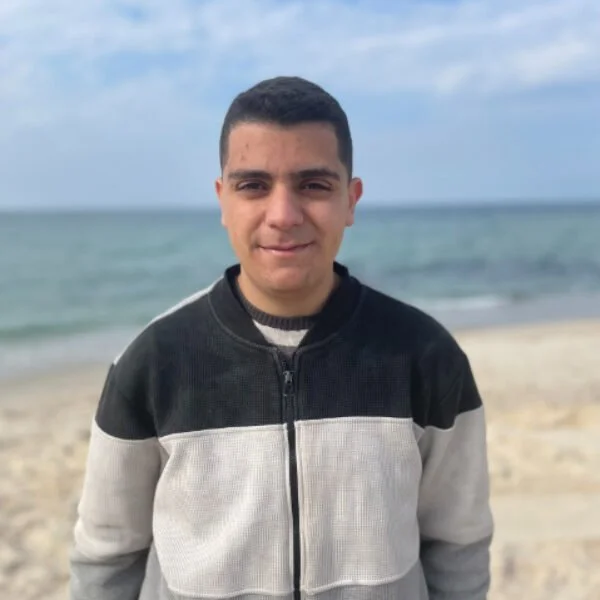
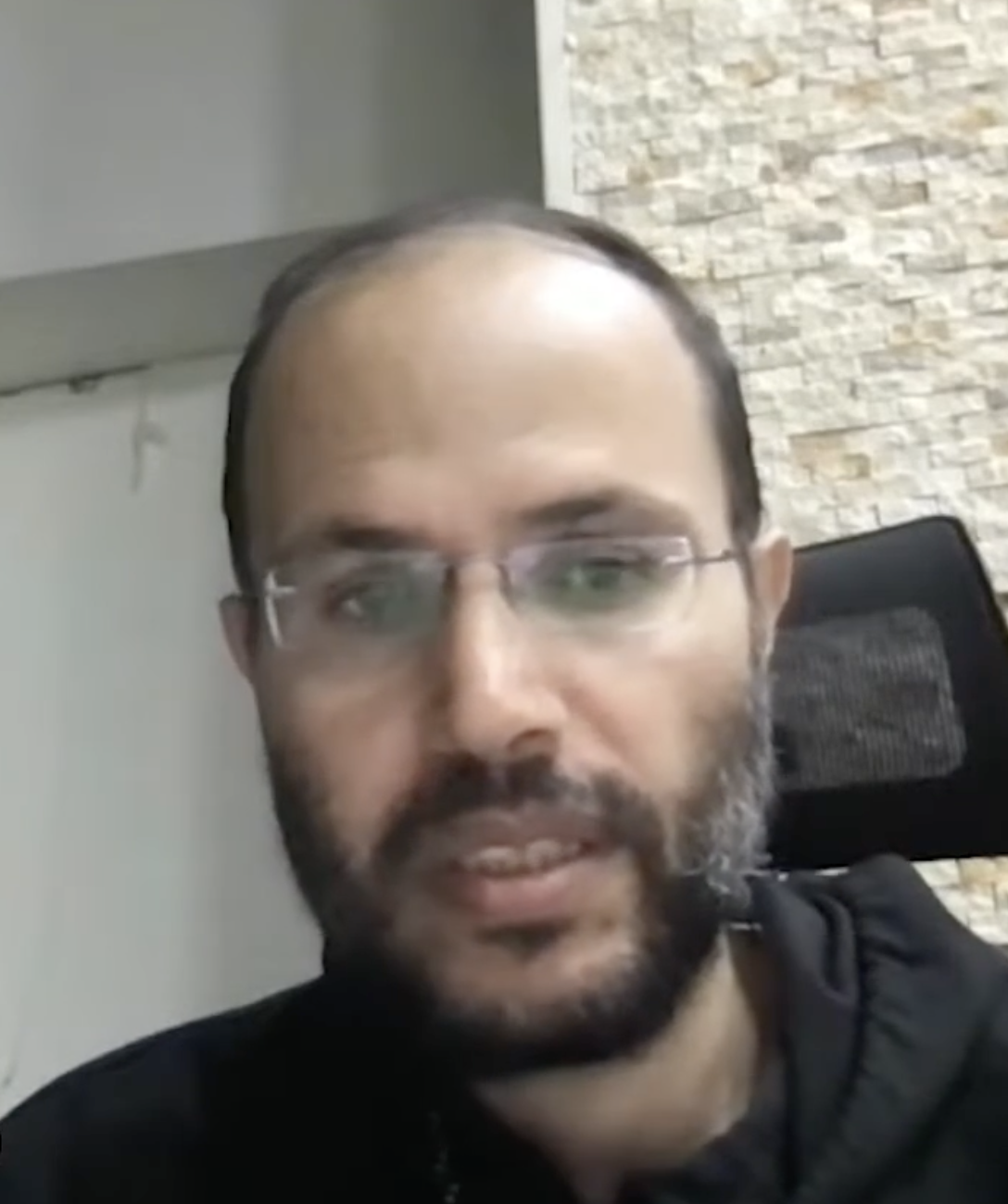
Refaat Alareer on December 2, 2023, interviewed by the Electronic Intifada just days before he was assassinated. Source
December 16, 2025 — I first heard about Dr. Refaat Al-Areer after my high school graduation while I was looking at university programs in Gaza. I always wanted to study English language and literature but did not know which university to apply to. But, when a former student of his told me about Dr. Refaat, I was convinced.
Dr. Refaat Al-Areer was a towering figure in Palestinian literature and education. A poet, teacher, and mentor, he dedicated his life to developing Gaza’s literary voices and preserving the stories of his people through creative writing. His first book, Gaza Writes Back, stands as a testament to his vision, capturing the resilience, pain, and resistance of Palestinians under occupation.
On the evening of 6 December 2023, Dr. Refaat Al-Areer was killed in an airstrike by Israeli forces on his sister’s home in Al-Daraj neighbourhood in eastern Gaza City. The strike also claimed the lives of his brother, his sister, three of her children, and other family members.
In the weeks leading up to his killing, Dr. Refaat had received repeated threats from Israeli forces and had spoken publicly about his fear of being targeted. Friends and colleagues had urged him to leave Gaza, but he refused, believing that his place was with his family and students. His death was a deliberate, targeted act, aimed at silencing his voice and intimidating a generation of Palestinian writers who learned from him to write without fear. The apartment where he and his family were sheltering was surgically bombed out of the entire building where it’s located, Euro-Mediterranean Human Rights Monitor concluded.
His teaching and guidance were a major reason I chose the program. I wanted the chance to learn from him, to explore my writing under his encouragement, and to experience his unique approach to poetry and Palestinian storytelling firsthand.
In my third year, he taught me for the first time in the poetry course. I was so afraid of writing back then that sometimes I did not even try. That year, I decided to focus on my studies to improve my grades, so I started writing. When I shared my first poem in the class, Dr. Refaat was the first person to praise my writing.
Dr. Refaat highlighted the importance of literature and poetry as a way to capture human experience and emotion, which differs from history’s recording of facts and events. The first poem he taught us was, “Every Time Mama Unwraps a Piece of Gum,” by Noor Hammad. The poem is about four children from the Bakar family who were killed by the Israeli occupation while playing on the beach during the 2014 war. Beyond its tragic subject, the poem stands out for its lyrical rhythm and the way it blends innocence with sudden violence, juxtaposing the ordinary act of unwrapping gum with the horror of loss. Hammad’s imagery is vivid and tactile, drawing the reader into the scene and creating an emotional resonance that lingers long after reading. Her careful use of language transforms a historical event into a deeply personal and universal reflection on childhood, memory, and grief.
Dr. Refaat always asked us not to search for poems online, but instead write our own and then read them in class together, and then use our skills to analyze them.
Sometimes he would use unconventional teaching techniques. In one class, he encouraged us to create memes about what we were studying. I made a meme for Shakespeare's Sonnet 18, especially with its famous first line, ‘Shall I compare thee to a summer's day.’ The meme showed the reader what one would look like on a hot, humid summer day in Gaza. We shared our memes with the whole class and laughed at them together. Surprisingly, this helped me understand poems more deeply, because it forced me to translate complex metaphors and emotions into simple visual language. It taught me that poetry could be playful and accessible, and that serious literature could live alongside humor.
Dr. Refaat emphasized that it was important to understand the different points of view between the occupied and the occupier, so he sometimes shared Israeli poetry with us. "Dr. Refaat taught us not to read this poetry with fear,” Younis El-Hallahq, 26, who was one of his students, told Palestine Nexus. “He taught us to read this poetry with sharpness, to see how language can hide power, erase us, or sometimes unintentionally expose the truth of occupation. It made us feel more aware, more awake as readers and as Palestinians.”
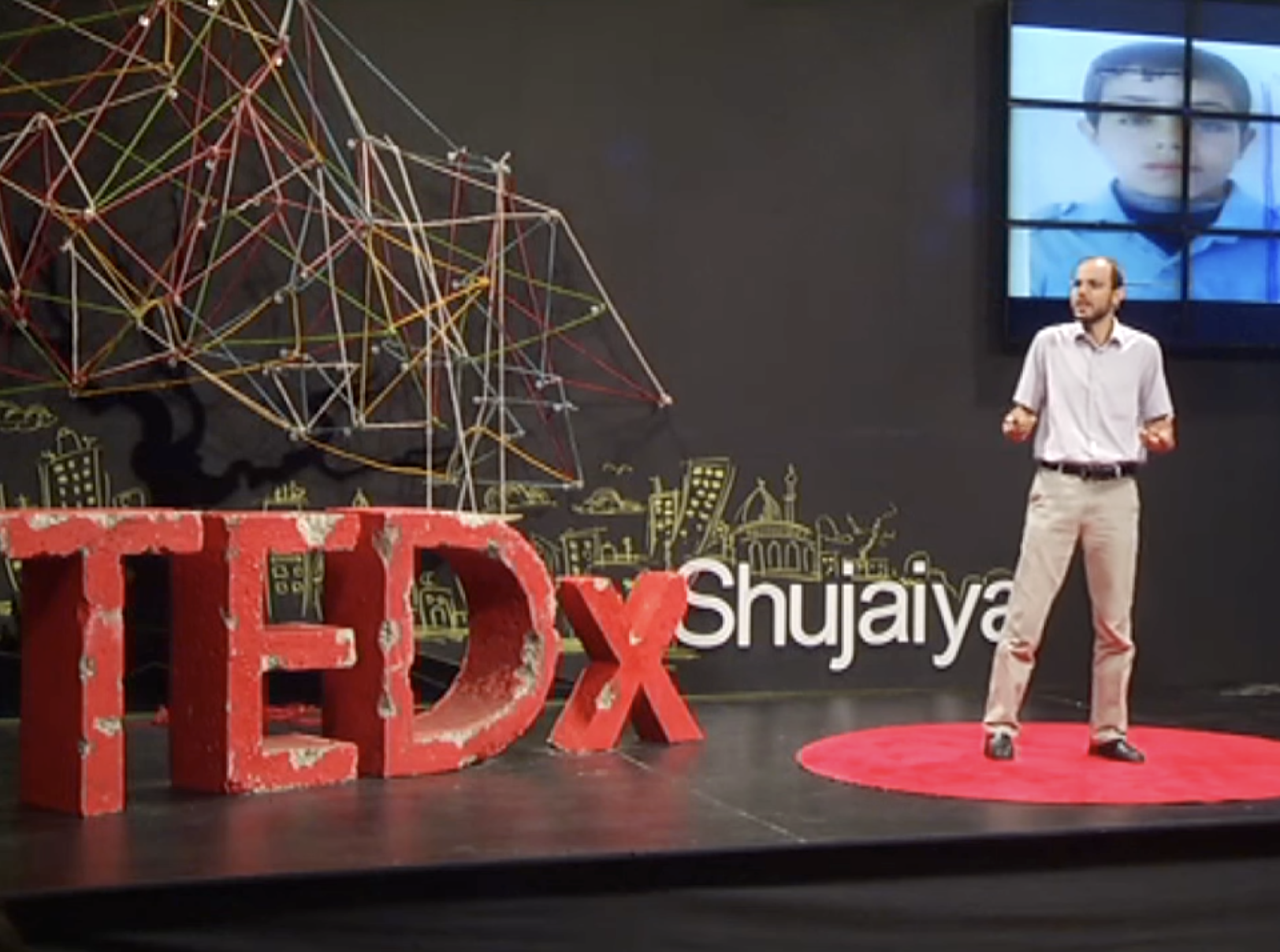
Refaat Alareer, presenting at a TEDx event in Shujaiya, Gaza, Palestine in 2015. source
These moments were testaments to Dr. Refaat’s deep belief in intellectual courage: he wanted us to confront difficult texts, and to grow stronger through critical reading.
During the poetry class, I assembled a portfolio of all the poems Dr. Refaat taught with my notes. When I asked if I could show him the portfolio during his office hours, Dr. Refaat told me, "You have to be confident, Khaled. Come and show it to your classmates and me." I didn't have the portfolio with me that day, so he asked me to bring it to the next lecture to share it with the class.
I didn't attend the next lecture as I was afraid of being embarrassed in front of the whole class. I had poured so many of my private thoughts, questions, and emotions into those colorful pages that showing them to the whole class felt like exposing myself. Yet now, I wish I had. I regret that moment every time I think of the poetry course and my portfolio, which I lost beneath the rubble of my home.
Dr. Refaat had a sharp sense of humor. During the course, he organized the Women in Folktales Show that brought together personal stories and inherited items passed down through generations of Palestinian women. Younis and I were part of the art fair with other classmates. I remember when I brought some of the very old utensils that my grandmother inherited from her mother. Dr. Refaat shockingly said, "You were hiding all of this, Qershali."
He left behind a body of work that still echoes across Palestine and beyond, blending mourning, defiance, and memory into powerful literature. Among his most notable works is the poem “If I Must Die,” first published in 2011, which gained global resonance after his death in 2023.
His anthology, Gaza Writes Back, features stories and poems by young Palestinian writers to give voice to Gaza’s reality and struggles. Through these works and others, which included essays, criticism, and creative writing, Dr. Refaat shaped a Palestinian literary tradition in English aimed at documenting suffering and resistance, creating bridges between Gaza and the world, and inspiring new generations of writers.
My friend Younis took three university courses with Dr. Refaat. "Dr. Refaat believed in writing as a form of resistance," Younis said. He explained that through writing, Dr. Refaat has shown the suffering of the people of Gaza through the lens of poetry and literary resistance.
It was my colleague, Khaled El-Hissy, who first told me about Dr. Refaat's assassination. That moment felt as though a voice that had carried Gaza’s stories with such clarity and defiance had been forcibly silenced. In that moment, grief became a terrifying realization; if someone like him, a guardian of our narratives, could be erased so deliberately, then none of us were living outside the crosshairs.
I did not want Dr. Refaat’s voice to fade, so I didn't stop writing. Following his steps, I am currently a contributing writer on the yet-unpublished Black Book for Gaza, a Spanish book written by writers from Gaza that documents their daily suffering.
I still carry his guidance and advice in every part of my writing. I am proud to be Dr. Refaat's student, and I believe his assassination did not kill him but created more Refaats to fight the occupation with their writings.
"Any loss of a human being in Gaza is a loss for Palestine," Younis said, in a recent interview. Dr. Refaat carried and shared the idea that we all grew up with, which is resisting the occupation.
“By his loss, the world and Palestine lost a well-educated writer and teacher, who spent his life investing in the new generation and a new form of resistance,” Mahmoud Al-Yazji, a former student of Dr. Refaat’s, told me.
“Gaza tells stories because Palestine is at a short story's span. Gaza narrates so that people might not forget. Gaza writes back because the power of imagination is a creative way to construct a new reality. Gaza writes back because writing is a nationalist obligation, a duty to humanity, and a moral responsibility.” -Refaat Al-Areer, Gaza Writes Back
Subscribe to the Palestine Nexus Newsletter: