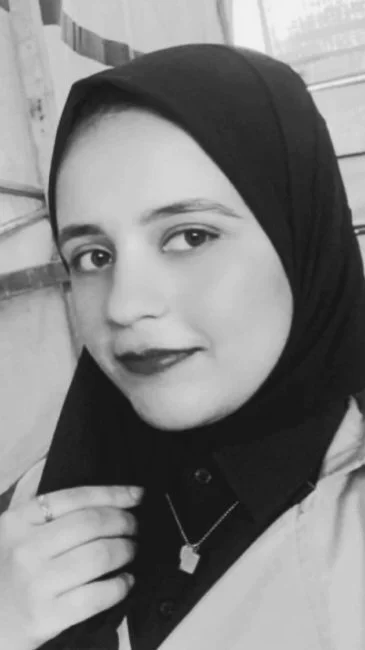

Growing Up too Soon: Israel’s War on Childhood in the Gaza Strip
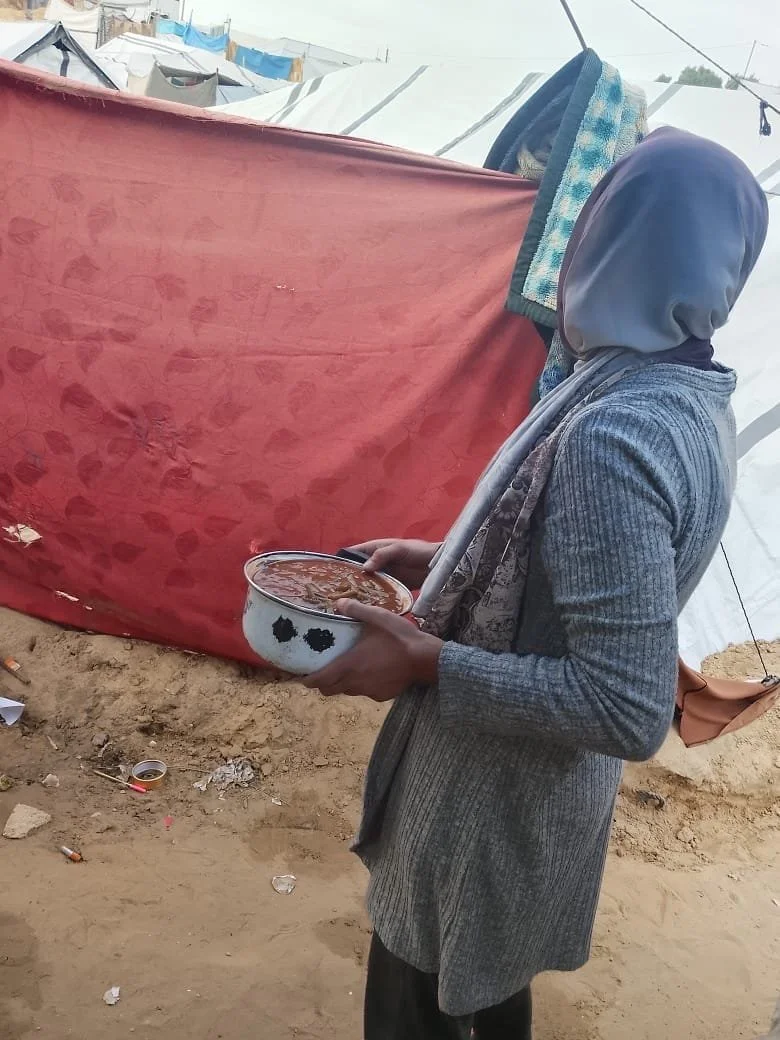
Seba, whose face is not shown at her request, carries a pot of food back from a local community kitchen to her tent, January 2026. Photo by the author.
Seba Ahmed Al-Reqeb wakes before sunrise. At 6 o’clock every morning, while the al-Mawasi area of Khan Younis is still asleep, she begins her long day.
Her morning begins with chores at home, a small, cramped tent that she shares with her mother and 3 siblings. She helps her mother arrange the tent before the family sits together over a simple breakfast — often just bread, canned beans, or hummus.
Seba, 15, is tall for her age, with brown skin and soft features. Her eyes dart around constantly, restless. She speaks in hushed tones, sometimes hesitantly, but there is a notable intelligence in her words. She dresses in worn but clean clothes, the same every day – a gray blouse and black trousers. She steps out of the tent toward the stall, and her mothers calls out, "اهتمي بنفسك، ماما"(Take care of yourself, mama).
The stall is a six-minute walk away. Seba carries a small tin with cash and some goods carefully along the narrow dirt paths.
While most children her age get ready for school, Seba arranges packets of biscuits and candy in the small wooden stall she has managed since the early months of the genocide in January 2024.
Twelve hours of work lie ahead.
Across the Strip, children like Seba are having to work or be caregivers in order to support their families, and being forced to negotiate survival in ways that strip them of their childhood.
“Sometimes it is tiring, but I have to do it,” Seba told Palestine Nexus. “If I do not work, we do not have money for food. I am still a child, but I feel like I have responsibilities now,” she said, adjusting her hijab nervously.
Before the genocide, she attended a local UNRWA school in Khan Yunis. Math was her favorite subject. Her notebooks were always tidy. She often scored perfectly in her exams. Her teachers praised her focus.
“Seba always took first place in the class with a certificate of appreciation,” her mother, Amani, said. “She was very smart, especially in math. I always studied with her and was very proud of her.”
“I miss playing hide and seek with my friends, visiting the park, and having my mom help me study for school. Those simple moments made my childhood feel joyful and normal,” Seba said. “I remember when I would talk with Nour and Rama; Nour told me she wanted to be a doctor, and Rama dreamed of becoming an artist. I long for the days when we would laugh together, run around outside, and share our dreams about the future.”
Seba’s childhood did not end in a single moment. It faded gradually, piece by piece.
Her father, Ahmed, was killed in 2018 during the Great March of Return, a series of mass protests where Palestinians demanded the right of return and an end to Israel’s blockade of the Gaza Strip, which had intensified after 2007. During the protests, Israel killed 223 Palestinians, including Seba’s father, while suffering 0 casualties. Seba was 7 years old at the time and does not remember her father well, but she remembers how he “loved us more than anything.”
Her father had been a police officer with the Palestinian Civil Police in Gaza. She still remembers his uniform, how crisp it was, how people stepped aside when he walked by. As she grew older, she pictured herself in one too. When asked what she wanted to be, she would smile and say without hesitation: “A policewoman, like my father.”
After her father’s death, Seba’s mother was left to care for four children alone. Seba is the second child in the family. Her older sister, Doha, is 19; her brother, Ibrahim, is 13; her younger sister, Raghad, is 12, and her youngest sibling, Sama, is 10. On Oct 7, 2023, Seba’s family fled their home in Khan Younis City. That same day, their house was bombed. They arrived in al-Mawasi with little more than what they could carry.
“There was no one to help us,” Seba said. “We could not depend on aid. Sometimes there was food, sometimes there was not.”
In January 2024, when they received a humanitarian coupon for basic cleaning products, her mother suggested they use it to start the stall to support the family. With her mother overwhelmed with responsibilities to take care of the family, Seba stepped up, believing that she could help her family survive the rising prices and famine.
During the famine, there were goods available from some merchants, but at exorbitant prices. Seba would buy certain items from one trader and resell them. Lately, however, she said it has been much easier; she can find larger, well-stocked markets selling these items where she can buy and resell without as much difficulty.
Since the “ceasefire” was announced in October 2025, some residents in Gaza have reported improved access to basic goods compared before, with certain food and household items reappearing in local markets. However, reporting shows that prices remain unstable and access uneven.

Displacement camp in al-Mawasi. The tent where Seba and her family now live. Jan 2026. Photo provided to the author.
The stall, a wooden makeshift structure, is modest and organized. Its shelves are filled with biscuits, candy, and occasional snacks that she manages to obtain. Seba straightens the packets of biscuits and candy one by one, and greets customers with a shy smile. She counts change slowly and carefully, speaking politely and seriously, trying to sound confident as she learns to manage her work. She insists on fairness, never overcharging, and remembers which customers promised to return later.
One day in January, a young boy from the camp named Anas, just five years old, came to buy a biscuit. It cost three shekels, but he had only one. After a brief pause, Seba smiled and sold him the biscuit for the single shekel he carried, watching him walk away clutching it with quiet satisfaction.
On good days, she sells enough to feel a sense of relief. When she returns to the tent in the evening having sold well, “I feel happy,” she said. “Like I did something useful.”
During work hours, she even has to temporarily close her stall to fill her pot with food from the tekkia, the community kitchens that have become lifelines for displaced families. Other times, she shuts the stall to walk long distances to fetch water, carrying heavy buckets back to the tent.
But even through everything, the hardest moments are when Seba sees other girls – some younger, some her age – walking to school. Their clothes are clean, their steps unhurried. They carry a sense of calm direction, one that now feels distant to Seba, like a life that belonged to someone else.
“I miss holding a pen. I miss writing. I miss exams. Maybe one day I will go back to school. I hope so. I really do,” she said, tears streaming down her face.
Amani is proud of Seba, of her strength and sense of responsibility, but she is deeply worried about her future. “At her age, children should be holding notebooks and pencils, not standing behind a stall trying to survive.”
Seba, too, is unsure what lies ahead for her. “I used to think I would be a policewoman. Now I just think about tomorrow, about what we will eat, if we will be okay.”
Then, she brushed the dust from her skirt, stood tall, and returned to her place behind the stall.
Seba returns to the tent each evening exhausted. Her younger siblings greet her eagerly. She eats whatever food is available and helps wash the dishes. Every night before sleeping, Seba opens a small notebook she keeps hidden among her belongings. In it, she writes about what happened during her day, who she met, what she sold, what made her smile, and what made her ache.
She then lies down to sleep, knowing the day will begin again before sunrise.
Subscribe to the Palestine Nexus Newsletter: