
How Gaza’s Youth are Struggling to Keep their Dreams Alive
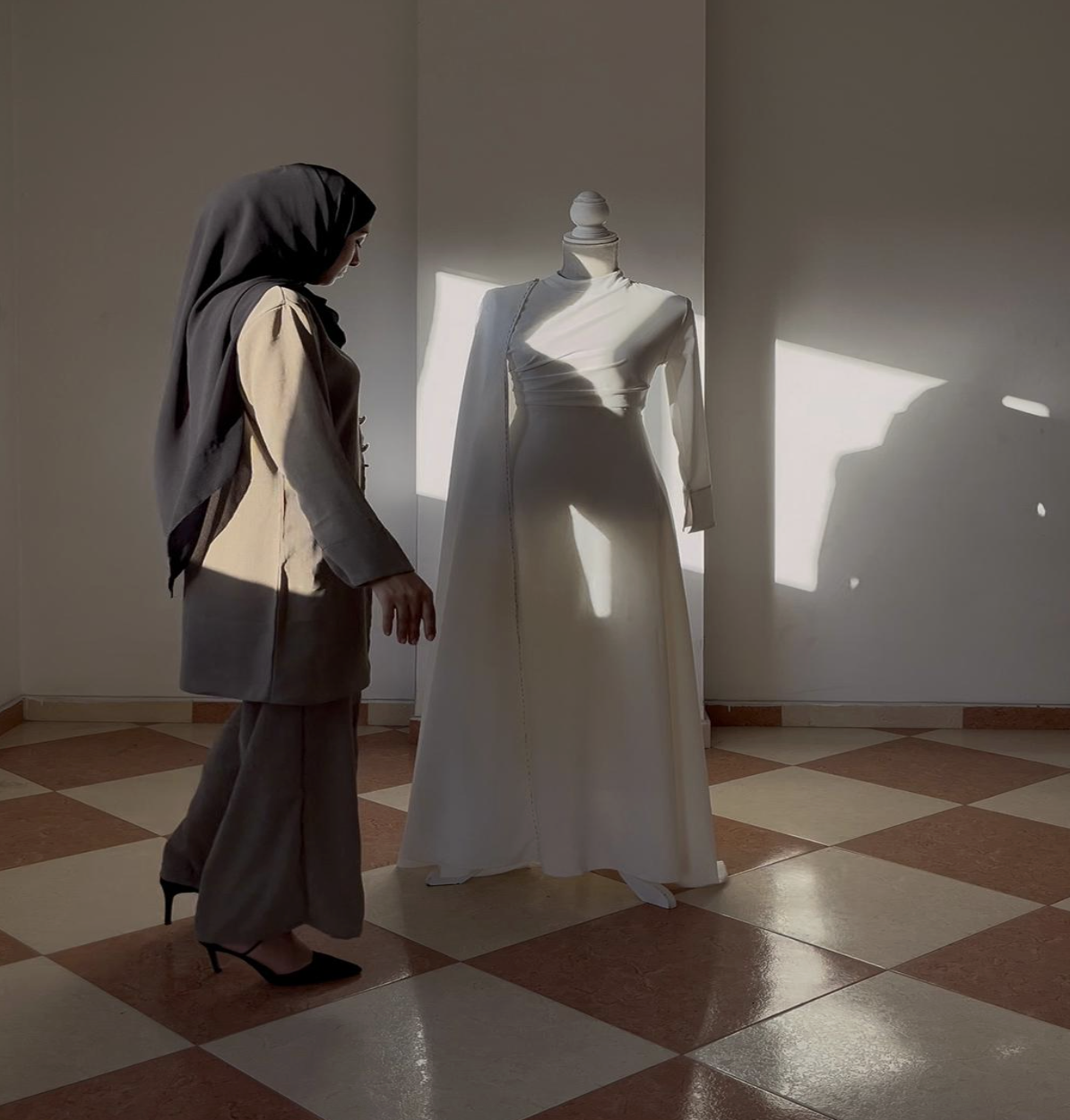
Noha in a custom Falham design created for a special occasion. “Thank you for making the moment I had been waiting for one of the most beautiful moments of my life.”
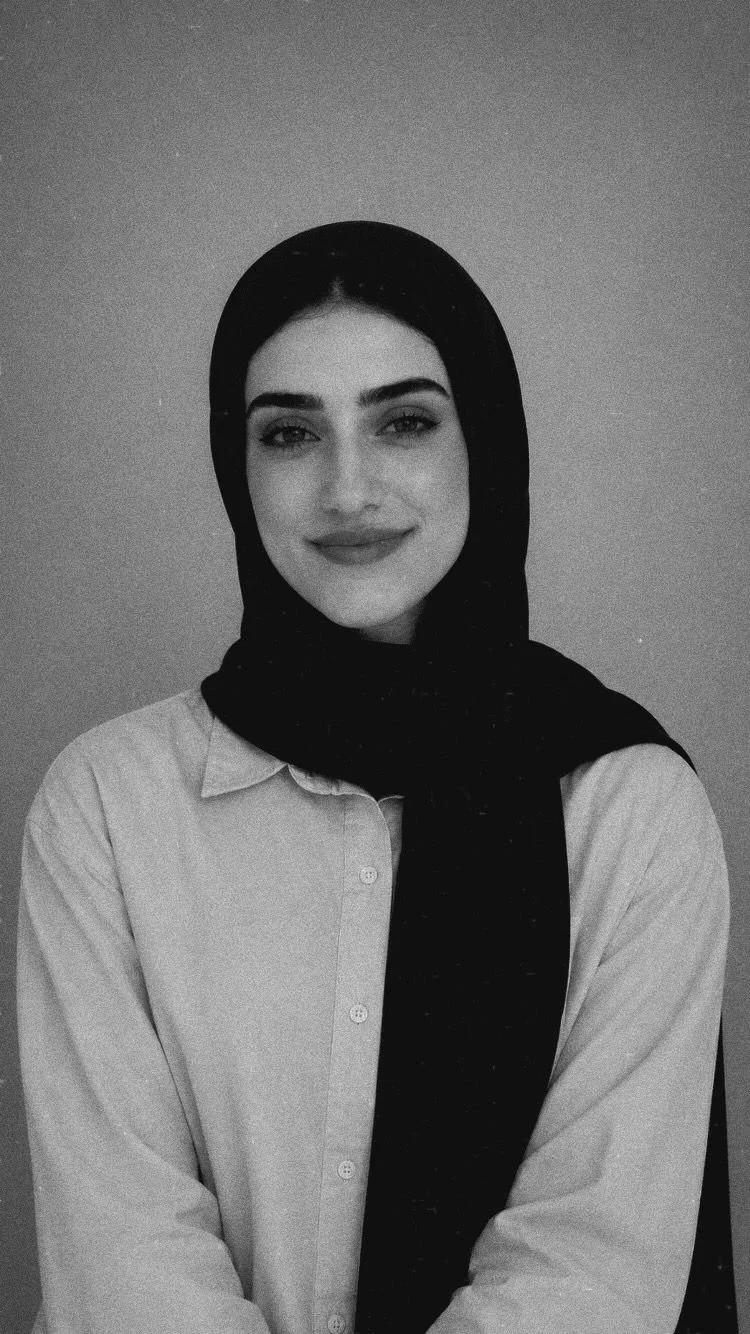
Noha Ouda, 26, graduated in clinical nutrition from Al-Azhar University in Gaza shortly before the war. Like many young graduates, she was still searching for a sense of belonging in her profession. Opportunities in her field were limited even before the genocide, and she never felt fully connected to it. Her true passion, she discovered, lay in design.
Just two months before the genocide began in October 2023, Ouda made a decisive shift. She pursued her dream of fashion designing and launched her own line of clothes, Reno Collection, selling abayas she designed – well-tailored, solid colored and made from soft, flowing fabrics.
“In a place where so much has been destroyed, I hold onto the ability to create,” Ouda told Palestine Nexus. “Design isn’t just work for me, it's how I survive emotionally.”
But as daily life collapsed, her project stopped entirely. “There was no room to think about dreams,” she said. “Only about staying alive.”
As Israel’s genocide devastates Gaza, young Palestinians are not only losing their lives and homes, but also the possibility of work, stability and a future.
Before October 2023, young people in Gaza like Ouda were used to a punishing job market. But now work opportunities are almost impossible to find.
In 2022, unemployment stood around 45% in the Gaza Strip and 13% in the West Bank. In 2025, those figures reached 78% in the Gaza Strip and 28% in the West Bank in 2025, as per the Palestinian Central Bureau of Statistics (PCBS), which reported that more than 650 thousand individuals faced unemployment in Palestine.
With the educational institutions severely impacted, the besieged enclave lost both access to employment and an educational pathway to prepare for it. For many youth in Gaza, careers did not pause, they dissolved. Survival replaced ambition.
‘I can’t give up on this dream’
Hala Ayman Abdel Fattah Abu Rukbeh, 20, had always dreamed of becoming a doctor. She pursued her dream by studying medicine at Washington for Health and Science University, an online program affiliated with an institution based in the West Bank. But, the genocide destroyed her family’s income, forcing her to instead find income to support her family alongside her studies. “Studying medicine is not easy,” Rukbeh said. “It's demanding, even without a genocide, but it’s what I’ve wanted since I was young.
Rukbeh’s education now exists in limbo, dependent on unstable electricity and scarce internet access. “I knew I had to keep learning, even when everything around me was falling apart. It’s exhausting, but I can’t give up on this dream.”
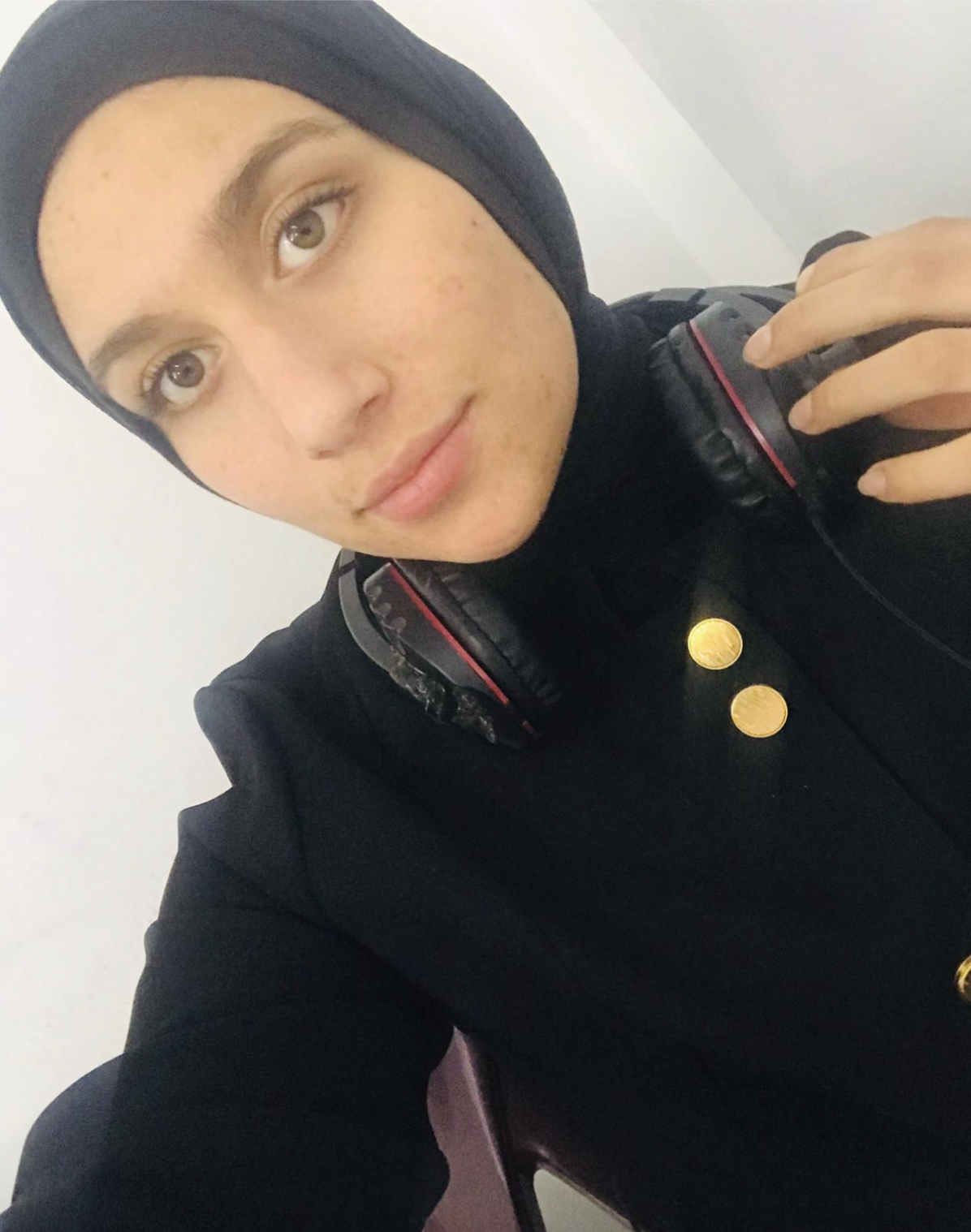
Hala Ayman, 20, studies medicine online while balancing the challenges of war in Gaza and working to support her family.
‘Losing the part of me that felt useful’
Before the genocide, Ali Ahmad, 28, had built a life marked by relative security. He worked at a private medical lab, handling samples and supporting the daily operations of the lab.
The genocide erased that. Laboratories were destroyed. Medical projects became largely unaccessible, and Ahmad lost his job. “[It] wasn’t just about money,” Ahmad said. “It was losing the part of me that felt useful, that mattered. Every test I ran, every result I delivered, it gave me purpose. Overnight, all of that was gone.”
Like many, Ahmad searched for alternatives, applying to teach in private schools, but he was repeatedly rejected due to strict requirements, age restrictions or experience thresholds he did not meet.
Now, Ahmad said that he is no longer searching for professional fulfillment or growth. “I don’t ask whether the job fits my degree anymore,” he said. “I ask whether it will help me stay afloat.”
‘Like watching someone’s dream shrink’
Among those trying to respond to this reality is Hassan Jamal, 30, a project manager in Gaza who helps prepare graduates for freelance jobs through relevant courses and training. Jamal said that he, too, sees the scale of the crisis everyday.
When he recently announced an entry-level administrative assistant position, the applications reflected the collapse of the job market: engineers, writers, and even medical school graduates applied not because the roles matched their qualifications, but because of necessity.
Jamal told Palestine Nexus that one application stayed with him. It was from a recent pharmacy graduate with years of study and clinical training experience. When Jamal informed him that the role required a different background, the young man responded by explaining that he had been applying everywhere, to get anything that might help him support his family.
“It wasn’t just rejecting a candidate,” Jamal said, “It felt like watching someone’s dream shrink.”
Work as a small act of care
Last October, when the “ceasefire” allowed Ouda’s family to return to their home in northern Gaza, she slowly returned to her small business. “Nothing was truly stable,” she said. “But I realized that if I waited for perfect conditions, I would wait forever. Returning to design was my way of refusing to stay frozen.”
Working during the genocide meant constant struggle – most fabric shops had been destroyed and electricity cuts were constant. Still, she continued. For her, designing was no longer just about passion or personal fulfillment; she kept going out of necessity, determined to earn any income that could help her family in the midst of soaring prices of food and everyday items as Israel continues to block aid, violating the “ceasefire” terms.
Ouda said that what sustained her was meaning. “Thank you for making the moment I had been waiting for one of the most beautiful moments of my life, captured in every detail crafted by your talented hands and brought to life with such creativity,” Ouda recalled a client telling her. At a time when people were cautious about every purchase, such feedback encouraged others, too, the confidence to buy from her.
Seeing clients respond to her designs, and watching beauty exist amid destruction gave Ouda strength, she said. Her work became a small act of care in a brutal environment, a way to soften a reality defined by violence.
Subscribe to the Palestine Nexus Newsletter: