

Israel’s Attempts to Dominate Lebanon, a Brief History

Map of "the land of Israel,” in David Ben-Gurion and Yitzhak Ben-Zvi, Erets Yisroel in Fergangenhayt un Gegenvart (The Land of Israel, in the Past and Present) (Poyle Tsien Palestina Komitet (Poale Zion Palestine Committee), New York, 1918) source.
Introduction
March 31, 2026 — Israel’s domination of Lebanon is a century in the making. For decades before and after Israel’s establishment, the Zionist movement coveted the Litani River as a critical source of water and as a “defensible” border. Israel also hoped to transform the rest of the country into a Maronite state subservient to Israeli interests. For years, Israel failed to turn that vision into a reality, first in 1948 and then throughout the 1950s and 1960s.
With the advent of the Palestinian Liberation Organization (PLO) in Lebanon in the late 1960s, Israeli plans for Lebanon came into focus, with ground assaults in 1968, 1972, 1975, 1978 and 1982, when Israel invaded the country and occupied 10% of it for nearly two decades. Israel expelled the PLO from Lebanon, but created Hezbollah in its wake, and the cycle of invasion, mass death and destruction, and withdrawal repeated itself: Israel invaded Lebanon in 1993, 1996, 2006, 2024 and is currently invading Lebanon now.
Israel’s invasions of Lebanon over the decades tell a story of its core military principles, all of which have compelled it down an ever interventionist and expansionist path. These are the doctrines of strategic depth, an “iron wall” and preemptive action. And so while Israel’s goals in Lebanon keep changing, as do its tactics, allies and adversaries, the drive to occupy, annex, and control it has remained unchanged. This is a brief history of Israel’s attempts to dominate Lebanon.
The Zionist Movement and Lebanon before 1948
Many early Zionist leaders had set their eyes on the Litani River. It constituted an important source of water, a defensible boundary and it made for an expansive northern border. David Ben-Gurion and Yitzhak Ben-Zvi, for instance, wrote in 1918 that “our country” stretched from the Litani River to the Hermon Mountain foothills and Wadi A'waj, just south of Damascus, in the north (see map above).
By 1919, the movement had come to believe control of the Litani was critical. The Zionist Organization’s map of the "Jewish National Home" extended south of Sidon and followed the foothills of the Lebanese mountains to the Litani River. Chaim Weizmann even told British Prime Minister David Lloyd George in 1919 the Litani was “valueless” to Lebanon but “essential to the future of the Jewish national home.” Alas, the British and French Empires disagreed, and drew the border at Ras al-Naqura instead.
Meanwhile, Israel developed a blossoming relationship with Lebanon’s Christians, especially its Maronites, during the 1930s and 1940s. Some of the earliest contacts were made in connection with land purchases, as many Lebanese families like the Sursuq’s owned large swaths of land in northern Palestine. But the alliance ran deeper, driven by a shared animosity towards Muslims and shared passion for cosplaying Biblical fantasies. In 1933, the Zionist official Victor Jacobson was received in Beirut by the “Young Phoenicians” who spoke to him about their aim of renewing the historical ties between the Phoenicians and King Solomon. In 1936, Lebanese President Emile Edde met with Zionist operatives, agreeing to a draft Lebanese-Zionist “Treaty of Friendship” that was ultimately rejected by the French High Commissioner. By 1937, the Christians of Lebanon had become the Zionist movement’s closest ally in the region.
Israel’s quest to co-opt Lebanon’s Christians mirrored its quest to control the Litani and its surroundings. In 1940, the Jewish Agency Executive began collaborating with Lebanese Maronite Albert Nakkash on a plan for a dam on the Litani near Sohmour to divert water to Palestine, consistent with a 1920 Zionist scheme developed by Pinhas Rutenberg. In 1942, Zionist agents met the Lebanese President Alfred Naccache in Marj-’Ayun, Lebanon to lay the groundwork for the dam project. In 1943, the Palestine Water Company, a Zionist cooperative, conducted a joint water study with Naccache’s firm, concluding Lebanon was only able to make use of one-seventh of the Litani's flow, recommending most of it be diverted through a tunnel to Palestine. In 1944, the American Zionist Walter Clay Lowdermilk also called for the usage of the Litani River for Zionist projects. Zionists continued to plot the diversion of Lebanese water to Palestine, such as the 1945 ‘Litani-Jordan-Negev Project’ and the 1946 Hays-Savage scheme to channel Lebanon’s Al-Wazzani Spring water to Palestine. Alas, the projects never materialized and were eventually shelved. Shelved, but not forgotten.
Israel’s First Occupation of Lebanon, October 1948- March 1949
The 1948 War set the stage for Israel’s first occupation of Lebanon. On May 14, 1948, Israel declared itself a state, and just days later, Prime Minister David Ben Gurion outlined the wartime goal of “smashing” Lebanon. “The weak point in the Arab coalition is Lebanon,” he told his officers, since “the Muslim regime is artificial and easy to undermine. A Christian state should be established, with its southern border on the Litani River. We will make an alliance with it.”
By the fall, Israel put the plan into action with a military offense in the north. In October 1948, Israeli forces crossed into southern Lebanon and occupied 15 mostly Shiite villages. During the short-lived occupation, Israeli forces massacred dozens of unarmed civilians in Hula. The Israeli commander of the offensive, Moshe Carmel, explained one of the goals was to take over the Litani River and Wadi Duba, since they afforded natural, defensible boundaries for Israel, and to leverage control of Lebanon in negotiations with Syria. Alas, Israeli troops remained in southern Lebanon until March 1949 when the two countries signed an armistice agreement, and Israel withdrew back to the international border.
In parallel, Israel sought to expel Palestinians in the Lebanese border region, destroy their villages and build Jewish settlements in their ruins. Israeli forces expelled Palestinians in Ghabsiyyeh, Zaytun, Kafr Bir’im, Iqrit, Kafr Anan, al-Mansurah, Khasas, Qatiya, Yanuh, in late 1948 and 1949. In their place, Yiftach and Malkiya were built in 1948 and 1949, respectively, over the lands of Qadas and al-Malkiyya. Margaliot was constructed on top of Hunin in 1951 and populated with Jews from Yemen and Iraq. Yiron replaced the depopulated Palestinian village of Saliha. These Jewish communities were to act as a first line of defense and offense in which Israeli civilians were placed on the front lines as human shields (1, 2, 3). Alas, by the 1950s, the border was ready for Israel’s next frontier: south Lebanon.
Israeli Attempts to Occupy Lebanon in the 1950s-1960s
Ben-Gurion was obsessed with water. In the 1948 War, he believed water was critical to control and thus Zionist militias were especially likely to expel Palestinians from villages with water sources. For the same reason he believed the Litani River was critical to Israel’s future. Indeed, it was Lebanon's longest river and its waters could be diverted to Israel on the cheap. Complete control of it could add some 800 million cubic meters a year to Israel's water supply, a theoretical increase of 50% to Israel’s 1600 million cubic meters.
Ben-Gurion also believed a Maronite leader could be cajoled or installed to serve Israeli interests in Lebanon in conjunction with Israel’s occupation of the south. This was part of his military doctrine of seeking “alliances in the periphery,” that is, alliances among the non-Sunni Muslims of the region, including Christians, Druze, Kurds, Baloch, Berbers and even South Sudanese. In fact, the doctrine extended to Africa and Latin America, as Israel understood itself to be a regional pariah and thus looked further afield for allies.
By the mid-1950s, Israeli leaders felt emboldened by international recognition, weapons procurements and rapid economic growth. So emboldened that, in 1956, Israel partnered with Britain and France to invade and occupy Egypt. In preparation for the war of aggression, the “supreme international crime,” as the Nuremberg Trials put it, Ben-Gurion presented his post-war (crime) vision to his co-belligerents, which included a complete re-drawing of the map.
Ben-Gurion envisioned a disintegrated Lebanon, with Israel annexing south Lebanon up to and including the Litani River, while Muslim areas of eastern and southern Lebanon would be detached, and the remainder of the country north of the Litani would be reconstituted as a Christian republic, allied with Israel. Ben-Gurion was dismissed by his British and French counterparts, but not by his disciples, who carried the vision forward.
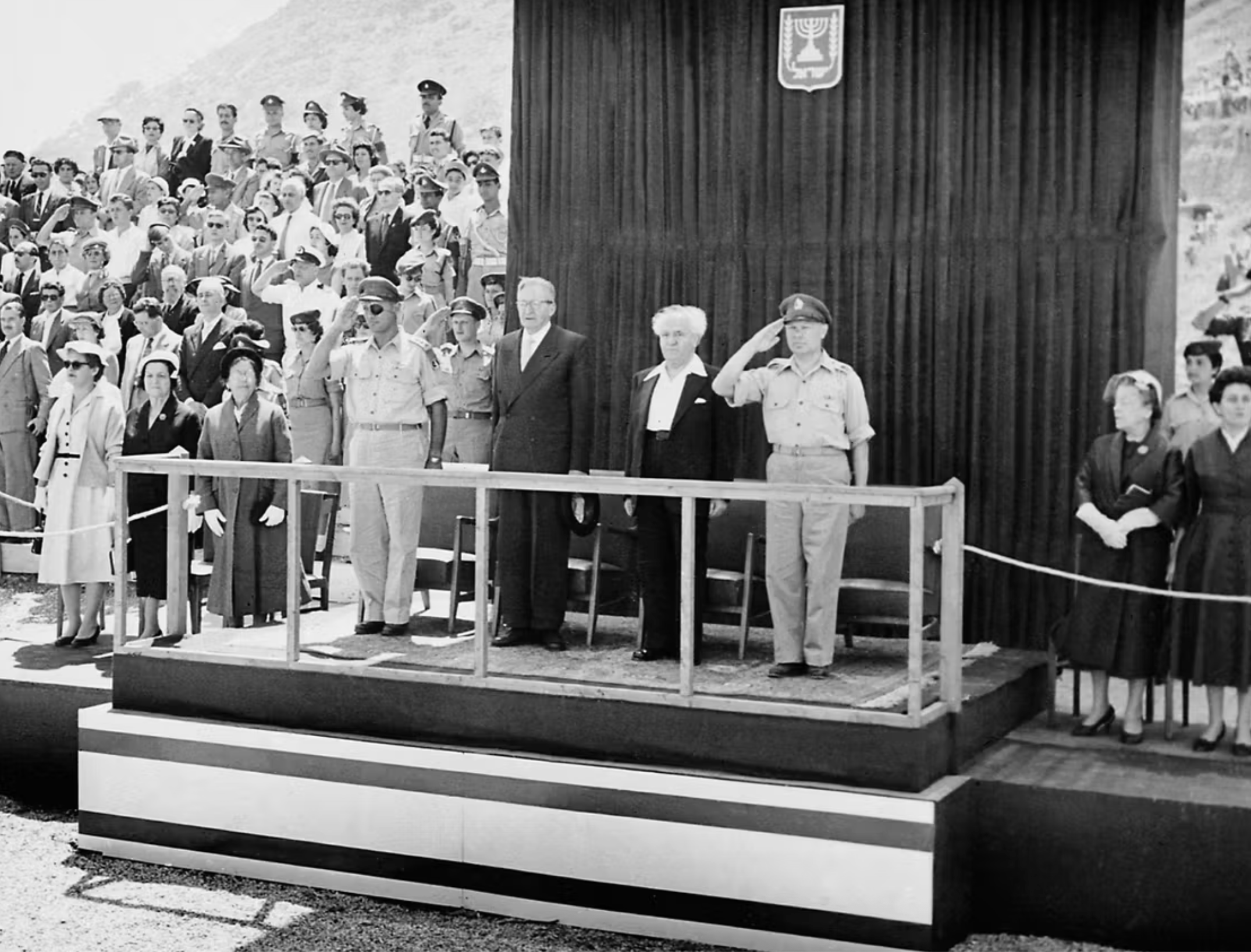
Left to Right: Israeli Defense Minister Moshe Dayan, Israeli President Yitzhak Ben-Zvi, Israeli Prime Minister David Ben-Gurion and the military commander of northern Israel, celebrating the eighth anniversary of Israel's independence on May 7, 1956. source
One of those disciples was Moshe Dayan, a key Israeli military and political figure and major proponent of an Israeli invasion of Lebanon (1, 2). In a meeting with Ben-Gurion in the mid 1950s, they discussed using an Iraqi invasion into Syria as a pretext for an Israeli intervention in Lebanon with the aim of annexing the south and turning the rest of the country into a Maronite state.
In fact, Dayan tried to convince others it would be easy to dominate Lebanon. “All that is required is to find an officer, even a captain would do, to win his heart or buy him with money to get him to agree to declare himself the savior of the Maronite population,” he said. “Then the Israeli army will enter Lebanon, occupy the necessary territory, and create a Christian regime that will ally itself with Israel. The territory from the Litani southward will be totally annexed to Israel, and everything will fall into place.”
In the 1960s, Dayan continued to pronounce Israel's northern border as "not satisfactory," writing in October 1967 as Israeli Defense Minister that Israel's borders, with the exception of that with Lebanon, are "ideal.”
It was not just Ben-Gurion and Dayan, but also Yitzhak Rabin, who believed in the desirability of controlling south Lebanon. In 1963, when Levi Eshkol became Prime Minister, Yitzhak Rabin, then deputy chief of staff of the Israeli military, outlined to Eshkol the ideal boundaries of Israel: the Jordan River in the east, the Suez Canal in the south and west and the Litani River in the north. Much like Dayan, Rabin was also influenced by Ben-Gurion, and inherited his views on Lebanon.
And that’s because the conquest of Lebanon was consistent with Israel’s emerging military doctrines.
First, Israel sought “strategic depth,” that is, the establishment of large buffer zones emptied of their native populations who were deemed theoretical and therefore imminent threats to Israel’s security. That’s why Israel depopulated its border regions during and after the 1948 War.
Second, Israel adopted an “iron wall” approach, that is, overwhelming, indiscriminate and disproportionate force. That was the Israeli military’s approach in the 1948 War and as well as during the “border wars” against the Fedayeen in the 1950s.
Third, Israel embraced the doctrine of preemption, that is, act first and worry about the consequences later, otherwise known as the crime of aggression. That’s why Israel has started most of the wars it has fought (e.g. 1956, 1967, 1982, 2006) and it’s why Israel invaded Lebanon ten times over the subsequent decades, as we shall see.
The Beginnings of Israel’s domination of Lebanon, 1970s
It was not until the advent of the PLO in south Lebanon, though, beginning in the late 1960s, that whet Israel’s appetite for further escalation. As Palestinian guerilla fighters, now based in south Lebanon, carried out cross-border raids, Israel responded with disproportionate violence and indiscriminate destruction. Throughout the late 1960s and early 1970s, Israel invaded, attacked, bombed and raided Lebanon, killing hundreds, displacing tens of thousands and carrying out mass devastation across the south.
In 1975, civil war broke out in Lebanon, leaving the Lebanese army fractured and the south defenseless. For Israel, this was not a crisis, but an opportunity to present itself as the “protector” of three Christian enclaves on the Lebanese side of the border, placing them under de facto Israeli military occupation. This began Israel’s decades-long presence in the country.
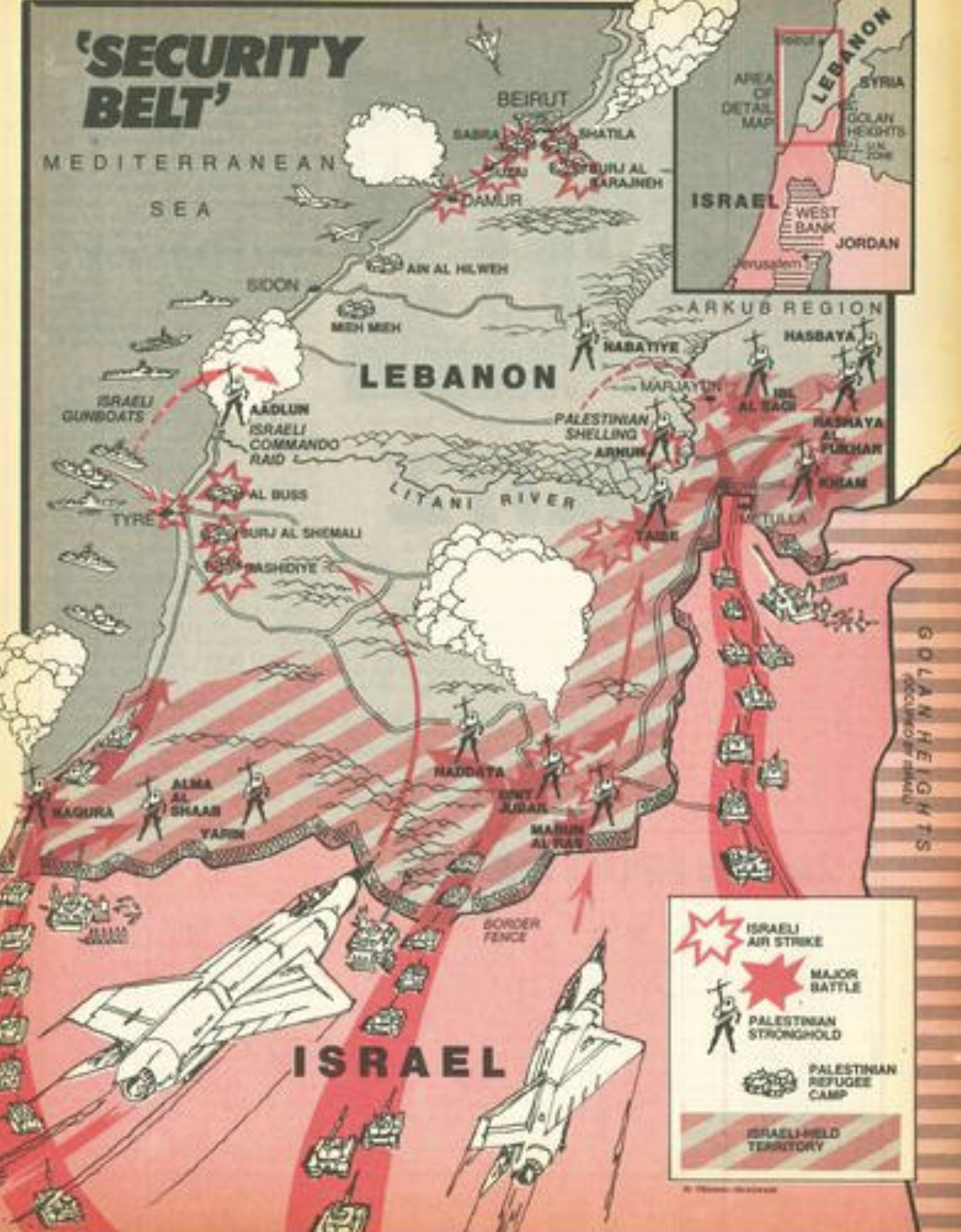
A map of Israel’s proposed “Security belt” in South Lebanon. Published in 1978. source
In 1978, Israel invaded Lebanon with the goal of uprooting the PLO south of the Litani River, killing 1,100, mostly civilians, and internally displaced 100,000 to 250,000. Israel was determined to “keep its troops in southern Lebanon indefinitely,” as the CIA put it. But then US President Jimmy Carter forced an Israeli withdrawal, threatening to cut off all military aid otherwise. Israel installed Saad Haddad, head of South Lebanon Army (SLA), a Maronite militia, in its place, while the US deployed United Nations Interim Force in Lebanon (UNIFIL) to oversee the peace. From that time forward, the Israeli army moved back and forth across the border, and at any given time deployed at least 1,000 soldiers in Lebanon.
Then, on July 25, 1981, Israel and the PLO agreed to a ceasefire. The PLO mostly adhered to the deal, despite Israeli provocations, with zero Israeli casualties in the north for nearly a year. Meanwhile, throughout 1981-1982, Israel repeatedly broke the ceasefire, attacking PLO bases, while Israeli military chief of staff Rafael Eitan made preparations for an invasion of Lebanon, presented to the Israeli cabinet on December 20, 1981.
Then, on June 6, 1982, Israel invaded Lebanon again, blowing up the ceasefire deal, declaring their intention to eradicate the PLO. Israel occupied the territory south of the Litani River, besieged Beirut for 10 weeks, killing some 19,000 people, mostly civilians. Israel also facilitated the massacre of thousands of Palestinians in the Sabra and Shatila refugee camps, despite guarantees made to the PLO that Palestinian civilians in the refugee camps would be protected. It was the longest, deadliest and most devastating Israeli assault on Lebanon to date by an order of magnitude, and it set the stage for the half century of Israeli domination in Lebanon that would follow.
From the PLO to Hezbollah
By 1985, Israeli forces had established a “security zone” in the south on 10% of Lebanese territory, where it exerted total control. Israel tried to outsource its dirty work to the SLA and even attempted to create village militias in south Lebanon, much as it had done in the occupied Palestinian territories in the 1970s and 1980s, but this project floundered. Nevertheless, in 1983, the CIA envisioned a partition of Lebanon in which the south would be annexed to Israel, where the Lebanese would act as a new "source of cheap labor for Israel much as West Bankers and Gazans have." Alas, south Lebanon did not turn into a source of cheap labor for Israel.
Instead, it turned into a source of resistance. Israel’s military occupation gave rise to a new Shi'a organization, Hezbollah, founded in 1982 with support from their co-religionists in Iran. The Lebanese government had abandoned the Lebanese south decades early, offering the mostly Shiite population of the south little in the way of public services, infrastructural development or basic protection.
Soon enough, Hezbollah attracted a larger number of followers and developed into a state within Lebanon, building an increasingly sophisticated guerrilla force able to inflict casualties on Israeli occupation forces. Throughout the 1980s and 1990s, Hezbollah forces killed some 559 Israeli soldiers and another 621 SLA forces over the decade and a half long occupation, suffering 1,276 casualties themselves in the liberation struggle.
South Lebanon became Israel's Vietnam. In 1993 and 1996, Israeli forces re-invaded Lebanon beyond the security zone, seeking to force Hezbollah north of the Litani River and “effect a massive displacement of the civilian population in south Lebanon,” as Human Rights Watch put it. In 1993, Israel killed an estimated 140 Lebanese, wounded 500 and displaced 300,000. In 1996, Israel killed 154 civilians and injured 351. Israeli soldiers would return home from the fighting, wondering why no one cared about the forever war?
The occupation grew costly. Israel improvised its occupation tactics, targeting Lebanese civilian infrastructure to punish the government and the entire population for not having restrained Hezbollah. Israel struck Lebanese power plants, darkening much of Lebanon in 1999 and twice in 2000. But, in the end, south Lebanon “didn’t have glory in it,” as one Israeli put it. Israelis didn’t much care about the place, and Israeli forces withdrew from the “security zone” in 2000 with their tail between their legs. Hezbollah declared victory in the south.
But Israel kept many Lebanese detainees and continued to occupy disputed border areas, and so the tit for tat border skirmishes persisted. That was until Israel re-invaded Lebanon in 2006, killing more than 1,109 people, mostly civilians, and displacing a million people, while Hezbollah killed 167 people, two-thirds Israeli soldiers. According to the Pentagon, the war was seen as "a disaster" for the Israeli military, as Hezbollah forces were able to wreak havoc on Israeli armor columns. In 2006, Israel discovered south Lebanon would not go without a fight. This was another foreshadowing event.
From October 7th, 2023 to the Present
For nearly two decades, Israel and Hezbollah managed an uneasy truce, but the October 7th attacks tore that apart. Over the course of the next year, Israel and Hezbollah exchanged tit for tat fire, resulting in the deaths of hundreds of Lebanese and dozens of Israelis.
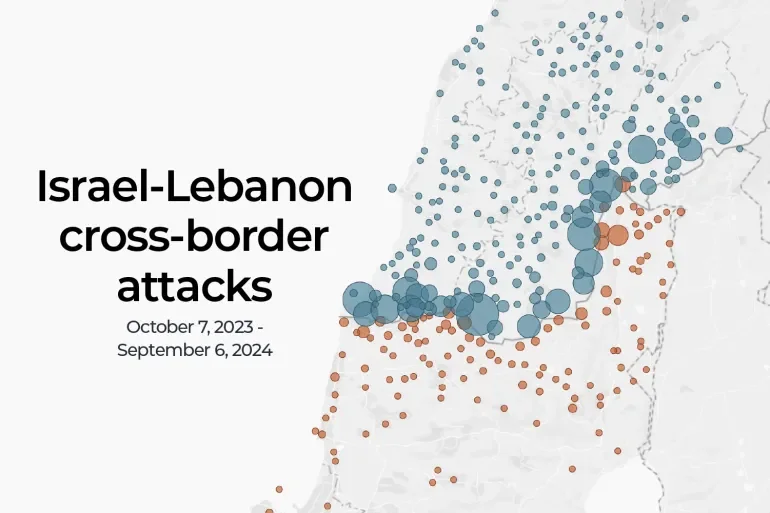
Mapping 11 months of Israel-Lebanon cross-border attacks: Israel, Hezbollah and other Lebanese groups have exchanged more than 9,613 attacks between October 7, 2023 and September 6, 2024 source
Then, in September 2024, Israel escalated the conflict with a series of perfidious attacks, planting bombs in communication devices like pagers, killing scores across Lebanon, and assassinating Hezbollah leader Hassan Nasrallah. Israeli ground forces invaded Lebanon, but failed to occupy and hold much territory due to heavy resistance by Hezbollah forces (1, 2). All told, Israeli forces killed some 2,720 people, mostly civilians, while Hezbollah killed about 120 Israelis, nearly two-thirds soldiers.
The war ended in a ceasefire deal in November 2024, adhered to by Hezbollah until March 1, 2026, and violated 15,400 times by Israel, killing more than 370 people.
That was until a few weeks ago. On March 2, 2026, Israel launched a full scale war on Lebanon, in addition to the war it is waging on Iran, killing more than 1,238 and injuring 3,543 in Lebanon since, including dozens of targeted strikes on medical workers, journalists and civilians. Israel also issued evacuation orders in southern Lebanon and south Beirut, displacing more than 1.2 million. Some have called it a Lebanese “Nakba,” as residents of the south have been told they “will not return to the area south of the Litani [River] until the safety of the residents of the north [of Israel] is guaranteed.”
Israel’s Finance Minister Bezalel Smotrich declared “the Litani River must become our new border with the State of Lebanon.” His remarks come amidst a mobilization of some 400,000 reserve soldiers as the country enters its fifth week of fighting in Lebanon. Meanwhile, Israel announced last week that it was planning to occupy Lebanese territory south of the Litani River. Alas, Israel is waltzing into another forever occupation of Lebanon.
This history may seem antiquarian, but to many Israelis, it’s living. Ben-Gurion’s vision for Lebanon was cited by Menachem Begin when Israel invaded Lebanon in 1982, and it’s being cited now by academics and pundits as justification for the war.
If history is any guide, Israeli troops will face inhospitable terrain in Lebanon and an even more inhospitable population, one fighting a war for its very existence. And, after months or perhaps years of occupation, Israeli forces will eventually withdraw from Lebanon, wondering what got them into the quagmire in the first place.
Subscribe to the Palestine Nexus Newsletter: