

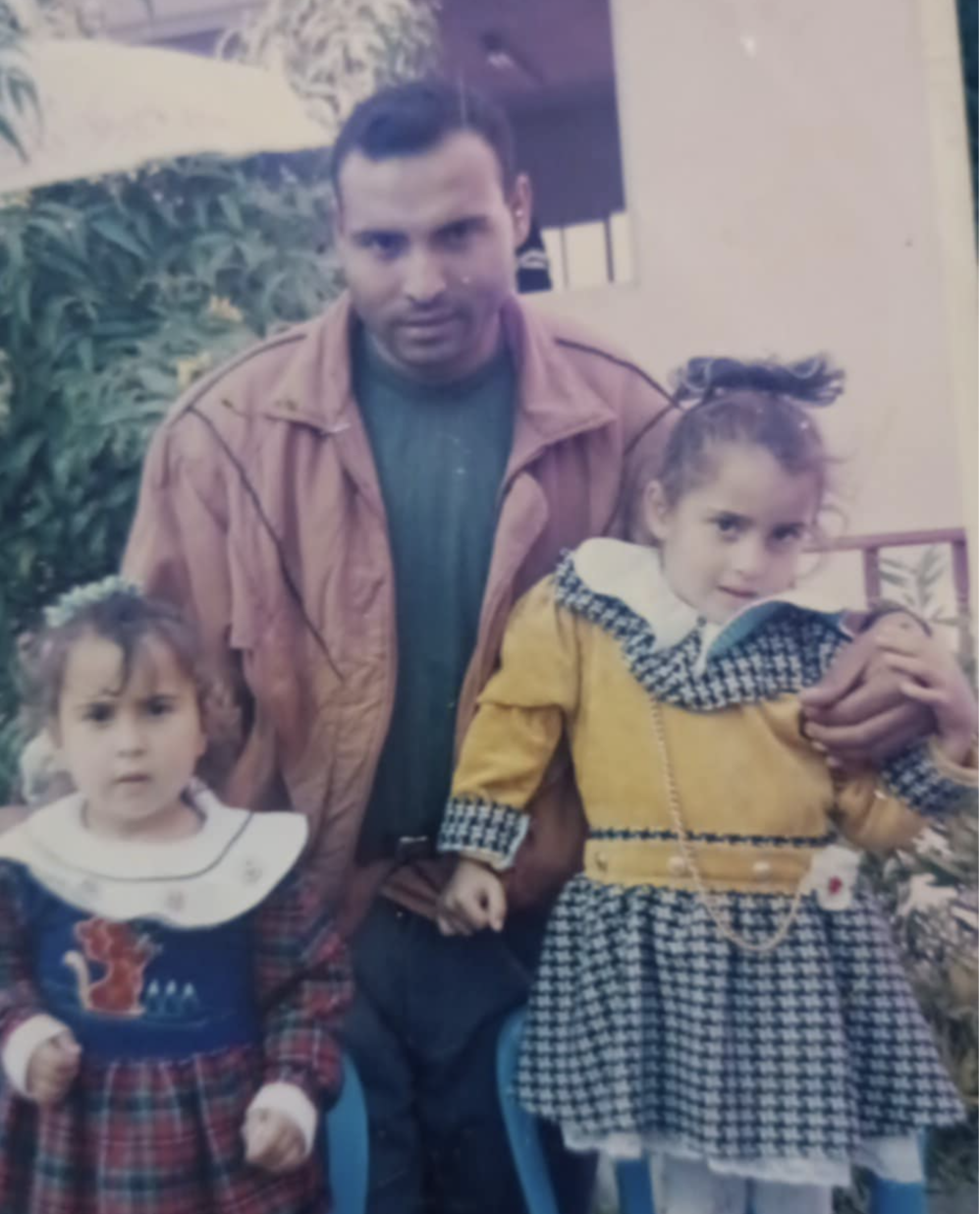
Left to right: Haneen Sabbah, Abed El Kareem Sabbah and Fatima Sabbah. Photo taken in the 1980s.
October 6, 2026 — On Sunday, September 7th, 2025, my father, Abed El Kareem Sabbah, was shot by Israeli soldiers while trying to buy flour in Rafah. He lay on the ground and bled for hours until a woman picked up his phone and dialed my brother Taher’s number to inform him of the situation.
He was rushed from Rafah to the Red Cross field point, then to Nasser Hospital, where doctors operated all night. But the explosive bullet had penetrated deep into his internal organs, and he had lost too much blood.
We prayed for his recovery, and for a moment, we thought there was hope. He was waking up and sleeping, and speaking of old memories with his mother, as if he was talking to her.
My brother Taher was on his way walking from Deir al-Balah to bring a mattress and blanket because the hospital had run out. My mother spent the night with him, wiping his face, comforting him and asking him to rest.
But, a few hours after my mother left, on Monday, September 8th, at 9:30 a.m., my father left us. He left us shocked, speechless, still trying to process the loss. Our only comfort is that we were able to bury him. That made us luckier than many others, whose loved ones are still buried under the rubble.
My family was first displaced in August 2024, when Israeli tanks approached their home in the Al-Tuffah neighborhood of Gaza City. They fled south to Deir al-Balah, where they rented a house for around 3,000 shekels [$1000 USD] a month, which was extremely expensive. However, after two months, they had to leave because the entire residential area was at risk of a ground invasion and evacuation orders had been issued.
After that, they went to stay at a relative’s house. There was not enough space for everyone, so my parents and brothers stayed in a small room in the courtyard. They cleaned it and made it livable, and stayed there for six months. Some of my sisters stayed separately with another sister in her apartment.
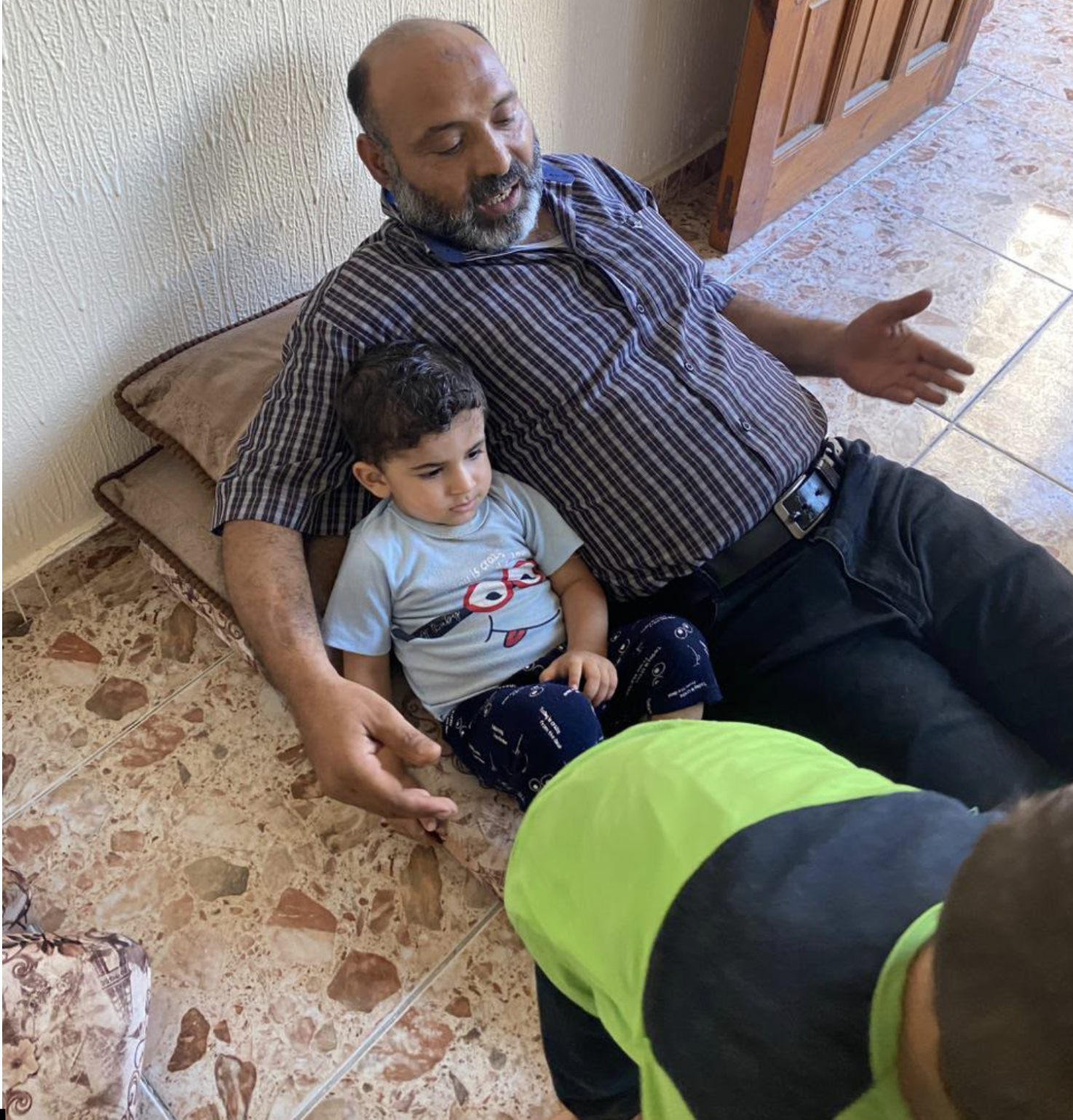
Abed El Kareem Sabbah, displaced in Deir al-Balah, with his grandson , Hamada, in 2024.
They later moved to a rented house in the Al-Bassa area of Deir al-Balah, where they paid 1,500 shekels [$500 USD] a month. There was no running water there, so every day they had to wait in line to collect water. They eventually bought a large water barrel to store what they could collect, but water remained extremely scarce.
They stayed there for about a month before moving again, this time to another rented home in the Al-Hakar area of Deir al-Balah. They stayed there for around seven months. During that period, Gaza went through a time of severe hunger and food scarcity. Food was very difficult to find, but my family survived the famine.
Their house was eventually bombed, forcing them to flee, but they later returned and continued living there. They remained in that Rafah house until my father was killed. After his death, the landlord became afraid that my family would no longer be able to pay the rent because my father had been the one supporting them, so he forced them to leave. This happened at an incredibly difficult time, when they were still grieving and trying to cope with the loss of my father.
They then rented another home in the Al-Salam Street in Deir al-Balah, where they stayed for about six months. Later, an apartment in the same building was bombed, forcing them to leave once again.
They were displaced yet another time and moved into an apartment in a building in Deir al-Balah, where one of my sisters also lives.
My father, Abed El Kareem, had dark skin, as if he was kissed by the sun, and a beautiful smile. He was a kind man with a generous heart, a community man and land caretaker. He had olive trees, orange trees and a beautiful vegetable garden. He took on the responsibility of caring for the land his parents left behind.
On Fridays, our home, nicknamed “El Sekka,” became a gathering point for all our family, friends, and neighbours. My father would host barbecues—I can't even remember how many times—offering his home-made tea was his love language, while feeding others fed his soul.
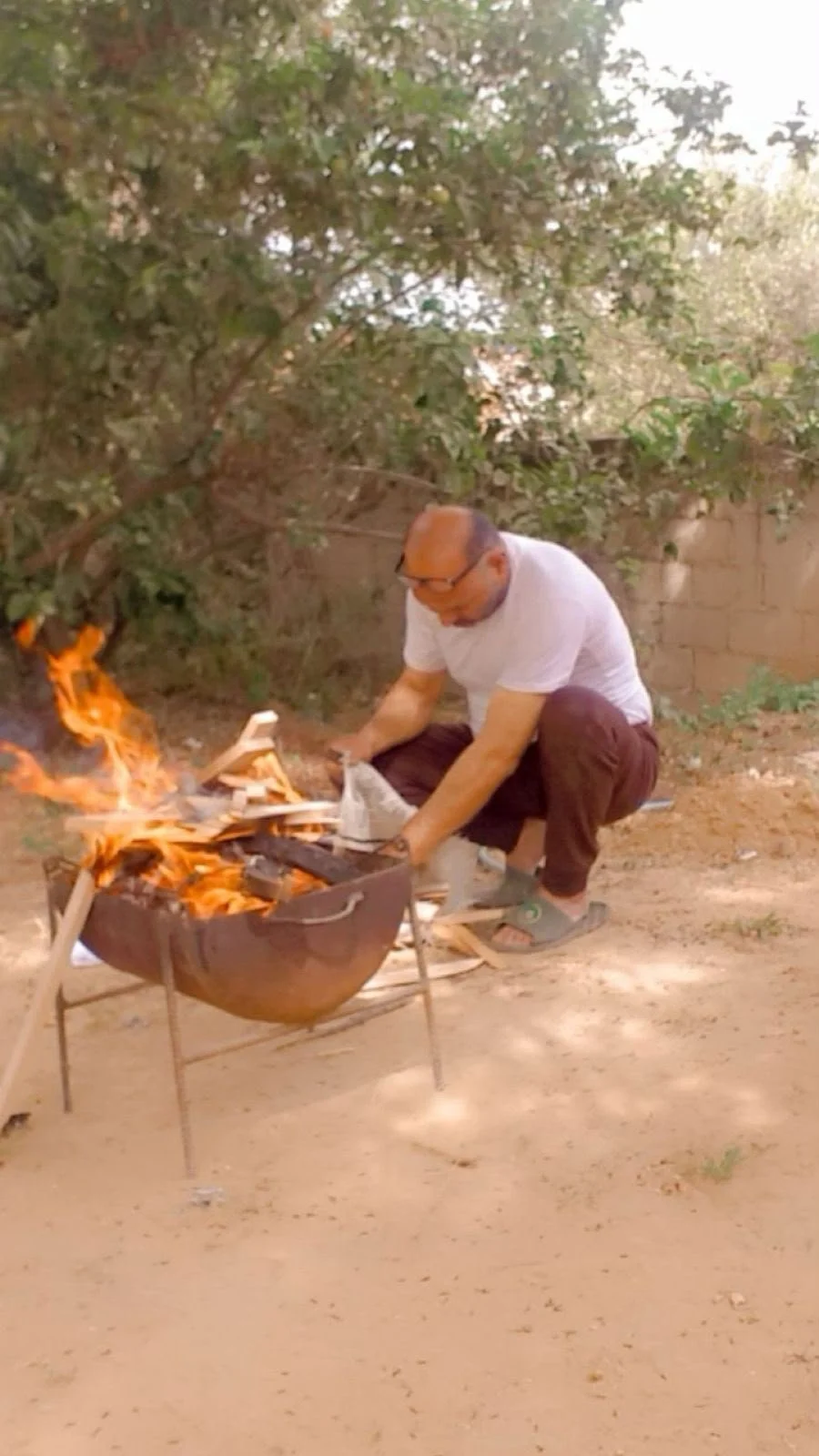
Abed El Kareem preparing a fire at his Gaza home to host a family barbecue. Date unknown
Friends and neighbors called him “Abona kolna,” our father. So often, I had to share him with them, and with my six sisters and three brothers, my mom, cousins, uncles, and aunts.
He worked as a policeman with the Palestinian Authority. After 2005, he cared for our land in Gaza. He witnessed two Intifadas, the Oslo Accords, a half dozen wars waged on Gaza, and a genocide, experiencing too many near-death experiences, as is common in Gaza, before he was murdered on September 8, 2025.
I remember he would take me and my siblings and cousins to the sea when we were young and buy us ice cream and barbecued corn with paprika. And he would always take his grandchildren too. They adored him. He always said yes to them, no matter what their request was.
Even during the genocide, as he was facing extremely difficult circumstances, he always helped out others, feeding people suffering from hunger in Gaza during the genocide.
I remember one of the times he was barbecueing in 2016, and my daughter Hanan wanted to eat chicken wings, and I was asking her to wait so we would all eat together. She started to cry, and my dad said, “she is a child she doesn't have to wait!” and went on and gave her a plate of chicken wings, and hugged her. I uttered, whatever grandfather says! And then he laughed and gave me some chicken wings too, I smiled and we continued to watch him grill.
His story is the story of thousands of Palestinian dads who have had to endure brutal occupation, an occupation that keeps categorizing and dehumanizing them and labelling them as terrorists for trying to make a life for their families.
Zionism took away his life, bombed his home and olive trees and displaced him many times, but it will never erase the honor of having him as my father. I will never forget the times under our olive trees, our family gatherings, his laughter, courage, and his embrace.
Yet I couldn't say my physical goodbye, as the occupation has not allowed Palestinians to enter Gaza, not even to bury their own parents, as I’ve been in Portugal since 2018. No kiss on the forehead, no final embrace, just weeping from afar. I planted an olive tree for his soul, because he loved olive trees.
Grief is bitter and heavy. I thought for months that I would never be able to see the daylight. It's like I lost a part of myself. As months passed, I started to dream about him and feel more of his spirit, strength, and guidance. I felt him in the sunsets, and the sea, and nature, whispering, “Carry on. You'll manage. I believe in you.”
Then he appeared in my dream. He gave me a long embrace, handed me a key, and went to a field of olive trees where my grandmother was awaiting him with open arms.
Subscribe to the Palestine Nexus newsletter: